


Table of Contents:
Why Paediatric Dentistry Matters
How Do Cavities Actually Form?
Understanding the Need for Paediatric Dentistry
Why Should Cavities in Children Be Treated Early?
How Pacifiers Can Affect Your Child’s Teeth
The Impact of Thumb Sucking on Growing Teeth
How Should We Manage Prolonged Thumb Sucking?
How Early Can Dental Misalignment Be Treated?
Common Childhood Habits That Affect Oral Health
Understanding the Dental Effects of Bottle Feeding
How Long Does It Take to Correct Mouth Breathing?
Common Causes of Bad Breath in Children
Signs That Your Child May Need Dental Care
Understanding Proper Brushing Technique
What Foods Are Best for Healthy Teeth?
Common Parenting Mistakes That Can Lead to Cavities
The Challenges of Treating Young Patients
What Are Clear Aligners and How Do They Work?
Denture Myths and Facts
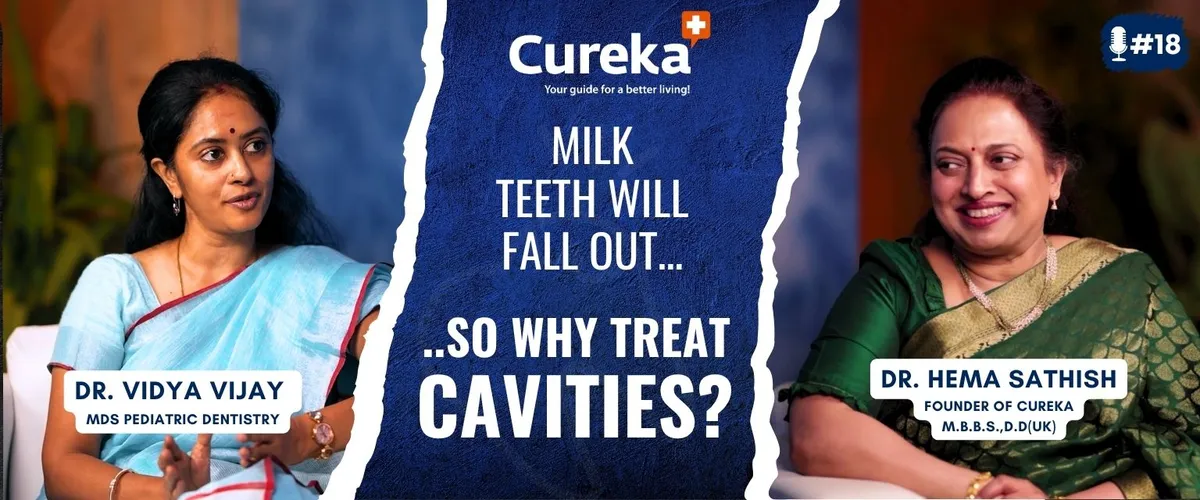
Dr. Hema Sathish: Did you know that cavities are one common condition which mostly all children suffer from why does it happen even before they turn three and go to school they have cavities and if these teeth are going to fall off why worry so much about it so what can be done how to prevent it so let's speak to Dr. Vidya Vijay who's a paediatric dentist welcome doctor.
Dr. Vidya Vijay: Hi, thank you so much.
Dr. Hema Sathish: Dr. Vidya Vijay has got several papers published in journals. And not only that, she has written quite a few chapters in a couple of textbooks for paediatric dentistry. So it's great to have you Vidya.
Dr. Vidya Vijay: Pleasure is all mine.
Dr. Hema Sathish: So first tell me, why is paediatric dentistry so important?
Why Paediatric Dentistry Matters
Dr. Vidya Vijay: Pediatric dentistry, as the name suggests, it caters to children from birth till they attain adolescence, 16 to 18 years of age. So especially in our country, it tends to be overlooked because of the common misconception that milk teeth, they will eventually fall off. So there is no need to get them treated. So even though in Western countries, the awareness is far more, in our country, we still live by that old adage that, you know, milk teeth don't need much treatment or they don't need any special care, which is totally wrong. So that is why Pediatric dentistry as a specialty encompasses everything, everything that a child needs from dental treatment point of view. Could be habits, could be cavities, could be trauma due to fall, injuries, sports injuries. So a lot more gum problems, bad breath. So a host of problems. And of course, what people are most aware of is the braces. So it's like a multidisciplinary speciality which caters to everything that a child goes through.
Dr. Hema Sathish: That's quite a bit, right?
Dr. Vidya Vijay: Yes, yes.
Dr. Hema Sathish: And what really makes me think is like earlier when anybody had cavities, I mean, it's very common to have cavities, right? Because these kids don't brush very often. And parents also don't force them because they say they're kids. And night brushing is very, very rare.
Dr. Vidya Vijay: Of course.
Dr. Hema Sathish: And the parents insist, these kids also, they don't do it much. So tell us about how cavities actually form.
How Do Cavities Actually Form?
Dr. Vidya Vijay: So what happens is all of us have microorganisms in our saliva and whatever food we eat, especially the sticky food, that tends to be in contact with the teeth for a long time. And in those areas, these microorganisms will multiply and that is the reason for cavity formation.
Dr. Hema Sathish: Okay. So that's known to everybody. But nobody wants to stop it. And above all, I think today's food, the way we eat and things have changed a lot, right? So I think kids don't like to munch a lot either. Is it because of the pampering or is it just that we have just made that as a norm that we have soft food?
Dr. Vidya Vijay: Soft food, you know, the choice of food, the kind, the variety of food that is available, processed, semi-processed, then the convenience factor where working parents prefer to give ready-to-eat snacks to the children. So everything put together, I think the diet patterns have changed a lot. And progressively towards bad choice of snacks and food, and I think it's a societal issue we are all facing. Earlier it was a thing that we used to see that only cavities, dental cavities as it is called, was restricted to the socially or economically upward start of society, because they could afford a lot of sugary food. But now the trends are all going haywire, you know, even the socially, economically backward people also are coming up with a lot of decay, because I think the availability of snacks and sugary foodstuff is ubiquitous, it's everywhere.
Dr. Hema Sathish: I know. And you know, like those days and all, apple, we used to bite into the apple. Now we do not, but that also helps, right?
Dr. Vidya Vijay: Yes. So a lot of fruits, fibrous food, the salads, I think that part of the diet is slowly being replaced by all sorts of snacks, which we don't have to chew much, soft food, like you said.
Dr. Hema Sathish: So that's one of the reasons for this.
Dr. Vidya Vijay: Yes.
Dr. Hema Sathish: So if a child gets cavities before they even turn two or three, that's become very common now.
Dr. Vidya Vijay: Yes.
Dr. Hema Sathish: So what should we do? I mean, should we really treat it?
Dr. Vidya Vijay: 100%.
Dr. Hema Sathish: So why do you need a subject called paediatric dentistry? Because it's after all only the teeth. I do agree that pediatricians are required because the child is small and the medications are very, very different. So explain a little more on that.
Understanding the Need for Paediatric Dentistry
Dr. Vidya Vijay: Sure. So, as you all know, treating a child requires special set of skills. And even though the treatment procedure may be the same, but to derive the child's cooperation, you have to have special training. It's not everybody's cup of tea. So, as a parent, when you take the child to any common dental practitioner, you may not get the right kind of advice because in my own practice I've seen a lot of parents coming and telling me when the tooth is in a very bad shape that they earlier went to a few of their family doctors or maybe general dentists and they were told that no treatment is required or in a place where actually a root canal would have helped, they have done just a temporary fix kind of a filling and sent the child home. And in the long run, the child is the one who suffers. So definitely parents must take their children for a consultation to a paediatric dentist. Not a very general dentist.
Dr. Hema Sathish: So you explain why paediatric dentistry is so important. Now for a child who's got a cavity, why is it so important that you've got to treat it? Will it cause any problems in the future or internally also it can cause some other issues?
Why Should Cavities in Children Be Treated Early?
Dr. Vidya Vijay: Definitely an untreated dental caries or cavity will first of all keep progressing deeper into the tooth. So what can be treated with a small filling will eventually end up going for a root canal or in worst cases it may also need the tooth to be removed, what we call as extraction. And not just going deeper into the same tooth, it also tends to spread to the adjacent teeth or the opposing tooth. And then we have patients coming with a lot of pain. They have difficulty to chew from that side. So the diet suffers. And then there is toothache because of which they end up missing school and during the crucial time of maybe exams or whatever. So all of these problems can be avoided by timely treatment of the cavity. So definitely it should not be ignored and treatment must be sought at the earliest.
Dr. Hema Sathish: So what's your take on using this pacifiers or first we'll start with pacifiers and I want to talk about thumb sucking. So pacifiers do bother in the development of the teeth.
How Pacifiers Can Affect Your Child’s Teeth
Dr. Vidya Vijay: Pacifiers for a brief period during infancy is okay, it's acceptable. But prolonged usage of pacifiers is generally not advised. And parents sometimes they dip the pacifier in sweet juice or maybe honey for the child to like the taste and retain it for a longer time. It is definitely to be avoided because that gets the child hooked on to that sweet taste and develop a propensity for having or a likeness for sweet. So generally it is to be avoided. And prolonged use of pacifier definitely will affect the jaw. It will cause the teeth to be more protruded or proclived. So malocclusion also develops because of prolonged pacifier use. So generally, we don't recommend.
Dr. Hema Sathish: Ok. And what about thumb sucking?
The Impact of Thumb Sucking on Growing Teeth
Dr. Vidya Vijay: Thumbsucking is a very common habit we come across very regularly. And till about 4 to 6 years of age, it is okay, as long as it's an occasional indulgence for the child. But if it's a very severe thing and beyond the age of 6 years, definitely we advise some sort of appliance to stop the habit. There are different types of habit-breaking appliances. Some are removable, some are fixed. So depending on each case, we can give some appliance to the child. Beyond six years, definitely it is not encouraged.
Dr. Hema Sathish: Now if the child is sucking the thumb for a long time and if you are forcing them to stop it also, it's not good for them psychologically.
Dr. Vidya Vijay: Yes.
Dr. Hema Sathish: So then you suggest that they can suck it, but then again they'll have a problem, right? The protrusion.
Dr. Vidya Vijay: Yes.
Dr. Hema Sathish:There is a real misalignment of the teeth inside.
Dr. Vidya Vijay: Yes.
Dr. Hema Sathish: So how do you handle that?
How Should We Manage Prolonged Thumb Sucking?
Dr. Vidya Vijay: So, not just giving the appliance to the child, we first start with counselling of the child. By the time the child is six and above, the child has heard all the things, you know, by parents and elders in the house. He has heard everything. So, basically, there are some methods which we train the child. We make him or her realize that what is the fallout of continuing with this habit. And then along with that, we give them certain exercises, we give the appliance. So it is a slow process. And like you said, we can't do it in one go because the child is psychologically dependent on that habit. So it's a slow process.
Dr. Hema Sathish: Now if the child has got thumb socket, and it's used to it, and you cannot ... You're considered and everything, but then the misalignment which happens is going to be permanent, right? And how do you treat a child like this?
Dr. Vidya Vijay: So what we do is, depending upon the severity of the habit, Anywhere after six years and above, we take the child for treatment with appliances.
Dr. Hema Sathish: Okay. So you can start that early.
Dr. Vidya Vijay: We can start that early. We have certain removable ones. There are some bandages which can be applied at the elbow area, which will prevent the thumb from reaching the mouth. Because a lot of children do it unconsciously during sleep. So to prevent that part where during sleep the habit is being practiced, we can go in for these type of mild appliances. Then there are fixed ones which are fixed onto the tooth surface. That can be done after 6, 7 or 8 years of age. And that helps, really helps.
Dr. Hema Sathish: And if the malalignment has happened, how early can we start the treatment for them?
How Early Can Dental Misalignment Be Treated?
Dr. Vidya Vijay: So that we can start whatever braces the child needs. So there are preventer ones, like this habit breaker. Appliances, they come under prevention for malalignment or malocclusion. Then there are certain interceptive appliances that we can go in for. So upwards of six years, we can, as a case-to-case basis, we can evaluate and go ahead with these appliances.
Dr. Hema Sathish:So if we start the treatment earlier, then when they are actually having their original teeth, that's a permanent teeth which comes in, and so that time they won't need any treatment, is it? Or that time the orthodontic treatment would be recommended?
Dr. Vidya Vijay: Yeah, so for some children, if the malocclusion persists into their permanent dentition, they will definitely need braces in their permanent teeth also.
Dr. Hema Sathish: Okay.
Dr. Vidya Vijay: So our focus is to prevent first. If not, at least intercept and stop it with as minimum damage as possible. If there is any residual malalignment or occlusion, malocclusion, then we have to go in for braces in the permanent teeth also.
Dr. Hema Sathish: So thumb sucking is one common habit. But there must be some other habits also. A lot of things kids end up doing. So can you list a few of them?
Common Childhood Habits That Affect Oral Health
Dr. Vidya Vijay: Yeah. So other than thumb sucking, we also come across tongue thrusting, in which the child, when he's at rest and not occupied generally, or he's engrossed doing something, he tends to bring the tongue and place it-- the tongue tends to push the upper and lower front teeth. So that also causes malocclusion, malalignment. Proclined upper teeth, front teeth. So that also needs to be corrected as soon as it is observed. Then we have something called lip biting. Upper lip, lower lip, that is also a very commonly found habit. That also causes small alignment of teeth. Then we have something called bruxism or clenching of teeth, which parents very commonly complain of. During sleep, the child tends to bite down hard on their-- and clench their teeth. So that also-- each of these habits, they have appliances meant for stopping the habit. So all of these will cause some amount of malalignment or joint issues, the temporomandibular, this joint issue. So you need to treat these habits. Mouth breathing.
Dr. Hema Sathish: Yes.
Dr. Vidya Vijay: Definitely mouth breathers are there. During childhood, a lot of children have tonsil issues, adenoid problems. So during cold cough, that type of mouth breathing is not a habitual one. But there are children who have this habit. That also needs to be corrected.
Dr. Hema Sathish: Okay. And when you spoke about clenching, usually, you know, they say if the child clenches in the steep, then it's got worms in his stomach. Is that i mean that's not uh related right but usually people say that.
Dr. Vidya Vijay: See irrespective of that deworming as a regimen is recommended for children of that age group so whether the child clenches or not deworming as a regimen should be given.
Dr. Hema Sathish: Yeah but nowadays there's a different school of thoughts for that also
Dr. Vidya Vijay: Yes
Dr. Hema Sathish: Until then you you're sure that your child has got some problem otherwise don't give it because it sensitizes otherwise.
Dr. Vidya Vijay: So that apart, what the bruxism does is the entire muscles here on the cheeks, they get sore and eventually there's a lot of wear and tear of the enamel of the teeth. So the teeth flatten out and they don't, they're not very effective. And the teeth which should be there in a healthy manner for many years, they become treated very quickly. So you need to stop this clenching habit. Generally with children, it is associated with stressful times like exams or some nightmares. Children who have frequent nightmares also tend to clench. So I think addressing those type of issues will eventually help.
Dr. Hema Sathish: And then the TMJ joint, the temporal mandibular joint, that also gets affected. So there's wear and tear there also and that's really bad.
Dr. Vidya Vijay: It is painful.
Dr. Hema Sathish: Especially when you age and you have... Arthritis of the TMG that's the worst thing to treat.
Dr. Vidya Vijay: Correct.
Dr. Hema Sathish: So we have to address it much much earlier and make sure that the child is handled better.
Dr. Vidya Vijay: Yes.
Dr. Hema Sathish: So psychological counselling also would be required. I think time from the parents.
Dr. Vidya Vijay: We have something called night guards. We have soft splints. They're very comfortable. Child can wear them during night and during sleep. That also helps a lot.
Dr. Hema Sathish: Yeah, those are all things which is required, at least to break the habit to start with. Then the counselling and that takes a longer time, right?
Dr. Vidya Vijay: Yes.
Dr. Hema Sathish: We spoke about thumb sucking, but what about bottle feeding? I mean, does that also have the same effect? Because there are some kids who don't get out of the bottle for a very long time.
Understanding the Dental Effects of Bottle Feeding
Dr. Vidya Vijay: Yes. So bottle feeding is also a very common practice. And the ideal recommendation is to not add any honey, sugar, palm sugar to the milk substitute that is being given or the cow's milk that's being given to the child. And the biggest problem with the bottle feeding is it's not the bottle feeding, per se, or the milk, which is the problem. It is the habit where children, they keep sucking on it and they just fall asleep. So the milk pools around the teeth and starts to cause decay. There's a specific name also for that called early childhood caries. A baby bottle, tooth decay and all that. So it is a very commonly seen condition.
Dr. Hema Sathish: Yeah, true, true.
Dr. Vidya Vijay: Yeah, so... Unsupervised and for prolonged bottle feeding habit leads to this type of decay which spreads very rapidly. Today the child, the parent will notice one tooth having some discoloration and very soon it spreads to all the other adjacent teeth. So that is...
Dr. Hema Sathish:That's quite scary.
Dr. Vidya Vijay: It is, it is. So, best is to avoid bottle feeding altogether. If it is not possible, then after every feed, the child should be made to rinse his mouth or, if possible, brush. And especially avoid bottle feeding during the night, just before sleeping.
Dr. Hema Sathish: I think that most of the parents do it because it's convenient, right?
Dr. Vidya Vijay: Yes, that's the convenience.
Dr. Hema Sathish: And the child falls asleep also happily.
Dr. Vidya Vijay: Yes. So that is the one thing that is to be avoided. Similar to breastfeeding, breastfeeding also is to be avoided during the night. And once the teeth start erupting, about six to seven months of age, starting from that time, we slowly start reducing the breastfeed. And weaning time is recommended for about 14 to 18 months, the weaning should be complete. And in our society, mothers tend to breastfeed children for a longer period of time. And they do it especially in the night. So that kind of causes these type of early childhood cavities. Also because of the same thing, the milk pooling around the teeth, not because of the breast milk per se. Yeah, that was true.
Dr. Hema Sathish: But for working moms, I think that's the time when they feed the most, right? Because in the daytime, I think they leave the milk in the bottles also for somebody else to be helping them out with.
Dr. Vidya Vijay: So that is where the counselling and the right advice, the guidance that is to be given to the new mothers is so important. So if they visit a paediatric dentist, all of this is told to them and is explained to them in a very detailed manner, what they should be doing and why. Which they will miss out if they don't visit a paediatric dentist.
Dr. Hema Sathish: When you are speaking about mouth breathing, so mouth breathing also can lead to cavities?
Dr. Vidya Vijay: It causes dryness of the mouth, so that dryness can lead to decay. So the mouth breathing habit is not directly related to cavities, but it causes a lot of gum issues. The gums become really weak, they become inflamed because of the constant drying up, and eventually decay does happen, but it's not the direct cause or result of this habit.
Dr. Hema Sathish: But that's also not good. So, do you have something to stop the mouth breathing?
Dr. Vidya Vijay: Yes, yes, we have appliances for the mouth breathers also. We have certain exercise, myofunctional appliances, then we have some exercises which the child can practice. So, everything put together, we can stop the habit.
Dr. Hema Sathish: How long does it take if you are using the appliance? So for the mouth breathing to stop, what's the time limit which we are looking at?
How Long Does It Take to Correct Mouth Breathing?
Dr. Vidya Vijay: It depends from case to case. There are compulsive mouth breathers who feel very threatened when that habit is we are trying to stop the habit. So for them, it has to be a very gradual process. Then there are some who just do it when they have frequent cold coughs or adenoid issues. For them, it is faster. It is easier to stop the habit for them.
Dr. Hema Sathish: But I have seen that even if they have tonsils or they have adenoids, even if it's removed or it's fully treated, the mouth breathing still persists.
Dr. Vidya Vijay: Yes, that's the habit that will persist unless it is treated. So it is better to consult the dentist and check what can be done. Also it leads to bad breath, mouth breathing and the dryness of the tissues in the mouth that causes bad breath also. So parents usually they don't notice the habit as such but they come complaining of bad breath. So then we tell them that the real reason is the habit.
Dr. Hema Sathish: And what are the other causes of bad breath? Of course, if you have a cavity, you will have a bad breath.
Common Causes of Bad Breath in Children
Dr. Vidya Vijay: Cavity, the most important thing is the way you maintain your oral hygiene. If the brushing is not proper, then you are bound to have your bad breath. And especially in the transition phase where the milk teeth start falling off and the permanent teeth start erupting, child feels some amount of discomfort like how we've seen teething troubles in small infants similar to that the child has a discomfort when the tooth starts to shake falls off eventually and the new one starts coming so there is food accumulation around such areas and that causes bad.
Dr. Hema Sathish: I think it scares them also
Dr. Vidya Vijay: Especially girls they'll be a little too careful so yeah that happens And the common thing parents nowadays resort to is the use of mouthwashes. In the paediatric age group, generally mouthwash use is not recommended because the taste buds are extremely sensitive. And especially if the mouthwash is used in an undiluted form. It causes a loss of taste sensation. It should be used for a very short period and dilution. And preferably after consulting a dentist. Not all children require a mouthwash as such. So better to consult a dentist and then start taking. Use of a mouth. Yeah.
Dr. Hema Sathish: That's something very, very interesting about mouthwashes for children.
Dr. Vidya Vijay: Because it's available over the counter, parents tend to just ask.
Dr. Hema Sathish: I mean, nobody would exactly know, right? Because they're children, we will dilute it a little bit. But then it's going to bother the taste buds for something new to me also. So what signs would you suggest that the parents should look for and come to the dentist?
Signs That Your Child May Need Dental Care
Dr. Vidya Vijay: So signs of decay would be the first or the initial sign would be a white spot lesion. It's called a white spot lesion.
Dr. Hema Sathish: The white spot lesion is so difficult to find out.
Dr. Vidya Vijay: Yes. So that is something which the parent may not be able to see. And that is where the regular dental check-ups come into play. The recommended checkup times are once in six months, ideally. If not, at least once a year. And for those children who have a tendency for developing cavities, for them, ideally it should be once in three months. So that helps. And the other thing is, before the pain starts, the child may start complaining of some foot getting stuck between teeth. So generally parents, they think the child is not brushed properly. So they tell him, go brush properly and it will be all right. But then that is when we need to just give a closer inspection to the teeth and see if there's any cavity there. Because that is the first sign the child will notice about food getting stuck. And if left untreated beyond this point, then the pain, the pus formation, swelling, all of that starts.
Dr. Hema Sathish: So when you say brushing, I'd like you to talk about what's the best way to brush.
Understanding Proper Brushing Technique
Dr. Vidya Vijay: So the brushing twice a day is a must. There are no two ways about it. Morning and night. Of these two, brushing in the night is more important. So if a child is brushed before going to sleep, after the dinner is over, then in the morning there's hardly any plaque build-up. Unless the child has, you know, snapped after the brushing, which is strictly a no-no. So then, of the two, brushing in the night is more important, which generally tends to be overlooked and skipped in today's day and age. So that is what the parents should really insist on, that the child brush during the night. And brushing should not be like a very quick and back and forth, to and fro motion. It has to be like a proper two-minute procedure where the child focuses the junction between the gums and the teeth. That area has to be cleaned properly. So you have an up and down motion, a circular motion, not just a to and fro motion, which the child does in a hurry. For children who are very young, till about 4 years of age, we recommend the parents don't use toothpaste at all.
Dr. Hema Sathish: Okay.
Dr. Vidya Vijay: Because the children tend to swallow the toothpaste. Yeah. Yeah, so the particular type of brush doesn't make much of a difference. It's the proper brushing motion which is more effective or it should be more effective.
Dr. Hema Sathish: And what's that type of brush? I wanted to know like, you know, nowadays a lot of electronic brushes are also available.
Dr. Vidya Vijay: Yes.
Dr. Hema Sathish: So these electric ones are easy to use and the pressure is very much guarded, right? So the child cannot push it too much or press hard so the gums and all doesn't get wounded. So what is your take on that? If you would suggest an electric brush or a normal brush?
Dr. Vidya Vijay: So electric toothbrushes are very popular among children, no doubt. They are very effective for those children who have braces on.
Dr. Hema Sathish: Okay.
Dr. Vidya Vijay: Because they tend to remove plaque and debris in those areas where a normal brush will be, it will be difficult to reach with a normal brush. But for younger children, they tend to play with the brush. Instead of brushing properly, they would be probably playing with it in the bathroom. So the parent may think that, you know, the child is brushing very regularly for five minutes or whatever, but then the efficacy would not be that great. So for a certain age group, the electric brushes are very good when you paint it.
Dr. Hema Sathish: Perfect. And what about toothpaste? There are so many different types of toothpaste. And always, our fear is also-- first thing, they'll gobble the paste. Then the brush goes in. So if the toothpaste is not tasty also, they do not want to brush either. So it's quite a tricky thing for the parent. As a parent, it becomes very difficult. So what do you suggest?
Dr. Vidya Vijay: So again, the brand of the toothpaste doesn't make much difference. More or less, the composition fluoride content is similar. The flavouring agent that the companies add, that makes the children, sometimes younger, small children, they tend to swallow the toothpaste. So generally, we tell up to four years of age, they need not use toothpaste at all. Just with the brush, if they clean the teeth without using a toothpaste also, it is good enough, provided the diet is under control. And the advantage of this is they can brush as many times a day as they want. They need not be restricted to just the morning and night routine. After the child is able to spit the toothpaste out, gargle his mouth properly, then we introduce the toothpaste. And initially, the amount of toothpaste that should be given is a pea-sized, a very small minimum amount. And starting from that, the child can be told to start using the toothpaste. And so basically, the type of toothpaste doesn't really make much of a difference.
Dr. Hema Sathish: Ok. That's quite a bit solved, actually.
Dr. Vidya Vijay: But we do recommend a toothpaste which contains fluoride for maximum benefit.
Dr. Hema Sathish: Ok. Ok. That's good. Very easy then to pick up anything. When you said brushing, how early should we start? Because I have seen brushes where the moms can put it on their finger and gently rub their finger brushes, gently rub the teeth when only two or three of them have come in small babies also. So it's necessary to do it at that tiny age also?
Dr. Vidya Vijay: Yes. As soon as the first tooth rubs in the mouth, the parents should focus on keeping them clean.
Dr. Hema Sathish: Okay.
Dr. Vidya Vijay: So at that age, if you're once old, you need not use these finger brushes. You can use a soft cloth, moistened cloth, and wipe the teeth after each feed. Once the child is about a year, year and a half old, and the molar teeth have erupted, then the brushes are more effective. Till then, they tend to poke the gums. If the child is too small, and we tend to, if we try and use the brush, it kind of, it's not very pleasant for the child.
Dr. Hema Sathish: So there are different types of foods, right? Like food for the brain, food for faster growth, but food for the tooth.
What Foods Are Best for Healthy Teeth?
Dr. Vidya Vijay: So good food for the teeth would include your good dose of vegetables, green leafy vegetables, fruits, and generally your nuts, dry fruits and nuts. And your cheese is also supposed to be carry protective. Fruits, by way of their mechanical cleansing action, they are fibrous, the salads and fruits. So when the child bites down on these type of food, it helps to mechanically cleanse the teeth of whatever deposits, the soft plant deposits that the tooth may have. So, yes, whatever is good for the body in general is good for the teeth as well. Dr. Dr. Hema Sathish: Now, when we talk about all the sweets also, I mean, I'm going to tell you all the sweets only, but tell me which is the worst, like chocolates, then you have lollipops, gummies, then candies. Which are the worst for the tooth?
Dr. Vidya Vijay: Actually, they're all equally bad. But I think lollipop would be the one thing which because you tend to keep sucking on it and that doesn't get stuck as long as don't bite down on it.
Dr. Hema Sathish: Yeah.
Dr. Vidya Vijay: So the moment you bite down on the lollipop, even that is really bad. Any sweet which if you're able to swallow it immediately, like for example, the fruit juices, it goes in straight away. Your ice creams, they don't tend to linger too much around the teeth. They are slightly better than the other sticky food, like candies and sticky. You have these nougat-containing chocolates. So they are really bad.
Dr. Hema Sathish: So any subject we speak about, we speak about screen time. So now I want to know dentistry and screen time. So what does it do?
Dr. Vidya Vijay: Yes, that's a new thing we are seeing among children nowadays that parents and other elders in the house, for the children to eat food quickly or without fuss, they make them sit in front of gadgets and have their meal.
Dr. Hema Sathish: Yeah, that's very common.
Dr. Vidya Vijay: That is common. But the biggest false side of it is the child is so engrossed watching the content that he or she tends to keep the food in the side of the cheeks for a long time without biting, without swallowing. So in those areas, we will see more of cavity formation. So believe it or not, the screen time is also affecting the cavity patterns that we're seeing now among children.
Dr. Hema Sathish: Oh, that's something quite interesting. And very new also.
Dr. Vidya Vijay: Yes.
Dr. Hema Sathish: So what do you think parents do, commit some mistakes? What do you think the parents are doing wrong that the kids get cavity more? Nowadays it's much more.
Common Parenting Mistakes That Can Lead to Cavities
Dr. Vidya Vijay: So I think the reliance on quick fixes and the schedule, the lifestyle of parents, most of the women are working now. So, in order to rush through the school schedule or breakfast schedule, you are giving, if you are going to give the child some sweet thing like sugar with maybe dough side or having chapatis with jam. So, the child loves it. But it's so bad for the teeth. So the reliance on the traditional food is now slowly moving away to these sugary type of quick fixes where the child also is happy. All of these spreads, these chocolate-based spreads that are very commonly available and very popular among children.
Dr. Hema Sathish: What about cereals?
Dr. Vidya Vijay: Yes, very good question. Cereals, again, you have a wide range of fruit loops and the full with sugar and hardly any nutrition value. So best to be avoided. If at all a parent wants to give a cereal, then the regular unsweetened I think corn flakes would be the best. Mixed with some fruit, nuts of choice, that works best. But anything which has added sugar in it, strict no-no.
Dr. Hema Sathish: How is dental health and immunity related?
Dr. Vidya Vijay: So if a person has good immunity, the dental health tends to be better.
Dr. Hema Sathish: Okay, so it's the other way around.
Dr. Vidya Vijay: Yes.
Dr. Hema Sathish: Okay.
Dr. Vidya Vijay: So you have these immunoglobulins that are present in saliva in the fluid that are there around the teeth within the gums.
Dr. Hema Sathish: Okay.
Dr. Vidya Vijay: So a good level of those immunoglobulins will mean that the tissues are healthy and the infection levels will be less, less chance of infection. So that is one of the karyoprotective factors that we have. It protects us against cavities.
Dr. Hema Sathish: Okay. Now, what happens is, in children, they tend to run, fall. So, if a trauma happens in a tooth, I mean, do you want to salvage the tooth, or you want to remove it early?
Dr. Vidya Vijay: Definitely, it is one of the medical emergencies, or dental emergencies, as we call it. Any trauma to the tooth, any fall, the tooth gets cracked or chipped, or it breaks into two. The first thing to do would be as soon as possible you see a dentist, a paediatric dentist. Most cases when we sterilize the broken fragment of the tooth, it can be re-fixed.
Dr. Hema Sathish: Okay. So even in the milk teeth, we should fix it back, is it?
Dr. Vidya Vijay: Generally, we don't do that for the milk teeth.
Dr. Hema Sathish: Yeah.
Dr. Vidya Vijay: But for the permanent teeth, yes.
Dr. Hema Sathish: Permanent teeth, I mean, it's mandatory.
Dr. Vidya Vijay: Yes.
Dr. Hema Sathish: But if it chips off, it can be fixed back, is it?
Dr. Vidya Vijay: Yes.
Dr. Hema Sathish: Okay.
Dr. Vidya Vijay: But in the initial stages of the trauma, the fall or the injury, the child is not very cooperative at that point of time. So it is difficult to do the re-fixing immediately with smaller children and male teeth. That's why we don't take it up. And if there's any infection in the milk teeth, it may be passed on, it may go to the permanent tooth bud, which is developing underneath. So it's not worth the risk. For primary teeth and milk teeth, generally we don't do all of these procedures. But for the newly erupted permanent teeth, front teeth especially, and in children who have proclination or forwardly placed teeth, or buck teeth as they are commonly called as. In those children, the chances of tooth breakage is quite high when they are running around, playing their sports in school. So in those children, definitely the tooth, the broken fragment must be salvaged and it must be taken to a paediatric dentist as soon as possible.
Dr. Hema Sathish: That makes a lot of sense, right? Because nowadays, cosmetically also, if the tooth is open, it looks so bad and bothers them a lot, especially in their confidence.
Dr. Vidya Vijay:Yes. And you will not believe me that children as young as maybe four, five, when they are just entering their kindergarten, Even those children tell us that they are being called names, they may be made fun of in the school, which is a very new thing. Children are very aware these days and there's a lot of name calling even in a very young age group. So the parents, they want to come and get the front teeth treated. If they have cavities and the teeth are looking discoloured, shabby, Parents want the child to not be ridiculed in school. They want the child to regain his confidence more than anything else. More than the function or anything else they want. The looks part of it. So, yeah.
Dr. Hema Sathish: What's the earliest age when a cavity has been treated by you?
Dr. Vidya Vijay:I would say around 12, 14 month old infant.
Dr. Hema Sathish: Okay. Yeah. That only?
Dr. Vidya Vijay:That only, yes.
Dr. Hema Sathish: Oh my God.
Dr. Vidya Vijay:Mostly related to your feeding habits, your breastfeeding, bottle feeding.
Dr. Hema Sathish: Is it more like bottle feeding or in breastfeeding?
Dr. Vidya Vijay:No specific difference, yeah. It's the timing of feed, and that night-time feeding is the main thing. Could be bottle breast, doesn't make much of a difference.
Dr. Hema Sathish: Well, can you, from your experience, just share an experience where you had a very tough case of a child, you know, because they're children, right? It's very difficult to treat them. So, something you can recall where it was really tough handling them, or, you know... And doing the procedure which you felt was required, but it was very difficult for you and for the child.
The Challenges of Treating Young Patients
Dr. Vidya Vijay:The thing is, as with all dental treatments, the treatment for a child is not done in one sitting. They keep coming back for multiple sittings. So invariably, the child who is very cranky or uncooperative in the initial appointments eventually settles down and starts to cooperate. So there is so much joy in seeing the child change his attitude and behaviour. And they are such a joy to be with. I really love working with children. And I find them much better patients than adult patients any day. They are so much more simpler and they are so much fun to interact with. So I wouldn't say any case which has been really tough. But yes, behaviour management is a very central thing in paediatrics dentistry. Everything revolves around it.
Dr. Hema Sathish: And usually the child is so scared to see a dentist, because you're asking to open the mouth and then you're keeping it open for quite some time also. And they can't see what's going on.
Dr. Vidya Vijay:And the sights and sounds of the child, the water, the sensation of water being used inside your mouth. All of that makes a child feel very uncomfortable, especially during the first initial appointment. So what the sequence of treatment that we go, that we proceed with. First, the most non-invasive ones like taking x-rays and maybe cleaning, just general cleaning. And then slowly we introduce these type of treatment which involve a lot of equipments and materials. So that way the child is acclimatized and he's that much more cooperative.
Dr. Hema Sathish: Yeah, the confidence once they are, then they come back and then they are okay with the procedure. Yeah, that's really true. And when you were talking about so many things leading to misalignments, so there are these latest treatments available, right? The invisible Aligners, what do you call it? Aligners. So those are nice to use, cosmetically very nice. Because otherwise-- I remember when in our school, school days, they used to call us jaws or something, because we had metal braces around. So then now it has become more refined and then they are more invisible ones. But then this Invisalign, right? This is something very new. Can you tell something about that?
What Are Clear Aligners and How Do They Work?
Dr. Vidya Vijay:Yes, so I think the AI has found its place in dentistry also, like all things.
Dr. Hema Sathish: Fabulous.
Dr. Vidya Vijay:Yeah, so this is the latest technology that is being used. And these are all called clear aligners. So because they're transparent, when they are worn, they're removable aligners. When they're worn, you can't see them unless you're very close to the patient. So they are nearly invisible. That's what gives them the name Invisalign. And it has a wide range of application. But the best part, I would say, is because it is AI-generated, you take the scan, and the patient is able to see the pre- and post-treatment results upfront. So unless he is convinced and happy about the outcome, he can suggest changes and those things can be incorporated in the treatment plan. With the regular braces, the child has to wait one and one-half years, two years till the treatment is over, then see his pre and post photographs or scans or casts, and then he realizes, "Okay, my look has changed so far." But with this and the click of a button, the child is able to see upfront before the treatment has even started how it is going to end. So that is the biggest thing which patients are very happy with.
Dr. Hema Sathish: Okay.
Dr. Vidya Vijay:And especially for adult patients who are working professionals who move around much and they feel awkward wearing the metal braces, teenagers, college students. So they prefer the Invisalign type of treatment. Treatment.
Dr. Hema Sathish: And for children, how early can you start this treatment?
Dr. Vidya Vijay:Children, yes, not for all children. Invisalign will depend on case to case. But children, they do well with braces, regular fixed metal braces or ceramic braces for that matter, because this Invisalign treatment success depends largely on the patient cooperation, compliance. It has to be worn for about 20 to 22 hours a day. That's tough for a child. That's tough for a child, and he may not comply for such a long duration of wear. So for children, we still go ahead with the fixed ones, which he or she can't remove at will. It's only for those children who are self-motivated teenagers, who are conscious and they know the ins and outs of it. They are the ones who do really well with the removal.
Dr. Hema Sathish: The conscious ones.
Dr. Vidya Vijay:Yes, yes. And the only thing is it has to be removed while they eat something because otherwise if it gets stained then that the value of being invisible is lost. They tend to become a little, they change color and then they start to be seen. That's the only thing and wearing it for a long time.
Dr. Hema Sathish: So there are so many myths about denture issues. So let's bust a few of them.
Dr. Vidya Vijay:Sure.
Denture Myths and Facts
Dr. Hema Sathish: So if you don't have any tooth pain, that means that you don't have any cavities.
Dr. Vidya Vijay:Definitely not true.
Dr. Hema Sathish: Okay.
Dr. Vidya Vijay:So there may be cavity which can cause food lodgment. So pain is not the only indicator of having a cavity.
Dr. Hema Sathish: And if you have tooth pain, it means it's gone way deeper, right?
Dr. Vidya Vijay:Yes.
Dr. Hema Sathish: Okay.
Dr. Vidya Vijay:And there is sensitivity. So it is not like there are no dental issues in the absence of pain. Sometimes the tooth becomes really bad and becomes like a dead tooth, which is what we call as non-vital tooth. Even such a tooth will not give you pain as such. But that doesn't mean the person is not having cavities.
Dr. Hema Sathish: So the milk teeth doesn't need to be treated if there is a problem.
Dr. Vidya Vijay:Of course not. Milk tea do need a lot of care and attention. Because like I said, they are there for quite a long period of time, starting from six months to about 15 years of age. So that's quite a long time actually.
Dr. Hema Sathish: Especially the molars.
Dr. Vidya Vijay:So they don't need treatment if there is an issue.
Dr. Hema Sathish:So if you brush hard, then the teeth get cleaned better, is it?
Dr. Vidya Vijay:Not necessarily. It's the way you brush, not just brushing hard or rigorous brushing. No, that's not how it works. The way you have to make sure that all the surfaces of the teeth are clean, especially focusing on the area which is the junction of the gums and the teeth.
Dr. Hema Sathish: Okay.
Dr. Vidya Vijay:So... A circular motion. An up and down motion helps better than a to and fro rigorous brushing.
Dr. Hema Sathish: Okay. That's good to know. So we say candies, chocolates, not allowed. What about fruit juices?
Dr. Vidya Vijay:Fruit juices are bad because of the added sugar content, without. But as compared to candy and chocolates, they stay for a less amount of time in the oral cavity. So that way they are better.
Dr. Hema Sathish: So sports drinks are healthier than soft drinks. Is it true?
Dr. Vidya Vijay:No, not really. Both are full of sugar. So for general health as well as oral health, better to avoid.
Dr. Hema Sathish: Nowadays, they say sugar, sugar, don't take sugar. So I give not the brown sugar or jaggery or they add honey. So is it better than sugar for the teeth or it's all the same?
Dr. Vidya Vijay:They are healthier alternative, no doubt. But for teeth, they all will cause decay.
Dr. Hema Sathish: So there's no difference. The teeth doesn't know to differentiate. So sugar-free products never cause cavities, is it?
Dr. Vidya Vijay:Sugar-free products will not cause cavities because of the sugar content. But if it is a sticky food, it will cause cavity. Be it savoury or sweet, any sticky food, especially the ones that kids are really fond of like your potato wafers, your popcorn, cream biscuits, all of these are bad. Not just the sweets or candies or chocolates.
Dr. Hema Sathish: Okay. That's so sad for children, actually.
Dr. Vidya Vijay:I know. Most of the things they like, we tell them not to have on a regular basis. One-off thing, yes. No problem.
Dr. Hema Sathish: I think it's quantifying them.
Dr. Vidya Vijay:The frequency should be reduced, yeah.
Dr. Hema Sathish: So cavities are inherited. So if somebody in the family has got it, you will get cavities.
Dr. Vidya Vijay:Not decay as such but the shape and the anatomy of the teeth, the saliva composition, they are all determined by genetics. So if the parents have high cavities activity tendency or index as we call them, the child also may have.
Dr. Hema Sathish: So cavities, are they contagious?
Dr. Vidya Vijay:In a very early infancy, when the child is a toddler, if the parent or the elder person in the house, if they share spoons, if the infant is being kissed around the lips or the mouth, then the saliva, the microorganisms do spread via saliva. So yes, cavities can spread.
Dr. Hema Sathish: Oh, that's scary actually.
Dr. Vidya Vijay:But beyond certain age, that doesn't make much of a difference. The initial, in the infancy stage, sharing of spoons from the older sibling to the younger one, that can.
Dr. Hema Sathish: So if the child has got white, nice sparkly teeth, then it's considered to be healthy?
Dr. Vidya Vijay:Not necessarily, because what is visible generally are the front teeth. What happens to the molar, the back teeth, is anybody's guess. So a nice, pearly white smile may not necessarily mean that all teeth are healthy.
Dr. Hema Sathish: Oh, that's really true. So if a child has got bad breath, then it's absolutely normal, is it?
Dr. Vidya Vijay:No, there is some underlying cause. So it needs attention, and whatever is the cause has to be eliminated.
Dr. Hema Sathish: So you don't need any dental help for children if they, until and unless all the permanent teeth come in, is it?
Dr. Vidya Vijay:Definitely not. The child needs regular check-ups, right from the, ideally we say when the first tooth erupts in the oral cavity, about six months of age, starting from that age, the child must be regularly taken to a paediatric dentist.
Dr. Hema Sathish: Okay, okay. So as a paediatric dentist, what would you advise? Because you have to advise the parents and the children. So tell me what would you like to tell the parents and the children?
Dr. Vidya Vijay:So my message for the parents would be that it's okay to be the bad guy in the house, you know.
Dr. Hema Sathish: Okay. The good cop, bad cop. That's so difficult.
Dr. Vidya Vijay:It is difficult, yes. But somebody has to do the dirty work. So the level of pampering that we see nowadays is unprecedented. And there are various ways to show your love and affection to a child rather than showering them with all sorts of bad food. So that's the main advice I give parents, that find out other ways to make pampering more fun for the child, a healthy way to reward a child, rather than buying all sorts of junk or bad food. And it's easier said than done. I accept that. But there has to be-- if we want our children to have healthy teeth and happy smiles, that is something which we have to do. No other go about it. And let's not call out only the chocolates or sweets as being the culprits. We have to generally eliminate or reduce the frequency of the sticky food. So maybe the child gets to pick a day, Sunday or Saturday or any day, and that day he or she can eat whatever they want. That one day they are allowed. But the rest of the day, they need to self-control. The ability to say no to bad food has to be inculcated from a young age. Only then it works.
Dr. Hema Sathish: So that's a lot of information, Dr. Vidya. Thanks a lot for sparing your time and telling us so many details. Because it really taught us a lot about paediatric dental health.Thank you.
Dr. Vidya Vijay:Thank you so much.