

Table of Contents:
Understanding Your Family History and Cancer Risk
Breast Lumps Before Periods: What’s Normal and What’s Not?
The Link Between Modern Lifestyles and Rising Cancer Rates
How Does Smoking Increase Cancer Risk in Women?
Living with a BRCA Mutation: Lifestyle Changes and Preventive Care
Breast Lumps: Warning Signs You Should Never Ignore
Look Beyond Lumps: Recognising Unusual Breast Changes
Breast Cancer Screening: The Right Age to Start
What Diet Is Best for Women with a BRCA Gene Mutation?
Exercise for BRCA-Positive Women: Is Yoga Enough?
The Protein Challenge: Are Vegetarians and Vegans Getting Enough?
Ovarian Cancer: What Are the Major Risk Factors?
Understanding Cervical Cancer: Causes, Risk Factors and Prevention
HPV Vaccination: Who Should Get Vaccinated and When?
Diet and Cancer Risk: Which Foods Should You Be Mindful Of?
Alcohol and Cancer: Understanding the Link
Cancer Myths Busted: Separating Facts from Fiction
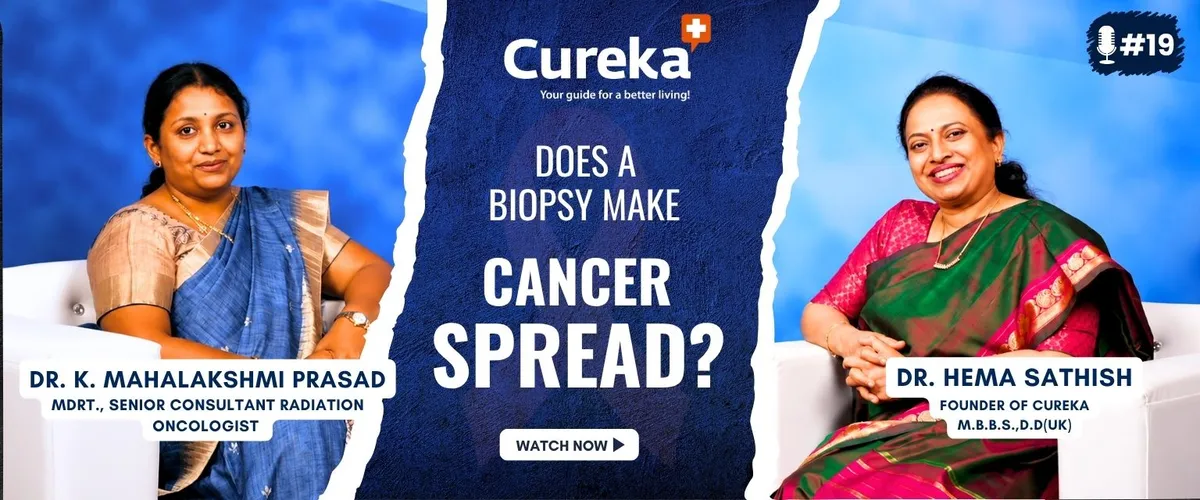
Dr. Hema Sathish:Hello everyone. Cancer doesn't come with a lot of pain or it doesn't give any signals many a times. But good part of it is nowadays the awareness is very high and there's a lot of treatment to even cure it and apart from that the awareness is there so to prevent it from getting very bad is also there. So here we have Dr. Mahalakshmi Prasad who can explain us better about the myths, facts, the realities and how to prevent cancer. She is specialized in radiation oncology. She holds a specialization specifically for breast cancer and for gynecocancers,that is the women related cancer. She has done her specialized courses from Rome and of course a lot more researches. She has published more than 30 papers to her credit and many more presentations. Welcome Dr. Mahalakshmi.
Dr. Mahalakshmi Prasad:Thank you very much ma'am for making me a part of this podcast program of yours.
Dr. Hema Sathish:Glad to have you today.
Dr. Mahalakshmi Prasad:Thank you.
Dr. Hema Sathish:So I just want to have a very practical discussion with you. So I want to understand what kind of patients do come to you?
Dr. Mahalakshmi Prasad:Ma'am, actually I have an incredible journey of more than 18 years. I have been practicing oncology in this part of Madurai. So what I have seen is both young women as well as older women, they have come to this illness. So off late in the past five years if you see younger generation people due to their lifestyle changes and lack of physical activity and faster lifestyle So more young people also do get cancers nowadays.
Dr. Hema Sathish:Young means in a sense what age is the youngest you have seen so far in women cancer that is?
Dr. Mahalakshmi Prasad:In women cancer especially I have treated a breast cancer patient of around 26 years old.
Dr. Hema Sathish:Oh that's really young.
Dr. Mahalakshmi Prasad:That's really young. So in such cases we have to study about the familial genetic inheritance as well. So usually in women related cancers especially, youngsters familial history comes to make a very big role. So there is genetic inheritance plays a very important role because most of their parents or anyone of their first degree relatives would have been affected with cancers and nowadays we have many genetic panel tests are also available to detect those cancers even at an early stage.
Dr. Hema Sathish:So when you speak about genetics, so as you said there are panel tests available. So if you have some relative who's got it or you know it's there in the family like breast cancer especially we hear of it and even cervical cancer right. So we hear about the mother or the aunt having it and then you know it's there in the family so they keep checking themselves very often but now with this early rise of cancer so how early do you think they should test.
Understanding Your Family History and Cancer Risk
Dr. Mahalakshmi Prasad:So actually the genetic inheritance especially in breast cancer the gene is the BRCA so you all must have seen in the newspapers that is a five or eight years back the famous Hollywood actress AngelinaJolie she underwent the bilateral mastectomy and that was the headlines in new york times and other things So basically even in India we have those tests where we can do genetic screening when a person is affected with breast cancer to know whether they have a family inheritance or even their children for example a woman with 40-45 years has a breast cancer and she has a child who is around 20 years old she can undergo this BRCA testing. But in our country, we don't recommend this testing often because the fear of getting cancer increases.
Dr. Hema Sathish:Yes, that is so high, right? Then you are not living a good life also.
Dr. Mahalakshmi Prasad:Yes, that's true. So the counselling part is very important. So when a patient is not having cancer, just because their mother or aunt has a history of breast cancer, so we have to undergo a lot of counselling. We have to do a lot of counselling to the patient. To know whether they really want to do that because the treatment for persons who are having BRCA gene positive you don't have any preventive drug as such. So that's a very important thing. So the treatment is going to be only bilateral mastectomy. It reduces the risk. But in our society nobody was going to accept a bilateral mastectomy or a bilateral oophorectomy. So societal issues come into play especially in a country like India. See, Angelina Jolie did bilateral mastectomy at the same time she underwent reconstruction.
Dr. Hema Sathish:Yeah, true.
Dr. Mahalakshmi Prasad:So in our population whether those things can be accepted, so it's really a question mark even today.
Dr. Hema Sathish:So the younger generation is very tough on them, right?
Dr. Mahalakshmi Prasad:Yeah. So the best thing what we would suggest is any breast cancer will not come without a lump. So you go for a breast self-examination. So every month breast self-examination itself is more than enough to detect early breast cancer and to go to the doctor.
Dr. Hema Sathish:But that has to be taught very clearly and understood that how the lump would be. Because many a times many women, young women, they feel a lump just before their cycles also. Then they are absolutely fine once the cycle comes in.
Breast Lumps Before Periods: What’s Normal and What’s Not?
Dr. Mahalakshmi Prasad:Exactly, the hormonal estrogen and progesterone levels in our menstrual cycle especially during the progesterone phase just before our periods there will be normal lumps so it should not be mistaken as breast lump so that's why we recommend breast self-examination after the periods in the estrogenic phase rather than in the progesterone phase before the periods.
Dr. Hema Sathish:So that's also something we should keep in mind. You said lifestyle changes are also causing the rise in the cancers. So can you explain something about that? What are the reason evidences tell us?
The Link Between Modern Lifestyles and Rising Cancer Rates
Dr. Mahalakshmi Prasad:Everyday physical exercise of around 30 to 40 minutes reduces the direct risk of breast cancer by around 40%. That's a very large amount and now even in standard textbooks those trials and publications have been published. And not only breast cancer so any obesity related cancers like endometrial cancer ovarian cancer so where there is because of estrogen excess there is risk for endometrial ovarian cancers physical activity of every day of 30 to 40 minutes will definitely reduce the risk of cancer.
Dr. Hema Sathish:Okay.
Dr. Mahalakshmi Prasad:So today's women they are more professionalistic they do their jobs and they go for late marriages they go for late childbirths so the and a lot of infertility problems are there. So infertility I would highlight one thing here so it is not against gynaecologists but basically see infertility treatment you they put in a lot of hormones. So any infertility treatment what I would tell is you just go for one or two years or you try to go for an alternative method of infertility, there is surrogacy and other things. But people they don't accept. They again put hormone replacement therapy repeatedly and there is a direct correlation for hormone replacement therapy and ovarian cancer.
Dr. Hema Sathish:That's a real risk.
Dr. Mahalakshmi Prasad:Which many people have not been spoken about. But I do see in my practice where people undergoing hormone replacement therapy for more than 3-4 times, they are at a very increased risk for this gynaecological malignancies.
Dr. Hema Sathish:Is there a paper presentation for that also?
Dr. Mahalakshmi Prasad:Yeah. It's proven. Infertility is a very sensitive topic. You can't just like that because everybody married people they need a child and those things. So it's not over spoken in any forum. And one thing you have to remember is the contraceptive pills, those things also contain some hormones. That oral contraceptive pills which we are using is not going to cause cancer because they are only in micrograms. So many youngsters come and ask me, "Ma'am, I have been using these OCP pills for some PCOD problems and other small period’s related issues." So those doses are only micrograms which will never cause cancer. But for infertility, we infuse a large amount of estrogen and those things. So that should be taken care of as well. So coming to lifestyle as mentioned obesity, reduction in physical activity, intake of junk foods and decrease intake of fiber content. So this fiber content is very important especially in colorectal cancers. Actually when now we are talking about women but coming to men. So in men, young men the commonest cause for cancer is smoking. The second thing is the highest risk is in colorectal. That is because of their dietary habits. You can see a lot of men coming with colorectal cancers nowadays.
Dr. Hema Sathish:In women it is lesser.
Dr. Mahalakshmi Prasad:Yeah, in women it is lesser.
Dr. Hema Sathish:But smoking is quite on the rise with women also, right? Today's women, modern women, many of them smoke. So what is the rise of risk of cancers in women because of the smoking?
How Does Smoking Increase Cancer Risk in Women?
Dr. Mahalakshmi Prasad:Smoking there is increased, ma'am. But actually if you consider smoking does not cause only lung cancer.
Dr. Hema Sathish:Yeah, true.
Dr. Mahalakshmi Prasad:From the mouth till the stomach because the whole fumes are going to get absorbed and it causes cancer in any part, the mouth, the oral cavity, tongue, the digestive tract, stomach, lungs etc. But in India as such, as you have mentioned, though there are women who are smoking, our population, the incidence is little bit less when compared to the western countries.
Dr. Hema Sathish:So supposedly if a young lady has been, you know, has a genetic history also. So she checks and has a BRCA, that is B-R-A-C-A gene positive in her. So what would you advise her to do? Like what should her lifestyle be so that she at least avoids the other risk of developing the cancer and in spite of having the predisposition and then of course watching her closely would help to, you know, tide over this better. So what is your advice like?
Living with a BRCA Mutation: Lifestyle Changes and Preventive Care
Dr. Mahalakshmi Prasad:What I will advise ma'am, first to do a breast self-examination every month. So that is the first point. Second thing is lifestyle wise, I will ask her to go for a routine physical activity, do a little bit of meditation, take care of herself, to go for early marriage at least by 25 to 28 and go for the first childbirth before the age of 30 years. So these are all relative risk factors which increases breast cancer. So all these things can be avoided. When you do these small changes breastfeed the baby so these are I would recommend and also do a early screening so usually the screening recommendation is at 40 years but when you have a family history of breast cancer you start at an earlier age of 35 years just a mammogram every two years once that is the American recommendation as well So that's what we do.
Dr. Hema Sathish:And there is a different type of mammogram where you have to do it once in 5 years, right? So that is also once in 5 years for them also or it's just...
Dr. Mahalakshmi Prasad:No, family history is there and your BRCA mutation is also positive then you recommend every 2 years once.
Dr. Hema Sathish:Okay, whatever it is.
Dr. Mahalakshmi Prasad:Yeah, whatever it is. But there is no family history. You just want to take it as a screening part. Then you can go for 5 years once. So I will again and again tell the best thing is you go for breast self-examination.
Dr. Hema Sathish:Okay okay so that's the simplest method
Dr. Mahalakshmi Prasad:The simplest method there is no any radiation exposure because in mammogram you have both a digital mammogram or a MR based mammogram in MR mammogram maybe you don't have any radiation issues but a digital based mammogram it's nothing but a low dose x-rays so those things are there and one thing to remember is see in mammogram maybe you can find out micro calcifications other thing but a definite lump Whatever you feel in breast self-examination only will be put up in the mammogram as well. It's similar to an X-ray. So it's important that you do your breast examination especially after your cycles. So that's going to help you in the long run.
Dr. Hema Sathish:So when we are talking about examination of the breast, there are many a times when the person realizes there's a lump. But when to take it seriously and when to run to the doctor?
Breast Lumps: Warning Signs You Should Never Ignore
Dr. Mahalakshmi Prasad:Ma'am actually all the lumps cannot be told it is breast cancer. So most of the women due to hormonal changes there will be some breast lumps which can be a normal lump also. So when you have to consider a doctor even after your period cycle you have that lump persistent. And there is any sort of nipple discharge, you have a bloodstain nipple discharge or there is any retraction of the nipple when compared to the opposite breast, there is any pulling type of thing or you have any axillary nodes from your armpits they can examine.
Dr. Hema Sathish:So axillary nodes will be like just for understanding of the audience, axillary nodes will be just in your armpit and you might feel it like small small lumps.
Dr. Mahalakshmi Prasad:So those are the things which favours breast cancer. So whenever you do a breast self-examination and you feel a lump You just see whether it gets disappeared in another one week or ten days.
Dr. Hema Sathish:So you can wait for that specific ten days?
Dr. Mahalakshmi Prasad:Yeah, one week or ten days is okay. And even after one week if it persists, then I would always suggest you go consult your family physician. It is not necessary you come directly to oncologist. Because even today in spite of so much awareness, cancer is such a stigma in the society.
Dr. Hema Sathish:And it's scary also about being a stigma. Anybody who is going to even check on themselves gets scared, right?
Dr. Mahalakshmi Prasad:Yeah, that's true ma'am. So I would suggest you go to your family physician. Definitely she will be able to help you in a better way whether you need to go for a screening mammogram or whether that lump has to be biopsied. So those things can be addressed by her and accordingly you can proceed.
Dr. Hema Sathish:Sometimes you see a lump and sometimes there are no lumps. There is a type of cancer which comes without the lump also. Just for the awareness of everybody, can you explain that bit also?
Look Beyond Lumps: Recognising Unusual Breast Changes
Dr. Mahalakshmi Prasad:Actually in breast cancer, most of the cancer, more than 90% it comes with the underlying lump. Only less than 5% you don't have lumps. So in such cases the other symptoms like as I've already mentioned like any bloodstain discharge from the nipple or any retraction of the nipple.
Dr. Hema Sathish:It will be retraction will be sudden change.
Dr. Mahalakshmi Prasad:You should always compare it with your opposite breast. So that will be an ideal thing to compare. So there is difference or any stretching of the skin with you call that as a beauty orange appearance similar to the orange peel you will have that dot dotdot with redness and other things so those are all symptoms or changes which is towards malignancy or cancer so in such cases you should definitely go and consult an oncologist
Dr. Hema Sathish:And in case you are normal, you don't have a BRCA gene positive in you, and then what would you recommend? Like when should they start the screening?
Breast Cancer Screening: The Right Age to Start
Dr. Mahalakshmi Prasad:So when BRCA mutation is not positive and there is no family history of your mother or grandmother or aunt having breast cancer or any hormone related cancers, the routine recommendation for screening is around 40 years.
Dr. Hema Sathish:Okay.
Dr. Mahalakshmi Prasad:So 40 years every 2 years once you will have to do. Preferably you can go for an MR based mammogram where there is no radiation. So that is a better option.
Dr. Hema Sathish:And when you were saying if Braca gene was positive then they should be careful. So you spoke about diet. So what kind of diet would help a person to make sure that at least they have lesser chances of getting the cancer?
What Diet Is Best for Women with a BRCA Gene Mutation?
Dr. Mahalakshmi Prasad:Definitely ma'am. Diet, anything rich in fiber and rich in protein and a lot of fruits and vegetables. So Indian food is mainly a carbohydrate oriented food. So we can't thrive without rice.
Dr. Hema Sathish:Rice or roti, some form of carb has to be there.
Dr. Mahalakshmi Prasad:Yeah, I think the composition of that should change. And our fibre intake, see practically though we have been speaking in myself, I speak a lot about fibre, fibre. But when you count our plate, the fibre content will be very less. Because the actual recommendation is around 25 to 30 grams of fibre. But we do take fibre, but it will be hardly 10 to 15. So those things have to be taken care of. Protein rich meal, lot of fiber, lot of water content. So all those things should be taken care of. It is not only cancer, it protects you from other diseases like hypercholesterolemia, it keeps your liver clean from fatty liver and other things. So automatically your cardiac risk also decreases.
Dr. Hema Sathish:So that's really nice to know. Well and when you said exercise, so what type of MA is there a specific type of exercise because usually in our country we usually stick to yoga because that is more relaxing, calming and it puts all your chakras together and reduces the risk of many diseases. So it's that's only exercise or some other exercise where you hassle quite a bit also is Okay, okay for somebody with a BRCA positive.
Exercise for BRCA-Positive Women: Is Yoga Enough?
Dr. Mahalakshmi Prasad:Yoga and other thing will relax your mind and other thing. Actually whatever the scientific evidence tells is HIIT exercises, high intensity. 15 minutes of high intensity exercise is actually the real exercise. But most of the women don't do that.
Dr. Hema Sathish:So obesity is one of the culprit. Is it only visceral obesity or it's general also?
Dr. Mahalakshmi Prasad:Visceral and general. See the problem is when you start doing your HIIT exercise from your 30-40 years, your mobility will be more even at 60-70, your menopause will be delayed. See in our country people tell menopause at 40 years itself, I don't know why. Actually the perimenopausal age is after 45 and 50. It is because of all these slower lifestyle habits, I mean exercise habits and other things. People do very mild exercises, they tell walking as exercise and those things. So actually high intensity exercise is necessary to keep you prevented from all these diseases.
Dr. Hema Sathish:So high intensity in a sense it's only the way of exercise or the heart rate has to go up?
Dr. Mahalakshmi Prasad:A little bit the heart rate has to go up. Then only that the metabolic thing will reverse and things like that.
Dr. Hema Sathish:Do you think that cancer risk will be increased if a person is diabetic?
Dr. Mahalakshmi Prasad:Diabetic as such, you can't tell that it will increase the risk of cancer. But patients diagnosed with cancer who are diabetic, it's a little complicated to get treated. Because all your chemotherapy drugs will put your WBC count and other things down. So diabetic patient will have more risk for infection. But compared to a normal person who is affected with cancer and getting the treatment. So treating a diabetic patient with cancer is a challenge for a doctor oncologist rather than treating a non-diabetic patient. But as such diabetes will cause cancer there is no direct correlation.
Dr. Hema Sathish:There are a lot of vitamins right so vitamin D was so popular in between so does it reduce the risk of cancer or help anywhere?
Dr. Mahalakshmi Prasad:Vitamin D you can't tell that it has a direct correlation to decrease the risk of cancer. But definitely vitamin D plays a very important role in women's health as a whole. Because especially in the perimenopausal age and other things, in Indian scenario, Our female take very less quantity of proteins and other things. So automatically your bone mineral density also gets decreased. So in such cases vitamin D supplements are mandatory when you are 45 plus especially in the perimenopausal age.
Dr. Hema Sathish:So that's quite true, right?
Dr. Mahalakshmi Prasad:Yeah, sure.
Dr. Hema Sathish:How much, especially if you're vegetarian, vegan all the more. And then trying to make up for the protein content becomes quite a task, especially on a daily basis.
The Protein Challenge: Are Vegetarians and Vegans Getting Enough?
Dr. Mahalakshmi Prasad:Yeah, definitely, ma'am. Because our people are more oriented of carbs. Because we eat, even breakfast we do only idli dosas. At night tiffin also we make rotis or same. So any form there is only carbs. We don't go for protein and other things and we are more of a spiritually based country. So any community you take they have their own lent days and all these varathams and other things.
Dr. Hema Sathish:So whatever fasting is also quite a bit and then a lot of time also I think the carbs are high.
Dr. Mahalakshmi Prasad:Carbs are they don't concentrate on the protein content so automatically most of our women more than 80 percent of our women they develop osteopenia.
Dr. Hema Sathish:Okay.
Dr. Mahalakshmi Prasad:So whenever you do a BMD you know we do for bone mineral density test. Most of the women above 45 years, you can see that the graph will be in -2, -1. It should be usually more than 0. So, gradually going towards...
Dr. Hema Sathish:Well, we have spoken so much about breast cancer and you did mention a little about the ovarian cancers also on the rise because of infertility treatment and things like that. Can you elaborate a little more on what are the other causes for ovarian cancer?
Ovarian Cancer: What Are the Major Risk Factors?
Dr. Mahalakshmi Prasad:Ovarian cancer is more of a hormone related cancer. So generally obesity is a risk factor for ovarian cancer. Then hormone replacement therapy. So these are the main factors for ovarian cancers. And these ovarian cancers, the problem is usually they are diagnosed at a later stage. Because it's an internal organ, you don't have much symptoms. The patient will present at stage 3 or stage 4 when they have abdominal distension or they have loss of appetite and things like that.
Dr. Hema Sathish:There is no screening for ovarian cancer.
Dr. Mahalakshmi Prasad:Screening is only in ultrasound abdomen and abdomen pelvis and we usually don't go for an ultrasound abdomen pelvis unless your abdomen is enlarged or you have something problem happening over there. So most of the ovarian cancers are diagnosed at a little bit later stage only.
Dr. Hema Sathish:And when it comes to ovarian cancer, the only option is removing it, right?
Dr. Mahalakshmi Prasad:Yes, if it's an advanced stage, definitely ma'am, it's removal of the ovaries along with the uterus and things and according to the biopsy report, they will require chemotherapy additionally. So the adjuvant treatment you tell, depending upon the biopsy report, we have to go for that.
Dr. Hema Sathish:And if ovarian cancer, how early do they get it? Like for somebody to be aware that okay, I could be probably, I do not want anybody to be scared either. But then awareness is something which can prevent them from, you know, having a very bad treatment process also, right?
Dr. Mahalakshmi Prasad:In this ovarian tumours ma'am you have two spectrums that is that which affects the young people, young women and also the older women. So in older women it's typically epithelial ovarian cancer where it is due to this lifestyle changes and all these hormones you get it at a later age above 40 years. But what you gain in young women you call that as a germ cell tumour. So more of germ cell tumours you can see at 19 years, 20 years.
Dr. Hema Sathish:That early?
Dr. Mahalakshmi Prasad:Yeah, it's even before the marriage they get. So in such cases we don't remove the complete ovary and uterus and other things. So usually these germ cell tumours will affect only a single ovary. And it is due to the genetic mutations in their younger age and other things and only with that particular ovary will be removed so we will spare the uterus and the other ovary so that they can have a good marriage and also get conceived. So usually these germ cell tumours come under curable variety of ovarian tumours.
Dr. Hema Sathish:So the child bearing age group gets this. How often is this? I mean what's the incidence rate?
Dr. Mahalakshmi Prasad:The incidence is only around 10 to 12 madam per 1 lakh population.
Dr. Hema Sathish:That's not very less actually.
Dr. Mahalakshmi Prasad:Now when compared to breast, breast is around 24.
Dr. Hema Sathish:Yeah, that's quite.
Dr. Mahalakshmi Prasad:Fora 1 lakh population and cancer cervix is around 17 to 18. And this ovarian is on the whole. It's not only germ cell tumour, ovarian on the whole, it's around 10 to 12.
Dr. Hema Sathish:What about cervical cancer? Cervical cancer was gaining so much of mileage few years ago and it's good right because the awareness was so high now that everybody wants to prevent it then the pap smears are done. I think pap smears are done even the PHCs to make sure that the women are tested and then treated earlier. So why do they get cervical cancer?
Understanding Cervical Cancer: Causes, Risk Factors and Prevention
Dr. Mahalakshmi Prasad:Cervical cancer is mainly caused by the virus human papilloma virus so in human papilloma virus you have lot of strains like 6, 9, 11, 18 there are more than around 12 to 15 strains which causes this HPV infection this HPV infection can be acquired from many things like a patient can have multiple sexual partners. Those days home deliveries. It's a very common thing for human papillomavirus because people used to use all unsterilized things. So multiple childbirths earlier was an etiological factor for HPV infections and then poor hygiene especially if you see in villages they used to water whichever they use they used to use from the canals and other thing which is not washed or clean for many long years so in those factors only you get this HPV infection and most of this HPV infections are usually self-limited that is your own body's immune systems can wash out those but when it's repeatedly you're getting infected and over a long period of time it changes into a chronic inflammation and it causes cancer.
Dr. Hema Sathish:So there are so many ways to screen for cancer so one of them for cervical cancer especially is pap smear right it's a very simple procedure available in all the PHCs so just tell me some details about it.
Dr. Mahalakshmi Prasad:Pap smear, as you have already mentioned, the government has made a big proposal to introduce it in all community health centers, primary health centers, etc. And that's why the incidence of cervical cancer also has drastically reduced over a period of 10 years. Pap smear is a very simple procedure where you use just a wooden spatula where the scrapings of cervix are taken both ecto that is outside cervix and also the internal part endo cervix and then you make a smear and then you send to microscopic examination. And if there are any deformations or change in the cells then accordingly they go for a biopsy. So this is a very simple and easy procedure where most of the women can undergo. And the recommended period for pap smear, what usually the recommendation is, all married women above the age of 30 years, they recommend to go for pap smear every two years once.
Dr. Hema Sathish:That's also once in two years. So you can have your checkup schedules, all these women health check-ups every two years.
Dr. Mahalakshmi Prasad:Yeah, sure.
Dr. Hema Sathish:There was a big drive for human papillomavirus vaccinations. So what do you recommend?
HPV Vaccination: Who Should Get Vaccinated and When?
Dr. Mahalakshmi Prasad:HPV vaccination is definitely recommended especially in adolescent females. Not only females, even males can have that because it prevents any HPV related diseases like your CS cervix, cancer cervix, genital warts and even oropharyngeal cancers. So nowadays even in oropharyngeal throat cancers there are evidence of human papilloma virus as an etiological factor. So you have to give HPV vaccine both for your adolescent girl child as well as male child. So that is one thing. And HPV vaccine, there are two types of vaccines, Cervarix and Gardasil vaccine. Generally we prefer putting Gardasil vaccine because the strains which it covers is at a extended one. You have Gardasil 4 and 9. So 9 is preferable. There are 9 to 10 strains of HPV viruses you can protect and usually it is given in 0, 1 and 6. If the child is less than 14 years you can go for a 2 schedule 0 and 6. If it's child is more than 15 or 16 years preferably you can go for a 3 schedule 0, 1 and 6. And usually women, any unmarried women before the age of 25 years, we recommend HPV vaccination.
Dr. Hema Sathish:And for boys also it's the same?
Dr. Mahalakshmi Prasad:Yeah, it's the same.
Dr. Hema Sathish:So there are so many risk factors to cancer, right? So while discussing, I want to know how you can avoid this risk and what could be the risk factors. So diet of course. So in diet, what is the risk factor in diets?
Diet and Cancer Risk: Which Foods Should You Be Mindful Of?
Dr. Mahalakshmi Prasad:Actually, one thing people must know is most of the cancers are preventable. People think cancer comes itself, it's only due to genetic factors and these things. But more than 60 to 70% of cancers is only due to your lifestyle habits. As you have mentioned, diet. Nowadays, people eat lot of junk foods, cheese and other things. Similarly, when they increase intake of red meat. So red meat is all your pork, lamb and all those things. The recommendation is you have to take only around less than 500 grams per week. So anything conception of more than 500 grams per week increases the risk for cancer.
Dr. Hema Sathish:Oh, okay.
Dr. Mahalakshmi Prasad:Yeah.
Dr. Hema Sathish:That's like, oh.
Dr. Mahalakshmi Prasad:So, everyday intake of more than 500 or 350 grams, something like that, it is a proved factor to cause colorectal cancer. Because any type of red meat you take, there is some sort of oil which comes, either it's a cheese or any type of oil. Because of deep frying and other things, there are a lot of inflammatory changes which occurs in the colon. And it has proved to cause cancer. So diet is a very very important thing.
Dr. Hema Sathish:What about breast cancer, cervical cancer?
Dr. Mahalakshmi Prasad:Cervical cancer there is no direct correlation between diet and cervical cancer. But breast definitely is. So breast is indirect relationship. Because of increased diet and poor dietary habits it causes obesity. Obesity actually causes breast cancer. So all hormone related cancers there will be a dietary impact. Poor diet will lead to obesity. Obesity will be related to breast cancer, endometrial cancer, ovarian cancer.
Dr. Hema Sathish:What about smoking of course increases chances of lung cancer? Is there any other cancer which it can instigate?
Dr. Mahalakshmi Prasad:Smoking does not only cause lung cancer, other cancers, anything because smoking from the mouth till the GIT, stomach. So all those mucosal tracts will be affected with smoking. So you can get any type of cancers like tongue cancer, mouth cancer, esophageal cancer, stomach cancer, lung cancer. In Indian women, as our habitual smoking is a little bit less, lung cancer is not as common due to smoking as the etiological factor as in western countries. But we do get lung cancer cases in women. That is due to genetic. Mutational changes. If you take, of late many patients, female patients come with lung cancer. So the question which they ask me is, "Ma'am, I don't smoke." And nobody smokes in our home. Even my husband doesn't smoke.
Dr. Hema Sathish:I have heard about that. There is a big rise in women having lung cancer.
Dr. Mahalakshmi Prasad:Yeah, that is mainly due to the mutation. So nowadays this mutation pattern of all cancers plays a very important role. In the causing of cancer and also the treatment aspect. So one thing in this lung cancer is especially women they will get this exon 20 deletion mutation. So usually they have a targeted treatment for that.
Dr. Hema Sathish:Can stress directly increase the risk of cancer?
Dr. Mahalakshmi Prasad:Stress as such will not directly increase the risk of cancer. Stress will cause chronic inflammation in the body which over a period of time can result to mutational changes and result in cancer. So there is no direct correlation which suggests that stress will lead to cancer.
Dr. Hema Sathish:I think that's why people who have a very intense lifestyle have higher risk of contracting cancer.
Dr. Mahalakshmi Prasad:Yes, exactly. We call that as a Type A personality. So those kind of things definitely not only cancer other diseases also cardiac risk increase.
Dr. Hema Sathish:They have a higher risk. What about alcohol? I mean alcohol can it directly increase the risk of cancer?
Alcohol and Cancer: Understanding the Link
Dr. Mahalakshmi Prasad:Alcohol definitely directly can increase the risk of cancer because alcohol will result in fatty liver and fatty liver will lead to cirrhosis another thing and cirrhosis at last it will cause hepatosal or carcinoma. It's a proved risk factor and alcohol is similar to smoking. So smoking has a higher impact because of the tobacco content and other chemicals which are there in cigarette. Alcohol also, when you intake alcohol to a larger extent, it will damage your mucosa. So over a period of time, it will result in chronic inflammation and it is going to cause cancer.
Dr. Hema Sathish:Is sleep directly related to the risk of increasing cancer?
Dr. Mahalakshmi Prasad:Directly you can't tell now. Because sleep has a lot to do with your mental health, mood and other things. So definitely sleep will directly does not cause cancer. But sleep deprivation will lead to mental stress. So automatically depression and all those things. The chronic stress can cause chronic inflammation and indirectly it can lead to any type of cancer.
Dr. Hema Sathish:Well there are so many myths we need to bust about cancer. So let's get going on that. So cancer is completely hereditary, is it? So if no family member has got cancer, then the person cannot get it.
Cancer Myths Busted: Separating Facts from Fiction
Dr. Mahalakshmi Prasad:It's not like that. Familial history is only 20% of your risk factor. Other 80% is due to other etiological factors. It can be anything. Lifestyle habits, obesity, etc.
Dr. Hema Sathish:So if somebody takes the HPV vaccination, so they'll never get cervical cancer is it?
Dr. Mahalakshmi Prasad:So madam, HPV as I've already mentioned in the talk, it is caused by a lot of strains. So whatever vaccines we have, it's only for protects around 9 to 10 strains. So the strains which they have mentioned, the HPV infection due to that maybe you will not get severe cervix. But there are few other strains where still vaccines have not been So, in such cases, there is a little bit risk, but it is good to have HPV vaccination because the coverage is huge. It covers, it prevents you on more than 80% of your HPV strains.
Dr. Hema Sathish:Oh, that's 80% is quite a bit. So, if a person is undergoing a pap smear and in case they've already had a cancer, so will it spread fast?
Dr. Mahalakshmi Prasad:No ma'am, nothing like that. Pap smear is a screening method. So, generally all women, married women above the age of 30 years, we recommend pap smear.
Dr. Hema Sathish:So is it that only married women should have cervical cancer screening?
Dr. Mahalakshmi Prasad:It's not like that. Generally because of the society and things we tell it is a married woman. But even if you are unmarried, if you have multiple sexual partners it increases the risk of cervical cancer.
Dr. Hema Sathish:There is one thought right that breast cancer is caused because of tight bras also. So if you wear the right fitting bra then you cannot get breast cancer.
Dr. Mahalakshmi Prasad:No, definitely not. There is no relation between braziers and breast cancer.
Dr. Hema Sathish:If you keep your mobile phone in your bra, which many people do, does that increase the risk of breast cancer?
Dr. Mahalakshmi Prasad:No, definitely not. It's a type of habit where village women and things, they do that. But there is no correlation between that.
Dr. Hema Sathish:Underarm deodorants will cause breast cancer?
Dr. Mahalakshmi Prasad:No. No, not at all.
Dr. Hema Sathish:Breast implants, if done, they always cause breast cancers, is it?
Dr. Mahalakshmi Prasad:No ma'am, that's also a myth only.
Dr. Hema Sathish:So if I don't have any symptoms, I don't need to screen, right?
Dr. Mahalakshmi Prasad:It's not like that. So screening procedure is recommended irrespective of your symptoms. That's why it is called a screening procedure.
Dr. Hema Sathish:There was so much of thought over this, right? That sugar, if you have a sugar-free diet, then you are starving the cancer cells and so that's a treatment for cancer. Is that true?
Dr. Mahalakshmi Prasad:No ma'am. Not at all like that. See increased sugar maybe it can lead to lot of other things in your body like obesity and other things which indirectly can predispose to diseases like cancer and cardiovascular disease. But there is no direct correlation that you cut down the sugar you won't get cancer.
Dr. Hema Sathish:Does organic food guarantee that you won't get cancer?
Dr. Mahalakshmi Prasad:It's not like that. See the thing is organic foods, non-organic foods, it's only the chemicals and things. See generally it is not only your chemicals which you use as fertilizers, even your room fresheners and even your wax and other things which you use. Anything which has benzene compounds in long term, it will cause cancer. So that's a proved fact. It comes under carcinogenic material.
Dr. Hema Sathish:Can herbs alone cure cancer?
Dr. Mahalakshmi Prasad:Herbs alone can cure cancer I think but I am not an Ayurvedic doctor but there are few medicines ma'am because even in our field, this chemotherapy medicines there are few drugs which are extracted from the plants.
Dr. Hema Sathish:True truetrue.
Dr. Mahalakshmi Prasad:So you must have heard in Kerala and Karnataka, there is one Shimogawa district where they are doing all these alternative medicines where few people, the disease is static without progression. It cannot maybe eliminate the disease or something but there are few alternative medicines where it works for cancer.
Dr. Hema Sathish:It works to a certain extent. So if we do a mammogram once and the person is fine, then they don't need to do a mammogram again.
Dr. Mahalakshmi Prasad:It's not like that. So mammogram is a screening procedure and it's recommended every two years once. So even if it's normal, you have to go for it.
Dr. Hema Sathish:Quite a tricky one. Only women get breast cancer, is it?
Dr. Mahalakshmi Prasad:No, it's not like that. Even men do get breast cancer.
Dr. Hema Sathish:The pain is the first symptom of breast cancer.
Dr. Mahalakshmi Prasad:Not like that. Lump is the most common symptom. But in some cases, it can present with pain.
Dr. Hema Sathish:A healthy lifestyle guarantees you will never get cancer.
Dr. Mahalakshmi Prasad:So healthy lifestyle, what my take home message will be, it will protect, definitely prevent most of the cancers. It's not like it will not give rise to cancer. There are other factors. So only lifestyle cannot be a risk factor for cancer.
Dr. Hema Sathish:The phobia is so much that the cancer treatment is worse than the cancer itself
Dr. Mahalakshmi Prasad:Cancer treatment I do accept and there is lot of morbidity aspects along with that But still there are protocols and other newer medicines available So what I would tell my patients is you just believe your doctor address whatever she tells, do it in a proper way, so most of the treatment will be comfortable. Because it is not only the treatment aspect, it is the cost factor also, logistics also comes along with the treatment. So those things people still have phobia and other things. So when those things are also addressed through some trust or NGOs and other things, insurance based and other things, definitely cancer treatment will be very easy.
Dr. Hema Sathish:So financially also it's nervous, mentally also it's nervous, physically also it's nervous. It's quite a lot, right?
Dr. Mahalakshmi Prasad:It's a little bit of a complex thing. But if they undergo and finish it off, definitely they can be healthier than before.
Dr. Hema Sathish:Radiation therapy burns the whole body, is it?
Dr. Mahalakshmi Prasad:Definitely a myth ma'am. Till now also though we are doing lot of awareness programs, people come and ask me whether it's going to be electric shock kind of thing or like that. It's not. So radiation is nothing but treating with mega voltage X-rays. So it's similar to a CT scan where you just go lie down in a machine and the machine delivers the treatment bad to treat.
Dr. Hema Sathish:Generally radiation therapy is considered to be very very scary. Of course, chemo also is not comfortable for anybody but I think chemo they have heard it so many times. Radiation is something they feel, "Oh my God, this is going to do something else."
Dr. Mahalakshmi Prasad:But it is the easiest and the painless treatment in cancer that many people are not aware unless they undergo that.
Dr. Hema Sathish:True, true. So if you have treated yourself for cancer then it comes back.
Dr. Mahalakshmi Prasad:No, definitely not. If you go for proper treatment by an oncologist and undergo proper follow-up, most of the cancers will not come again.
Dr. Hema Sathish:That's so heartening to hear. So, HPV infection is equivalent to cancer?
Dr. Mahalakshmi Prasad:No, ma'am. HPV infection can be self-limiting. Most of the women and men can, in their lifetime, can get exposed to HPV infection. Mostly it's self-limiting. It's not a must that you get cancer.
Dr. Hema Sathish:So once you attain menopause, abnormal bleeding is okay, is it?
Dr. Mahalakshmi Prasad:No. Any post-menopausal bleeding should be addressed.
Dr. Hema Sathish:It should be taken very seriously also, right? So if a woman removes her uterus, then all the women-led cancers are preventable, is it?
Dr. Mahalakshmi Prasad:It's not like that ma'am. See hormone related cancers, removing the uterus and ovaries is definitely a risk reduction strategy for cancer where you can reduce the risk for endometrial cancer, ovarian cancer, breast cancer but not for other cancers, habitual cancers like due to smoking and alcohol, stomach cancer, colorectal cancer. So those things cannot be avoided.
Dr. Hema Sathish:Is cancer contagious?
Dr. Mahalakshmi Prasad:No. Not at all. It is not a contagious disease.
Dr. Hema Sathish:So many people have this phobia, no? If you do a biopsy then the cancer will spread.
Dr. Mahalakshmi Prasad:No ma'am, that's a real myth. People do come and ask nowadays also biopsy will spread but it's not like that. Without a biopsy confirmation you cannot go for any radical treatment for cancer. So definitely biopsy is needed for any patients who has to undergo cancer treatment.
Dr. Hema Sathish:So early detection only helps you find the cancer but what about the survival after that?
Dr. Mahalakshmi Prasad:Early detection definitely helps to do a better treatment also it improves the survival. So it is not like that it is not going to improve the survival. Any site anywhere early detection is definitely going to improve the survival.
Dr. Hema Sathish:So there are some lumps in the breast which are actually they are not cancerous right not all of them are cancerous. So many young girls get it now, fibroadenomas and lot of fibrocystic diseases. So what about that?
Dr. Mahalakshmi Prasad:Ma'am, actually this fibrocystic disease as you mentioned, most of the women, especially after attending Menarche, from the age of 15 years to 35 years, it's a very common thing. Around 70% women have this fibrocystic disease.
Dr. Hema Sathish:Okay, that common is it?
Dr. Mahalakshmi Prasad:Because it is related to your cyclical... Hormones, Periods and things. So definitely those things can be addressed with little bit of antioxidants and other things. And one thing I would like to highlight is all fibrocystic disease need not you go and do a screening mammogram. So usually this fibrocystic disease comes for age groups less than 35 years, 30 years. So where you can do a simple ultrasound to see a cyst and other things which will be clearly delineated. And the most important thing is, usually these kinds of fibrocystic disease are self-limiting and also with certain antioxidants it gets controlled. Most of the people what they do is they go and operate on that.
Dr. Hema Sathish:You said antioxidants is more than enough but in case if it's a persistent cyst so I keep hearing about many people undergoing surgery or just lumpectomy for it. So what is your take on that?
Dr. Mahalakshmi Prasad:Ma'am I would definitely not recommend because usually this fibroadenoma and fibrocystic disease it gets self-limited especially when you undergo pregnancy, breastfeeding and other things. So unless it is going to cause pain, for example, if a fibroadenoma is more than 5 cm and it causes some physical disappearance for the child and she is going to get married and such things, cosmetically you can go for a surgery. Otherwise any fibroadenoma less than 2 cm or 3 cm you have to wait. So that is one thing I would recommend because most of them immediately go do surgery, put anesthesia scar on the breast. So those things can be avoided.
Dr. Hema Sathish:Now when we talk about breast cancer treatments also, there are many treatments available. So earlier it was just removal of the breast from one side or both sides depending on what is there and then removing the nodes. But nowadays we have some other treatments also where the breast is kept intact and only the cells are removed. Can you talk a little bit about that?
Dr. Mahalakshmi Prasad:Yes ma'am. Actually this breast cancer if you are detecting at an early stage, you can definitely go for breast conservation surgeries. But all breast cancers you cannot do breast conservation. So if the lump is really big and if it occupies more than half of the breast, in that case it is not possible to preserve your breast. So early reduction is the best mantra to do breast conservation surgeries and also for better control and cure rates.
Dr. Hema Sathish:Now when we talk about this fibrocystic lumps in the breast which actually are not cancerous, they are very big. But is there a chance for them to become cancerous later in life?
Dr. Mahalakshmi Prasad:No ma'am. Fibrocystic disease will never go to cancer. It's usually self-limiting and it is mainly due to hormonal changes because of estrogen, progesterone levels. And during pregnancy, after your pregnancy, breastfeeding and other things, it automatically disappears. And this fibrocystic disease is a little bit directly related to your stress and also your fast lifestyle. So people with type A personalities will have more of this fibrocystic disease.
Dr. Hema Sathish:Yeah, I have seen that. And breastfeeding, sometimes it happens, right? Some women develop some lumps during breastfeeding. So if they have this fibrocystic disease, are they more prone to developing the lumps in the breast during breastfeeding or it's just that doesn't bother at all?
Dr. Mahalakshmi Prasad:During breastfeeding, usually the lactating tubules where the milk gets stored and other things, you get that lump. But it disappears. Once you stop the breastfeeding, it usually disappears in a matter of a week or 10 days. But one thing here is lactating breast cancers are little bit aggressive than your regular breast cancers. So when a lactating woman stops her breastfeeding and if the lump doesn't disappears even after one month then she has to go and screen, she has to go to an oncologist.
Dr. Hema Sathish:Okay so that's something to be really concerned about then.
Dr. Mahalakshmi Prasad:Yeah so usually this lactating uh breast when they stop, so usually this lump appears only when they stop the breastfeeding. It usually gets regressed in 10 days to 15 days. But even after 15 days there is a persistent lump, then you have to definitely go and intervene. See it is not that you will get, it is a type of lactating type of cancer, it can be even an abscess. Because during lactation, because of the nipple infection and other things, there is more chances to get breast abscess as well. The only thing is the breast abscess will have more of pain, it will have tenderness, there will be erythema, skin redness and all those things. So more than one month, definitely you have to go and intervene.
Dr. Hema Sathish:So that's something which everybody has to be concerned about. So there has been a lot of myths, a lot of truths, a lot of facts discussed today. And I think so much about cancer made it very easy to understand. Thanks a lot Dr. Mahalakshmi for coming over and talking so much about this.
Dr. Mahalakshmi Prasad:Thank you.