
Table of Contents:
Perimenopause vs. Menopause: What's the Difference?
Menopause Symptoms: What Brings Women to the Doctor?
Beyond 60: What Health Risks Should Women Be Aware Of?
What Is Sarcopenia and Why Should We Be Concerned?
The Link Between Menopause, Muscle Loss and Fall Prevention
Bone Health Screening: What Tests Are Recommended and When?
Heart Palpitations During Menopause: Is It Hormonal or Cardiac?
Surgical Menopause: What Is It and Why Does It Happen?
Menopause and Intimacy: The Concerns Women Often Hesitate to Discuss
Understanding HRT: Exploring the Different Treatment Options
Understanding the Potential Risks of Hormone Replacement Therapy
Understanding Genitourinary Changes During Perimenopause and Menopause
Menopause and Mental Health: Understanding Emotional Changes
Menopause and Cholesterol: How Does It Affect Your Lipid Profile?
Menopause Myths vs. Facts: Separating Truth from Misconceptions
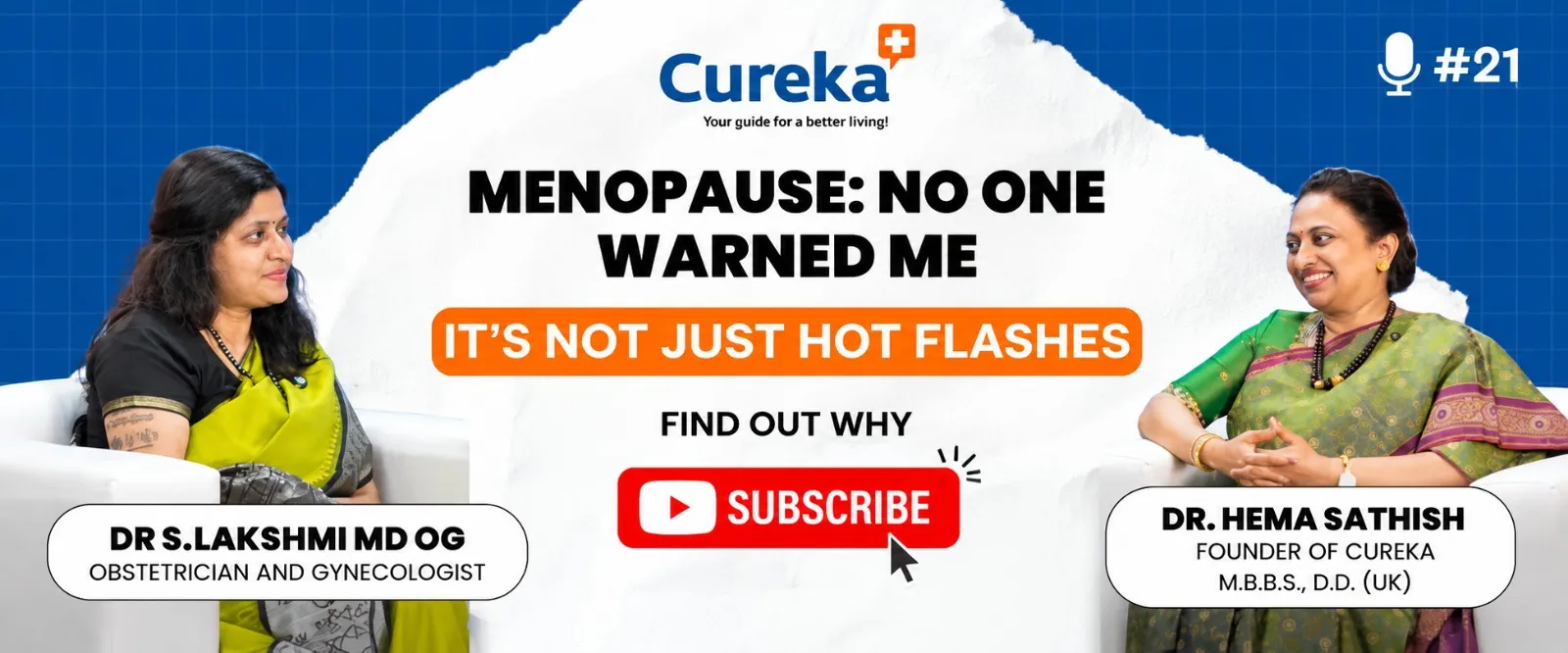
Dr. Hema Sathish:Have you ever felt that your body is changing drastically? Nobody around you understands what's wrong with you. And you're having some problem which you cannot explain or neither speak. Many women go through this and do not know whom to talk to, how to address this issue. So here we have today at Cureka Health Talks, Dr. Lakshmi, who is going to help us talk about and decipher a lot of things about menopause. Welcome, Dr. Lakshmi.
Dr. Lakshmi: Hi, Hema.
Dr. Hema Sathish:Dr. Lakshmi has got quite a lot of paper presentations to her credit and many many talks, many many guest lectures and she is very active in the Menopause Society also. So it's wonderful having you Lakshmi today.
Dr. Lakshmi: Thank you Hema.
Dr. Hema Sathish:So first to begin with, let's start by asking what exactly is menopause?
Dr. Lakshmi: See, menopause is just a phase in a woman's life actually. It's just like menarche, there is something called menopause where there is cessation of the periods and it's only that and nothing else to be worried about. There are little hormonal changes in the body and we just have to learn how to adapt to the new changes.
Dr. Hema Sathish:But this phase goes on for a long time, right? So when would you say menopause? Because perimenopause is also there and then there's menopause. So what exactly is the menopause? What is perimenopause? Shall we discuss both?
Perimenopause vs. Menopause: What's the Difference?
Dr. Lakshmi: Yeah. See, only if the menopause age less than 40 years, we call it premature menopause. Only that we have to be a little alarming. And for average Indian women... We can say a standard of about 55 years as the age of menopause, a mean. Many women have 10 years plus or minus and the upper limit will be 60 years.
Dr. Hema Sathish:Okay.
Dr. Lakshmi: Yeah. So we just have to work on if the cycle exceeds or there is a very increased or excessive bleeding in that and women is having some other symptoms in that, then we have to worry about that. Otherwise it might just start with a irregular menstrual cycle or a shortened menstrual cycle. And that would be the perimenopause. Perimenopause changes. And development of some symptoms. Yeah. Can be hot flashes or symptoms like that or genitourinary symptoms which might tell you that your hormones are weaning slowly.
Dr. Hema Sathish:And menopause would be a minimum of one year, no cycles.
Dr. Lakshmi: Yes, we call it the last menstrual period. So when the women had the last menstrual period from that to that one year, it will be in the perimenopause and then after that we call it as a menopause.
Dr. Hema Sathish:So it's one year of cessation of menstrual cycle. So how alarming is this? I mean everybody suddenly says, oh menopause, oh my god.
Dr. Lakshmi: Yeah, there is so, see actually we had those days, we had women just sitting in one corner doing their own work and we didn't have like, we didn't take care so much and the activity of living and all is more now. So the awareness of well-being is more nowadays.
Dr. Hema Sathish:True, true, that's really true.
Dr. Lakshmi: So we call menopause as the window of opportunity. That is 10 years from your day of menopause or up to 60 years. So that is your window of opportunity where you can get yourself checked. The investigations, the screening, the screening for malignancies, especially cervical cancer, you can get your HPV done or a pap smear done during that period. Check your lipid profile, check your bone density. So please use this as the window of opportunity. These particular 10 years that is from your menopause or upper limit of 60 years, we call it as window of opportunity or the golden period to get yourself checked. For the symptoms.
Dr. Hema Sathish:When you said pap smear, I would like to understand like how often a pap smear should be done. Like you were saying a window of 10 years, so how often in this 10 years should we do?
Dr. Lakshmi: Annual pap smear. The recommendation is you do an annual pap smear. Now we have HPV kits. So we can just take the cervical secretions and given it for the diagnostics. We detect the HPV also presence in there. So all these are very pre-screening modalities which are available now. I think women should start using it.
Dr. Hema Sathish:And when you said like so many symptoms arise during this phase, so what are the symptoms generally patients come to you for? Like usually I think these general things, I do not know if they want to come and say, I sweat a lot. I mean, I don't know if they say it. So I'm just wondering, so could you explain that a little more?
Menopause Symptoms: What Brings Women to the Doctor?
Dr. Lakshmi: Yeah. When you have so many people in the hall, a particular person feeling like, please switch on the AC when everybody else is comfortable. See, that's the time when you feel a little left out, you know, you start picking up, okay, am I developing hot flashes and all that? And sometimes you get into a room and you forgot like why I came here. That happens. It's called brain fogging. You forget as you enter the room, why you came inside the room, what you're searching for, you know, things like that. All these symptoms slowly develop. And also genitourinary symptoms which women are little reluctant to talk about and urinary symptoms especially some might develop incontinence or some might develop infection and bone health which was very much neglected i should say very recent camps which we conducted where we found the osteoporotic state in women who are like very educated women who think they are taking good diet and all that they were in osteoporotic state yeah and they were not aware of it they were like doing the routine screening is done so we might think we are very healthy but which may not be actually yeah so we have to get your again that's the golden opportunity comes the window of opportunity please use it to get yourself screened in the menopause transition.
Dr. Hema Sathish:So when you say this golden opportunity, if beyond 60 and up to 60 they have not checked, beyond 60 what could be the problems?
Beyond 60: What Health Risks Should Women Be Aware Of?
Dr. Lakshmi: The first problem is fractures. The bone health once it deteriorates the osteoporotic activity when it sets and it's very difficult because this is a very simple test where everyone can check it. You just sit on a chair and try to get up from the chair without gripping anything. So that's a grip test and many of them will have some difficulty. We have seen our grandmothers and they have some difficulty, they have to hold something and try to get up from the chair. You know, right from that. And when talking about fall risk in menopause women, we also have to cover sarcopenia.
Dr. Hema Sathish:You said sarcopenia, such a fancy term, right? Can you explain what exactly sarcopenia is?
What Is Sarcopenia and Why Should We Be Concerned?
Dr. Lakshmi: So sarcopenia is a very silent killer. Yeah, because we don't concentrate about muscle strength and how to build the muscle strength. What happens is when someone gets up and tries to make the first step, because of the loss of muscle strength and power, they tend to fall down. And when they fall down, due to weak bones, they tend to get a fracture. So we have to strengthen our muscle during the menopausal time. You might have to do a little bit of change in your exercise routine.
Dr. Hema Sathish:Yeah, muscle training is very popular now, especially menopause in women.
Dr. Lakshmi: Yes, apart from your routine training, I think they have to go for resistance training which will improve your muscle strength, especially to build your pelvic muscle strength and your adductors, hamstrings and quadriceps strength training. All these you have to include in your routine training.
Dr. Hema Sathish:That is all your thigh muscles.
Dr. Lakshmi: Yeah, yes. All these will prevent a fall when someone is trying to walk.
Dr. Hema Sathish:Well, can you explain why because of menopause all this happens?
The Link Between Menopause, Muscle Loss and Fall Prevention
Dr. Lakshmi: See, basically bone resorption occurs. Estrogen, I think you should say it's a glowing hormone which makes the woman glow in her life. And once there is a, this estrogen wanes off, slowly all the benefits, the glow and everything, we think it comes down. And yes, we also can replace it as and when required. So this estrogen is the most beneficial hormone. It has cardiac benefits, it has benefits on bones, and the lack of estrogen causes hot flashes and the genitourinary symptoms. It's something like from your hair to the toe, the estrogen does some magic. And when it slowly weans off, yes, it happens. It causes some changes in the body. We just have to get adopted to it and find some replacements for it.
Dr. Hema Sathish:Well, we were talking about muscle development and exercises for muscle that is strengthening and things like that. So can you explain a little more on how you can strengthen the muscles?
Dr. Lakshmi: Yeah. See, the resistance training when we talk about, it's mainly you can use thera-bands. There are loop thera-bands and there are linear thera-bands. So these loop thera-bands, particularly when you use for your thigh muscle and your pelvic muscle, and at the same time it causes stretching and relaxation. So this increases the resistance to the muscle and as you strengthen the muscle which will help you more walk and prevent falls, the fall rate will start going down.
Dr. Hema Sathish:That's quite interesting.
Dr. Lakshmi: You don't need a machinery to do this. You just can buy some TheraBands, keep it in your hand and do it as a routine.
Dr. Hema Sathish:And you can carry it anywhere.
Dr. Lakshmi: Carry it anywhere.
Dr. Hema Sathish:That's a boon actually. And there's something called early menopause, right? Which is actually, I'm seeing a lot of cases now. Earlier, I don't think this was there. You only explain the reason for it.
Dr. Lakshmi: See, early menopause, we call it as premature menopause. That's less than 40 years. There are so many reasons for that. There is something called premature ovarian insufficiency where the ovary ceases to function earlier. See, the concern in this woman is less than 40 years when the ovary ceases to function, there is a hormone... Imbalance you know the estrogen level drops as I said it will affect from your hair to the toenail and when it happens the bones become brittle there is a risk of fracture and they have hot flashes and all other symptoms but the happy news is that you have a hormone replacement therapy so those particular people have to consult the gynaecologist get themselves evaluated and as and needed they might need a hormone replacement therapy maybe it should go on till as the gynaecologist recommends sometimes till 60 years.
Dr. Hema Sathish:Well, when we talk about this bone weakening, so there are some tests which we can do, right? So what test would you advise somebody to do and how often?
Bone Health Screening: What Tests Are Recommended and When?
Dr. Lakshmi: Yeah, so this is bone mineral density test. There is something called bone mineral density. It will assess your how much the calcium presentation in your bone and it will give a score like T1 score so what is the value in it and from that you can assess like what is the mineral content in your bone and how much where you set in whether it is normal or osteopenic or osteoporotic and then there is a this DEXA scan this has to be I mean we do not have to do it routinely as and when the doctor prescribes you after evaluating the the doctor might say, "Okay, you might need a DEXA scan." So only then you have to get the DEXA scan done. There are other parameters like blood investigations where they evaluate calcium and vitamin D. And particularly in our scenario where we do not have so much of exposure to sunlight. - That's such an ironic thing. - Yeah, ironic thing. So in that particular cases, many of them are randomly, even if you check the college girls also, they are deficient in vitamin D these days. So this is something which we have to think about it.
Dr. Hema Sathish:So if you have to talk about all these things like is there something called a menopause diet which you can talk about?
Dr. Lakshmi: Yeah, you have to, I mean menopause, we earlier discussed about sarcopenia, right? So that sarcopenia, the resistance is number two. The point number one in managing sarcopenia is you have to increase your protein intake. Yeah, and many people think vegetarian diet does not have protein and only the non-vegetarians have the option of protein but I do agree they have the increased protein content but vegetarian diets do have very good protein content in that and I think many diets you can have a protein diet like dals, pulses, paneers and all these are very good protein. Being a vegetarian. Yes, being a vegetarian and non-vegetarians you know like egg whites and chickens and all that. So, good protein intake is the most important thing to have a happy muscle.
Dr. Hema Sathish:And what's your take on this protein shakes because many people then jump into all this protein shakes.
Dr. Lakshmi: I think protein shakes if you are getting it prescribed by your doctor and then yes you can go ahead. And the other protein shakes I think you have to take after consulting with your doctors.
Dr. Hema Sathish:Because I think protein is a little bit hyped also more than necessary. And then intake of too much of protein can bother the kidneys.
Dr. Lakshmi:Kidneys, exactly.
Dr. Hema Sathish:Because we see a lot of cases with kidney diseases now because thanks to the protein intake which has been hyped so much. So much. That people just believe that you shouldn't take any carbs or anything else.
Dr. Lakshmi: Exactly, try one protein, yes.
Dr. Hema Sathish:So a good amount of fiber is also necessary when you are taking the protein.
Dr. Lakshmi: Someone who is hitting the gym, okay yes, first time they will start with the protein I think.
Dr. Hema Sathish:And then the antioxidants in your diet also needs to be really high right? During menopause.
Dr. Lakshmi: Antioxidants also need to be high and there is some natural estrogens in the diet which we can think about the soy supplements like soy milk and the tofu and all these are natural plant based estrogens which can like supplement your I mean can add on to your estrogen requirement. And also calcium intake, milk and ragi. So all these are calcium rich foods and apart from your sunlight exposure, this diet also adds to your part of your menopause routine.
Dr. Hema Sathish:So I think with the diet you have to make sure you are having your sun exposure regularly.
Dr. Lakshmi: Yeah, exactly.
Dr. Hema Sathish:I think for Indians it's mandatory now because we are the most vitamin deficient country I guess. So when we talk about soya, you have to keep in mind that if you are having hyperthyroidism, you have to check with your doctor and make sure not to take a large quantity of it. So you have to be careful about how much you are taking. So if you are having hyperthyroidism or any problem with your thyroid, please consult your doctor before you take too much of soya. Because once you say it, people just feel that they should take a lot of it and that shouldn't lead to some other problems. We hear so many women complaining of palpitations, right? So palpitations is attributed only to menopause or they develop some cardiac problems?
Heart Palpitations During Menopause: Is It Hormonal or Cardiac?
Dr. Lakshmi: Yeah, actually menopause, the estrogen is little cardio protective. So you also have to check your cardiac status and your lipid profile as you enter menopause. Palpitation per se you shouldn't think okay I am having some cardiac issue. So many women become little anxious during their menopause time and little bit depressed. So in that particular time they might have some hot flashes with palpitations. So that doesn't mean you are having a cardiac issue. You have to meet your doctor and they will guide you and do the investigation as and when necessary.
Dr. Hema Sathish:But depression is also quite common. And is it the hormones which is causing the depression or it's just the phase of your life where everything is up in the air?
Dr. Lakshmi: So actually Hema, actually speaking this waning of estrogen is something it's like you're so much with the hormone and suddenly when something is taken off it will have some effects and yeah you have to like you don't have to fight with the depression you just have to find as I said alternative methods to keep yourself active and do it. I think menopausal women can do lots of activities you know which will make them get back to their old shape.
Dr. Hema Sathish:So that's a very valid point. So you have to do something new maybe, right?
Dr. Lakshmi: Yeah, something new. You can learn art. You can learn some dance or learn some sort of craft or something. Or something very easy like what you're doing in the right hand. Try doing it in the left hand sometimes. Yeah, that's something very easy. You don't have to get up, go to some class or you don't have to be dependent on anyone. You just can start doing it. You know, the brain learns a new thing when you do and so do you. You know, so many things which you can sit in one particular place and activate your brain. It's all about activating your brain. Yes, brain fog. This is a very common thing. Just entering a room and becoming blank, you know, like many of us would have encountered. Why did I come here now? So that particular thing, we have to keep our brain activated.
Dr. Hema Sathish:That's a very valid point. Well, there is something called surgical menopause, right? So can you please explain that too?
Surgical Menopause: What Is It and Why Does It Happen?
Dr. Lakshmi:So there are some situations for women in which the ovaries have to be removed. It might be a diseased ovary, you know that ovary might have some problem like it could be a cancer or it could be an endometriosis cyst. So many conditions which mandates removal of ovary. Surgical menopause is different from the natural menopause is that it just happens the next day. It's like you're taking off everything in a single second.
Dr. Hema Sathish:I know, that's like one thunderbolt in this thing.
Dr. Lakshmi: And you have to face with that, from the very next day you have to face that loss of oestrogen. By the way, natural menopause is like a gradual process. You just get exposed to it naturally. Surgical menopause, yes, it's a very immediate transition which the women have to get accustomed to it. But then there are options in which you can replace the hormones and keep the woman going on. The symptoms can develop slowly.
Dr. Hema Sathish:So when you said hormones you can give, you mean hormone replacement therapy, right? The HRT.
Dr. Lakshmi: Yes, HRTs. There are non-hormonal methods and hormonal methods for the women's beneficence and there are some things which require local application for the women. Not everything has to be oral, not everything has to be topical and not everything has to be taken in the form of injections or something. There are some local preparations for symptom specific. Again, when we come to treatment of menopausal women, it's always about benefit versus the risk. And it's always an informed discussion with the patient. And give the least dose possible to the woman to get maximum benefit away from the symptoms. So these are the things which you have to keep in mind when treating a menopause woman. It is an informed decision basically.
Dr. Hema Sathish:Yeah, because that's like a tightrope walking, right?
Dr. Lakshmi: Yeah, it's a tightrope walking again.
Dr. Hema Sathish:You have to watch the patient continuously.
Dr. Lakshmi: There are complications.
Dr. Hema Sathish:And you can't just take it over the counter and just say, yeah, I'm on HRT. That's not fun to take.
Dr. Lakshmi: See, there are clubs somewhere, some people are like, oh, you are taking HRT? Okay, I am taking HRT. That becomes a conversation starter. Maybe we need some more time to go leap on to that particular level.
Dr. Hema Sathish:Okay. Yeah, because HRT is more common abroad. In India, I think we are still very slow.
Dr. Lakshmi: Yeah, it's still a taboo because of a lot of misconceptions and myths and so many things revolving around the treatment of menopausal women with the Hormone replacement. But the thing, as I said, benefit versus the risk and it's an informed decision. As the women needs, we have to supply the treatment part of it.
Dr. Hema Sathish:I just want to ask you something very interesting or intriguing maybe.
Dr. Lakshmi: Okay.
Dr. Hema Sathish:Did you ever have a patient who came up to you and said that she's having problem with her intimate life or sexual life?
Menopause and Intimacy: The Concerns Women Often Hesitate to Discuss
Dr. Lakshmi: Yes. Many women are not ready to open up with that. It becomes a taboo to discuss with them.
Dr. Hema Sathish:But that's such a family issue and I've heard it so often.
Dr. Lakshmi: Yes, yes, yes. There are lots of issues but they might have dyspareunia and they might have loss of interest in their sexual activities.
Dr. Hema Sathish:Can you explain Dyspareunia over here?
Dr. Lakshmi: Dyspareunia is difficult during intercourse. The women might have pain and because of that they will avoid the intimacy parts in it. But the news is that there are drugs which we use locally for local application after which the women might not have those Dyspareunia symptoms. So yeah, it's going to improve their quality of life.
Dr. Hema Sathish:So when these patients come and tell you, they come only after they have lot of problems with their family life or they come earlier itself?
Dr. Lakshmi: The awareness about menopause among women, I should say it's not that much. Nobody comes to that. Nobody comes for a treatment. Okay, yes, once in a while, someone has heard about osteoporosis and they come to the clinic asking for that. But per se, about the sexual activities and other symptoms, the women coming up for treatment is very less, actually.
Dr. Hema Sathish:So even now, opening up is so less.
Dr. Lakshmi: One particular woman, you know, she used to say, after HRT, she said, okay, madam, I've started liking my husband now. That's an additional benefit, family benefit I think. See when you become irritable and with the mood swings, it's very difficult to handle even the regular problems or the small problems in the family. And when that irritability settles down, I think you'll handle everything better. So that improves your family life also.
Dr. Hema Sathish:That's good news actually. When we talk about HRT, what are the different types of HRT available for anybody to use?
Understanding HRT: Exploring the Different Treatment Options
Dr. Lakshmi: Actually, hormone replacement therapy are available in many forms. One is oral tablet forms that are also in different compositions. Different dose variations available. Basically we have to think about perimenopause women, menopause and postmenopausal women. So all these patients we treat differently and someone with uterus and without uterus that is post-surgical we are talking about. So that particular patients will have different combinations. Actually the worry among women is and also among many of the practicing doctors is development of complications. So, in the oral preparations yes there are some complications associated which we have to watch and carefully we have to ask the patient to come back and it is 0, 3 and 6 months you know you have to ask the patient to come again whoever is on HRT. Now recently the topical application has come. It comes with a spatula which has to be taken and applied onto the skin. You should not wash it for an hour or you should not get close to someone so that the drug will be transferred skin to skin.
Dr. Hema Sathish:And that's only plain estrogen is it?
Dr. Lakshmi: Yes, that's only estrogen and this particular things have come up new you know this like since it's a topical application it bypasses the other modality so there are side effects a little less with this topical applications and some local estrogen preparations are also there in case of women with vaginal dryness or some recurrent urinary infections there are some local estrogen preparations which are very beneficial women are very happy with that and some women who have extreme symptoms they can they even opt for laser treatments that option is also there
Dr. Hema Sathish:When you're talking about complications what are the expected complications?
Understanding the Potential Risks of Hormone Replacement Therapy
Dr. Lakshmi: HRT, the estrogen is a thrombotic tendency it has. So thromboembolic episodes.
Dr. Hema Sathish:Can you explain this in detail?
Dr. Lakshmi: Thromboembolic episodes is formation of thrombus in any one of the vessels.
Dr. Hema Sathish:That is the clots.
Dr. Lakshmi: Yeah, clots. And it blocks that particular... Vessel supply region it can happen with in the brain and it can happen anywhere else So venous thromboembolism DVT risk is also there and it might get clogged in the brain and it can cause
Dr. Hema Sathish:But that's like scary So how much does this happen?
Dr. Lakshmi: See that's what the the smallest dose which the woman needs that has to be calibrated by the practicing gynaecologist. And as I said, you have to ask the women to come again for the fall off. And do some blood parameters to check how it is working. And if the woman is comfortable with that particular dose, then we'll start weaning it. You select the least possible, lowest possible dose we have to select and put it on that woman. So that her symptom is corrected.And at the same time in the lowest dose so that the duration of exposure also you can control. So lowest dose, less duration and more effective. So that's the mantra of prescribing a HRT.
Dr. Hema Sathish:So if you take a HRT, you just don't run away saying you're feeling good now. You have to be stuck to your gynaecologist and having your regular check-ups and watching what exactly is happening to you. So that makes a lot of sense.
Dr. Lakshmi: Yes, you have to go for a follow up and also sometimes with the uterus when women with the uterus are taking HRT you have to look for the endometrial thickness. So how much it is growing and all that. And there was a previous study which showed there was a risk of breast cancer with the HRT. That was a knee jerk reaction it caused and many stopped doing it. And now the current study says the benefits of HRT is good. And I think right during the right dose is the right dose, lowest short duration. And for the needed patient. And annual screening of the annual breast examination we have to teach when the patient is coming to us. You know, if she develops some complications or any lump in the breast, she has to get back to us. And basically we train the patients about the warning symptoms. You know when they are taking a HRT.
Dr. Hema Sathish:So now next let's go to the genitourinary problems which commonly women come with during menopause. It's not only perimenopause, I think after the age of 40 itself the risk of so many things increases especially urinary tract infections.
Understanding Genitourinary Changes During Perimenopause and Menopause
Dr. Lakshmi: Yes, urinary tract infection, the frequency increases and many have a very irritable feeling while passing urine and all that. So many patients like this are benefited with their estrogen creams.
Dr. Hema Sathish:Okay.
Dr. Lakshmi: Which can be applied locally. And other supplementary, non hormonal methods are there. So that drugs also can be added to this. And few patients when they have these symptoms they are benefited from the laser therapy also.
Dr. Hema Sathish:Can you explain like what laser therapy and what they can do?
Dr. Lakshmi:See the laser basically causes, there are so many uses in which lasers are used in menopause for vaginal tightening and for this burning sensation and vulva also they are using and some patients complain with irritation or burning sensation again. So all these patients are benefited from the laser therapy.
Dr. Hema Sathish:And there's one more thing right once you attain menopause the vaginal loosening is also quite a bit.
Dr. Lakshmi: Yes quite a bit. So this laser tightening works very well and many patients have a positive feedback with this laser tightening. You might have to do some two to three sittings it depends upon that. And for few minutes you have to spend in the hospital. But the results are just locally applicable results. You don't have to take anything orally.
Dr. Hema Sathish:And what about the urinary tract infection? Why do you think this happens so common with women?
Dr. Lakshmi: Women have the short urethra and the fluid intake and all these things get added up you know and maybe the self-care also goes down and many women are reluctant to come for the checkup also when they have a urinary infection and interact when it becomes very intractable yes they come to us for a solution So in that particular case, we have to do a culture screening and all that identify which organism if it's recurrent, we have to identify like which organism is causing it and we have to address that particular organism in that patient.
Dr. Hema Sathish:Rarely though, but I've heard that people think they are going through menopause and then, oh, what a surprise they're pregnant. Yeah. Have you ever seen a case?
Dr. Lakshmi: Yes, yes. See the menopausal transition is about short cycles. Women will have irregular cycles. So they might think, okay, I'm entering into menopause. So that is the reason I'm not having. I've encountered women, it's so embarrassing for the women at the age of 42, 43 and getting pregnant without knowingly and thinking it's a menopause and then coming to a doctor and finding out a surprise, it's a pregnancy.
Dr. Hema Sathish:That is not a surprise, it's a shock.
Dr. Lakshmi: So that awareness also has to be imparted to the women. So whenever it is a prolonged amenorrhea period in your menopausal transition, it need not be only menopause. You also have to think about a pregnancy. It can be just ruled out with a very minimal kit, urine pregnancy kit.
Dr. Hema Sathish:But I don't think anybody thinks that could happen at that stage. Usually patients come and say, I thought it was menopause all the while.
Dr. Lakshmi: Exactly. So that awareness is lacking, I think. We might have to give that awareness to the women.
Dr. Hema Sathish:And when you said amenorrhea, I wanted you to please explain what you meant by saying amenorrhea.
Dr. Lakshmi: Okay, amenorrhea is absence of menstrual cycles. So when you do not get your menstrual cycles, women used to think it is the cessation or the stoppage of menstrual cycles. Yeah, which might happen again one or two months. The alarming thing which they have to worry about is after a period of one year cessation, that is you have attained your menopause and then you get your postmenstrual, postmenopausal spotting or something you have to worry about. So that is the time you have to consult your doctor because that is not acceptable. You know, after menopause, if you get a spotting or something, it might be so many reasons which is causing it. It cannot be a simple breakthrough bleeding after a menopause. So then you have to go to a gynaecologist and do a gynec examination and we have to find out the reason for that postmenstrual menopausal bleeding.
Dr. Hema Sathish:Yeah, the postmenopausal bleeding is something no gynaecologist wants to take any risk on, right? So they immediately jump into action. And that's warranted also.
Dr. Lakshmi: Yes. But that is the time women are reluctant to come for a checkup.
Dr. Hema Sathish:Yeah, yeah. Actually, many women, they say, no, it was just a little bit of bleeding. But I don't think anyone should take that lightly. That lightly.
Dr. Lakshmi: So when I was doing my post-graduation, we used to see lots of cervical cancer women. You know, old women who are very fragile even to walk. Those women we have seen with them with a big cervical mass coming to a gynaecology PD and getting examined. It will be so devastating to see those women at that particular place. I think it should thank the medical field for creating so much of awareness about cervical screening.
Dr. Hema Sathish:True, true, true.
Dr. Lakshmi: So that much of cervical screening awareness is there, but how much of women are getting it done? So I think maybe you have to counsel them regarding annual screening. Which will help them to detect these things.
Dr. Hema Sathish:In this pap smear there is one more type right which you can do it once in two to three years.
Dr. Lakshmi: Yes.
Dr. Hema Sathish:Yeah that is also beneficial or its annual is better?
Dr. Lakshmi: No annual screening we advise because any intra-pithelial lesion which is newly developing or something we can pick it up.
Dr. Hema Sathish:Okay.
Dr. Lakshmi: So basically it is aH human papilloma virus detection is the latest thing which has come up and it can detect the virus DNA present in your cervical secretion which is going to change the game. It's a game changer. And also we have to think about the newer generation.
Dr. Hema Sathish:The human papillomavirus immunization is catching us now. But it's not like you know something which is there in the list of immunization schedule.
Dr. Lakshmi: Maybe it will come in future. But for a healthy menopause tomorrow, I think today you have to counsel or you have to take your children at that particular age you know to have a vaccination. One or two shots and yes you don't have to worry about the HPV infection in the future. So that's a game changer again.
Dr. Hema Sathish:Mental well-being is one thing which we all talk about. And in menopause women, it's very important to be mentally also keeping yourself fit, right? When there is always a problem because they have problems because of the hormones. And something else. And I think the hormones is one issue. But when a small problem comes also, the reaction is very exaggerated.
Menopause and Mental Health: Understanding Emotional Changes
Dr. Lakshmi: Very exaggerated, yeah. See basically as the hormone wanes, many women get self-doubt also. There was a nice movie in Malayalam I should say. She'll keep asking a question whether I'm pretty, whether I'm pretty. You know, she develops lots of self-doubts and nobody around them was able to pick up. I think we have to start educating the family also and especially the male partner about handling menopausal women. And these days, each family member has to look at the screen and isolate themselves. That becomes again an issue in getting a bond among the family. These women, when going through the menopause transition, you know, need some love, care and affection who has slogged their entire life for the wellness of the family. So these particular women, not only I mean they should establish bond with their family they should also have some community activities they should also involve them some in social bonding community activity and keep themselves occupied so that that loneliness doesn't step in.
Dr. Hema Sathish:True true true
Dr. Lakshmi: And that anxiety depression and all that there are non-hormonal methods which can keep the women happy but we also have to think about the community activities which will make them feel valid actually.
Dr. Hema Sathish:And if the depression is much more, then I think you should seek help also. Don't hesitate to do that because at times depression can step in during menopause.
Dr. Lakshmi: Yes, exactly.
Dr. Hema Sathish:And the burning topic. I don't know if it's directly related or no, weight gain.
Dr. Lakshmi: Yeah, weight gain. There is little bit of abdominal obesity, set sin, as the metabolism slows down, so all these things crops up. And we have to educate them about their diet. And their activity, how much they have to work out or exercise, whatever they have to do to prevent this abdominal obesity. Because that is also going to have an impact on the lipid profiles and their cardiovascular health.So women out there have to be educated about their diet and exercises.
Dr. Hema Sathish:When you say lipid profile, can you explain what could happen to the lipid profile? Lipid profile is basically checking your cholesterol levels. So yeah, please explain.
Menopause and Cholesterol: How Does It Affect Your Lipid Profile?
Dr. Lakshmi: So people might develop hypercholesterolemia. So once the cholesterol develops, it is going to form plaques in the arteries and which is going to have some abnormal effects which is going to cause a blockage.
Dr. Hema Sathish:As we earlier that's like later on so let's not scare everybody with that but that's one of the complications
Dr. Lakshmi: Whether our cholesterol levels are normal you know to prevent complications in the future uh so that again you have to consult your doctor and your doctor will help you with the investigations
Dr. Hema Sathish:So cholesterol yeah it can increase then dietary changes are mandatory.
Dr. Lakshmi: Exactly exactly
Dr. Hema Sathish:So there are so many myths about uh menopause so let's bust a few of them. So is menopause a disease?
Menopause Myths vs. Facts: Separating Truth from Misconceptions
Dr. Lakshmi: It's a beautiful transition. I think you have to celebrate the cessation of menses like your menarche.
Dr. Hema Sathish:Okay. Do every woman experience hot flashes?
Dr. Lakshmi: Not everyone. Not everyone will have all the symptoms. Few women might have hot flashes and there are methods to handle hot flashes.
Dr. Hema Sathish:I think the movies are exaggerating a little more.
Dr. Lakshmi: Yeah, movies are exaggerating.
Dr. Hema Sathish:Menopause begins only after the age of 50, is it?
Dr. Lakshmi: No, not necessarily. I mean, the premature menopause starts before 40 and any particular time after that, the menopause transition can start.
Dr. Hema Sathish:Menopause always causes weight gain?
Dr. Lakshmi: Not necessarily. If the person is very active and maintains a good calorie deficit, that person may not gain weight during menopause.
Dr. Hema Sathish:A woman's sex life has ended after menopause, is it true?
Dr. Lakshmi: No, not necessarily. As we said, if sexual problems are addressed, like dyspareunia, the menopausal lady can continue having a happy sexual life.
Dr. Hema Sathish:Mood swings during menopause are drama.
Dr. Lakshmi: Nobody is a drama queen. Mood swings just happens. So you just have to help yourself with the consultation of doctors and why exactly it happens. And the people around them have to help them handle the mood swings.
Dr. Hema Sathish:Hormone replacement therapy is always very dangerous, is it?
Dr. Lakshmi: Not necessarily. It's always the benefit outweighs the risk. The shortest duration, the least possible dose has to be given to the women and for the necessary indications. It is like benefit with the risk.
Dr. Hema Sathish:Okay. Women should stop eating rice after menopause.
Dr. Lakshmi: Women have survived eating rice only for so long. So why should they stop eating rice? You know the portion has to be controlled. It should be a balanced diet. Portion has to be controlled.
Dr. Hema Sathish:I think the diet, the balance has to be there. And the balance is not only in the diet. I think it's in the sleep pattern. And then how you keep your cortisol also under control. Exercise is risky after menopause.
Dr. Lakshmi: No, we have to switch on to the exercise modalities which are needed during menopause, like resistance training and balance building exercises. You have to maintain the balance. Those particular exercises we have to switch over to.
Dr. Hema Sathish:So that's just a myth.
Dr. Lakshmi: Yeah.
Dr. Hema Sathish:Can menopause be diagnosed with a hormone blood test?
Dr. Lakshmi: Not necessarily. There are hormone tests which will wane in the menopausal time but that is not used for diagnosis of menopause.
Dr. Hema Sathish:Okay. So pregnancy is impossible if the periods are irregular.
Dr. Lakshmi: As we discussed, perimenopausal women can get pregnant. So check on your urine levels when you have a doubt, when the cycles are irregular and whenever you have a doubt.
Dr. Hema Sathish:So that's not something you should believe in. Make sure you are on the guard all the time. Natural or herbal supplements are very safe for menopause. Is it true?
Dr. Lakshmi: There are supplements which will help you during the menopause. And I think again you have to consult your doctor before taking the supplements.
Dr. Hema Sathish:Makes a lot of sense.
Dr. Lakshmi: Yes.
Dr. Hema Sathish:You can't just take it just because it's natural. Memory losses during menopause is start of dementia, is it?
Dr. Lakshmi: During menopause we have to start activities which will increase the brain activities actually. So like Sudoku and other things and learn a new art basically. So all this is going to postpone your dementia.
Dr. Hema Sathish:Vaginal dryness, you can't do anything about it, is it? And you have to just tolerate it. How true is this?
Dr. Lakshmi: Not necessary. There are plenty of options available for vaginal dryness right from your local application. So I think you have to consult your gynaecologist for that particular condition.
Dr. Hema Sathish:Okay. So after menopause, your life becomes less enjoyable and you're not active at all. Is it true?
Dr. Lakshmi: No, I think you have to celebrate menopause. The community living, community activities have to be increased so that you'll have a group of people who think alike and who have the basic needs alike. So that makes you happier, a happy community.
Dr. Hema Sathish:So when do you think that a woman should come to a doctor? to seek help?
Dr. Lakshmi: So a woman basically when she has very irregular cycles, she can come to a doctor for consultation and after they attain menopause, that is one year after that, then you come to a doctor for consultation and any symptoms, any symptomatic woman with following menopause, any of the symptoms as we discussed, so they can come for consultation with the doctor.
Dr. Hema Sathish:So I want your final words for the audience who are watching today.
Dr. Lakshmi: So please use the window of opportunity that is 10 years from menopause or until 60 years to screen yourself for a healthy menopause.
Dr. Hema Sathish:That's wonderful.
Dr. Lakshmi: Thank you.
Dr. Hema Sathish:So let's not feel embarrassed about going through menopause. Let's start having conversations. Let's not struggle in silence. Let's all speak. Let's all take the right decision, the right time to meet the doctor. So thanks a lot, Dr. Lakshmi. It was a wonderful conversation. It was nice catching up.
Dr. Lakshmi: Thank you.