
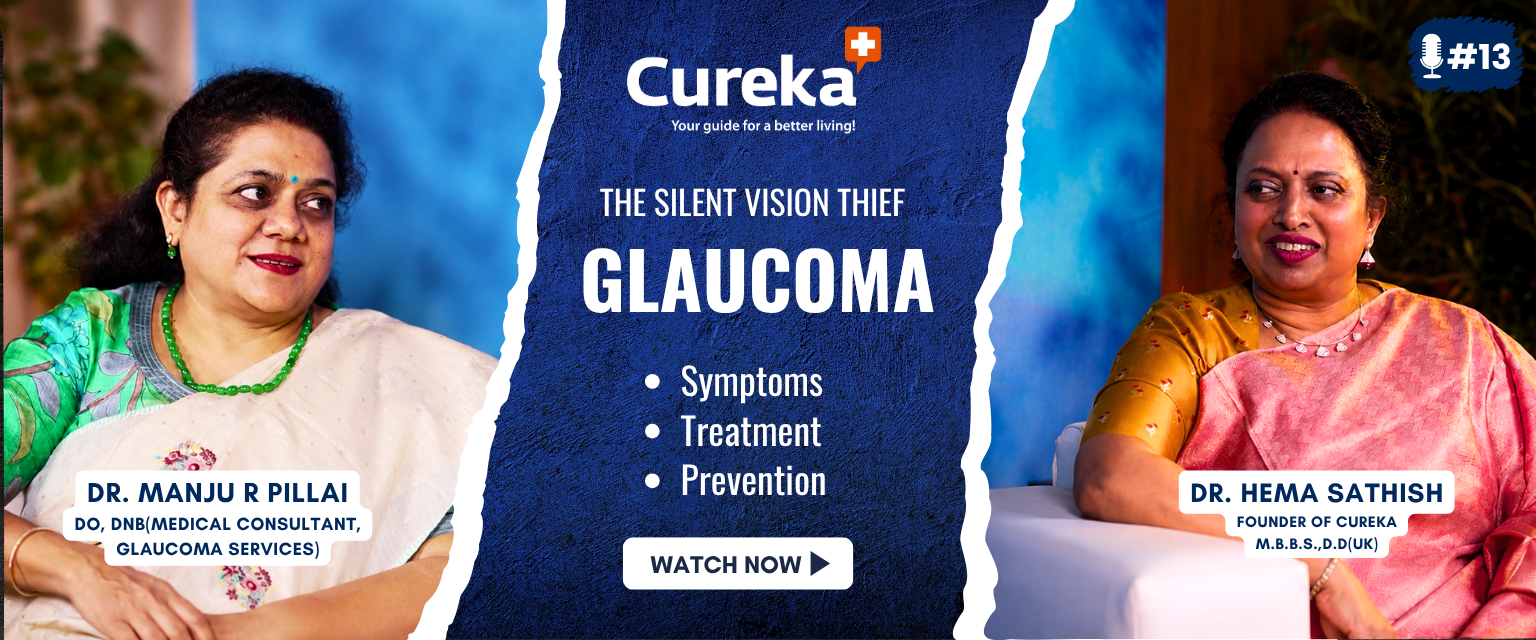
Glaucoma, Vision Loss & Eye Health: What Everyone Should Know | Dr. Manju R.Pillai & Dr.Hema Sathish
Table of Contents
- Understanding Glaucoma: A Closer Look
- Other Risk Factors for Glaucoma
- Glaucoma: Screening vs. Symptoms
- How Is Glaucoma Diagnosed?
- How Often Should Glaucoma Patients Be Monitored?
- Understanding Secondary Glaucoma and Pediatric Cases
- Role of the Brain in Vision Impairment
- Preventing Optic Nerve Damage in Glaucoma
- Role of Stress in Glaucoma
- Risk Factors and Predisposition to Glaucoma
- Risk of Glaucoma in Retinitis Pigmentosa
- Early Symptoms of Optic Nerve Damage
- Available Treatments for Glaucoma
- Role of Stents in Glaucoma Surgery
- Role of Patient Compliance in Glaucoma Management
- Impact of AI on Glaucoma Treatment
- Association Between Headache and Glaucoma
Dr.Hema Sathish: Hello everyone, here we have Dr. Manju Pillai today. She is not only ophthalmologist, she specializes in a subject called glaucoma. She has over 50 plus publications, that is she has published papers more than 50 and she has more than 200 presentations to her credit. So a warm welcome to Dr. Manju Pillai.
Dr. Manju R.Pillai: Hi everyone.
Dr.Hema Sathish: So, you know, when I was thinking, going through your profile, I was just wondering, like, you know, glaucoma has got so much to do. Yeah, I know it’s very risky, though. But then I would like to hear it from you. Like, what exactly is glaucoma?
Understanding Glaucoma: A Closer Look
Dr. Manju R.Pillai: Well, in one sentence, it’s a very complex question. And in one sentence to answer, it’s a little difficult. But glaucoma, to explain in one sentence, it’s like a pressure in the eye. So that variations of the pressures in the eye can cause damage to the inner part of the eye that is optic nerve. And that damage is irreversible. So we need to be careful. Once detected glaucoma, you have to be very careful about it and have lifelong monitoring.
Dr.Hema Sathish: So when you’re talking about it damaging the optic nerve the optic nerve is very very important right and the damage caused to it can be permanent and it’ll never be you can irreversible damage that is why glaucoma gets so much of attention i guess.
Dr. Manju R.Pillai: Exactly and they call it the silent thief of sight so it comes in very silently no one understands unless the patient loses the vision.
Dr.Hema Sathish: For a normal person, like, you know, to understand that they have glaucoma or I mean, what would they come to you with? Like, what are the symptoms they will come with?
Dr. Manju R.Pillai: Most of the glaucoma’s are asymptomatic.
Dr.Hema Sathish: Okay. So that’s all the more dangerous, right?
Dr. Manju R.Pillai: Yes. So people who have a visual problem or above 40 years of age or if they have a family history or if they have a history of diabetes, it’s better to get their eyes checked.
Dr.Hema Sathish: Okay.
Dr. Manju R.Pillai: Yearly.
Dr.Hema Sathish: Okay. What do you think are the other risk factors for glaucoma?
Other Risk Factors for Glaucoma
Dr. Manju R.Pillai: High myopia and complementary risk factors, diabetes also, or any other systemic illness for that matter.
Dr.Hema Sathish: So you think intake of the steroids for a long period of time can induce glaucoma?
Dr. Manju R.Pillai: Yes. Not even long term. Like, you know, people sometimes short term steroids also. That too, sometimes if you take steroids for skin condition or if they are asthmatic and if they take steroids, that can also cause glaucoma and cataract. So whoever is on long term steroids, they also have to get their eyes checked.
Dr.Hema Sathish: So screening is the only way to make sure that you’re not, you know, damaging your eye very badly. That is because glaucoma won’t show up until and unless it’s really bad. So you think they’ll come with pain because you said the intraocular pressure increases. So they will be present with pain or something?
Glaucoma: Screening vs. Symptoms
Dr. Manju R.Pillai: One type of glaucoma, that is the narrow ankle glaucoma, comes to us with pain.
Dr.Hema Sathish: That is acute type.
Dr. Manju R.Pillai: Acute type of glaucoma. So acute types of glaucoma’s require immediate laser and surgery if it’s not under control. But other types of glaucoma’s we can manage medically for some time.
Dr.Hema Sathish: So what do you think are the investigations we can look at when you talk about glaucoma?
How Is Glaucoma Diagnosed?
Dr. Manju R.Pillai: The main investigations is like one is the comprehensive eye examination. Second is, you know, looking at the optic disc. And that is optic nerve to look at the pathology. So there are two investigations which we can usually do. One is the Humphrey field analysis that is checking the peripheral side vision so that we can see how much of the field loss has happened, structural damage. And another one in the latest one is optical coherence tomography that’s OCT.
Dr.Hema Sathish: So you said field of vision. So this is the test where when you walk in, they take the computer and they check your eye, right? That’s the one.
Dr. Manju R.Pillai: I mean, it’s a perimetry. It’s called that. In a bowl, you just keep your eyes and they check the field of vision. But to tell, like, if I am also doing it for the first time or second time, I may not be having a very good field.
Dr.Hema Sathish: Okay.
Dr. Manju R.Pillai: Yeah. So I may not be that cooperative. So two or three times it takes for us to understand how the field is and then take the fields. And if the fields are stable, then we can do it once in two years. And if the field or the disease is progressing, then we have to do it once in six months or once in a year.
Dr.Hema Sathish: So how do you know it’s stable or progressive? Like the ophthalmologist has to decide and this has to be explained to the patient, is it?
Dr. Manju R.Pillai: Yes. The parameters are there. And the parameters, if it changes and if it’s a reproducible field effect. So sometimes if you see that once the field is there and second time it’s there, you can repeat a third time and see whether the same changes has happened. So if there’s a progression in the field, then that shows the diseases.
Dr.Hema Sathish: So for example, if you have to take it like if I have glaucoma, So how often should I check my eye?
How Often Should Glaucoma Patients Be Monitored?
Dr. Manju R.Pillai: Depends. So the thing is, like, if your pressures are stable, if your compliance is good, and if you’re adherent to your medications and treatment or whatever it is, then you can have once in six months. To tell you, it’s not a custom made, like, you know, it’s a custom made. It’s structured to one person. It’s not that, you know, one person’s rule is going to be the good for the other person, and that’s not going to be correct for the third person. So sometimes if it’s unstable, then we have to see them maybe every week also or once in two weeks to see how the pressures are getting under control. Then we have to treat accordingly. So then some patients have got the pressure, which is around 30. And some patients will have a pressure around 12. The average pressures for a normal human being can be from 8 to 24. For some people, the 8 will be good, 12 may be abnormal. For some people, 30 may be good or more than 26 will be normal. So it keeps changing. So if the pressure is around 30 or 35, then we have to start treatment. Then a single medication may not be enough. So we have to change our treatment to two drops or any other procedures.
Dr.Hema Sathish: So the treatment varies according to not only the, I mean, it’s not a standardized pressure either. What we study is like this much pressure is normal for that, but there also, there is a fluctuation and that probably for that individual could be higher. So there are so many things to be looked into. So that’s why I think they call it a silent safe of sight. You were talking about quite a few conditions where the glaucoma comes because of certain conditions. You said diabetes could aggravate it, steroids could cause it. But there is a type when children are also affected, right? Could you explain something about that?
Understanding Secondary Glaucoma and Pediatric Cases
Dr. Manju R.Pillai: Sometimes the newborn children can have glaucoma. So newborn children, you know, sometimes it’s from hereditary, they might have inherited from their family, grandfather may have glaucoma, they would have inherited it. But for the children who are born with glaucoma, I mean, they come early because the cornea is hazy, the eyes are blue in color, it’s big and watering with photophobia. And so they bring the children early and we operate even when the child is 10 days old or whatever. So these children, the important part is to explain to the caregivers that bringing the child back for regular follow-up is very important because then the child can go and have a good education in school.
Dr.Hema Sathish: So glaucoma doesn’t mean that the child will face blindness eventually.
Dr. Manju R.Pillai: No, they can. Sometimes they will be lucky enough that they can have a good vision 6-9 with glasses. Sometimes there will be partial blindness. Some children will have a total blindness. But nowadays the government of India has got good special educators in the government schools so that they can go in for the school education and they can enter colleges also.
Dr.Hema Sathish: So that’s very interesting, right? Because visually challenged children who are put in those special schools, I’ve always felt that it was not up to the mark and they never got the opportunity to learn or read as others did.
Dr. Manju R.Pillai: It should be integrated, ophthalmology with visual education. So they have to have every time a letter from us, you know, getting all the aids and benefits from the government is also very important for them to survive.
Dr.Hema Sathish: But even if they have partial blindness, do you think they’re supposed to use the brain or they can do normal?
Role of the Brain in Vision Impairment
Dr. Manju R.Pillai: Nowadays, there are so many other things other than brain. There are so many visual aids which can help them in reading also. Oh yeah, magnifiers are there. That’s why I say an ophthalmologist approach is also important for the child. Even if they say that they are labeled as blind, they can have good amount of vision or partial vision which can assist them in going to school. And there are some scripts who can support them. The government give benefits. Even the board exams, they get extra hour to write. So many benefits are there.
Dr.Hema Sathish: That’s really good. So from what you explained, it looks like glaucoma is a condition. If you get it, then there has to be some way where you have to be getting treated continuously. So what aspects would you like to look into when a person has got glaucoma so that they don’t go into damage of the optic nerve and which can lead to blindness?
Preventing Optic Nerve Damage in Glaucoma
Dr. Manju R.Pillai: It is not sometimes the treatment continuously. Sometimes in ankle closure glaucomas, the laser may be sufficient. And they have to have periodic review, means once in a year if it’s stable. But if there is an open ankle and if we think that the disease is progressing, Then they have to come once in four months or once in three months or as and when it’s required. I cannot tell that this person has to come later, this person has to come early. So one thing is to educate the patient and the caregivers properly on a good compliance strategy.Treatment and adherence to follow up.So that is very important. So if they can’t come and visit the glaucoma specialist, who is there who has started the treatment, it’s better even if they show the ophthalmologist in their nearby town. So that, you know, the common mistake that we have already seen or the patients make is that once we give the prescription for three months and if they can’t make it at the third month, they stop the medication, discontinue the medication. So that is one common mistake that we have seen. So to avoid that, the continuum of care needs to be there. So even if not coming to us anywhere where there is an eye hospital nearby, they have to have their follow-up.
Dr.Hema Sathish: So it’s something like diabetes where you have to keep yourself under treatment and under watch to make sure it doesn’t become bad.
Dr. Manju R.Pillai: Exactly. It’s a lifelong monitoring.
Dr.Hema Sathish: So what is the role of stress in glaucoma?
Role of Stress in Glaucoma
Dr. Manju R.Pillai: Stress, it’s not a direct related to glaucoma, but stress in a way can induce cortisol levels, increase the levels of all the parameters, and that can cause even diabetes. So diabetes is a complementary risk factor for glaucoma. Actually in AIMS, Delhi, they have got a paper on meditation has decreased the stress and that has given rise to a stable glaucoma. That lab is there in AIMS, Delhi. So that’s a good paper. So and second thing what I need to tell you is yoga. If a yoga instructor or person doing yoga gets glaucoma, they should avoid shirsasana. Second exercise that they should avoid is tight-fitting goggles while swimming. So that also can increase the pressure in the eye.
Dr.Hema Sathish: But the fact remains that by doing Shirsasana, you don’t get glaucoma.
Dr. Manju R.Pillai: No. Only thing is the people who have been diagnosed with glaucoma should avoid Shirsasana and tight goggles.
Dr.Hema Sathish: And stress is not the only factor because youngsters then take it so, you know, too much toward that.
Dr. Manju R.Pillai: Yeah, yeah. Stress is not the only fact.
Dr.Hema Sathish: If you have stress, then you can get glaucoma.
Dr. Manju R.Pillai: No, no, no, that’s not the only fact. And sometimes they say the tight collar syndrome, the collar, if it’s tight also, the pressures can elevate them. The central venous pressure can elevate and can cause glaucoma. So we have to avoid all these physical pressures, obviously.
Dr.Hema Sathish: These physical pressures should be avoided if you’re diagnosed to have glaucoma.
Dr. Manju R.Pillai: Yes. Or you have a glaucoma suspect predisposition.
Dr.Hema Sathish: If you have a predisposition for a glaucoma, then you should. So when we come to predisposition, whom do you think is predisposed to glaucoma more?
Risk Factors and Predisposition to Glaucoma
Dr. Manju R.Pillai: Oh, well, that’s a good question. Actually, if the parents are diagnosed to have glaucoma, if the patient is a diabetic, high myo, And for children who had cataract surgery done during their childhood, all these are at very high risk of having glaucoma. Then there is some other disease called retinitis pigmentosa, where it’s a hereditary stationary night blindness. So those patients can get glaucoma later on.
Dr.Hema Sathish: Okay. So retinitis pigmentosa can cause glaucoma, is it?
Dr. Manju R.Pillai: It cannot cause.
Dr.Hema Sathish: It can be associated.
Dr.Hema Sathish: So what are the chances of having glaucoma in those cases?
Risk of Glaucoma in Retinitis Pigmentosa
Dr. Manju R.Pillai: I mean, it’s not that, you know, every RP patient will get glaucoma, but you know, it’s a chance that we have to hire. Sometimes we have to do a gonioscope, a gonioscope, you know, looking at the narrowing of the ankle. So we may have to do a laser PA. It’s not that they are going to be on medications, but laser peripheral endotomy should be tried for narrow ankles. Not in this patient also. There are other patients who have a family history of narrowing of angles. We have to look at high hypermetrophs, that is high plus glasses. They also can have narrowing of the angles.
Dr.Hema Sathish: But that happens more in adults, right?
Dr. Manju R.Pillai: Yes. So in the… Children can have. And there is a lens inside the eye. So the lens sometimes, you know, shifts its position, like in syndromes, Marfan syndrome and all other, Erlen Dander syndrome and all those diseases. The lens shifts its position. So when this shifts its position also, you get glaucoma.
Dr.Hema Sathish: Okay. That’s quite interesting. There’s so much.
Dr. Manju R.Pillai: Yeah, in this tiny eye.
Dr.Hema Sathish: Yeah, I know. And I think it’s getting so much of limelight because of the optic nerve being damaged eventually.
Dr. Manju R.Pillai: Yes.
Dr.Hema Sathish: Now for optic nerve to be damaged, so does the patient come with some kind of a symptom like it’s bothering me? So what would be the first symptom they should look for?
Early Symptoms of Optic Nerve Damage
Dr. Manju R.Pillai: They never come for symptoms if it’s an open angle glaucoma. Some patients come with pain, redness, they might be having pressure elevated if it’s a narrowing of the ankle. Otherwise, it’s only by screening we have to find out whether the patient has glaucoma. So a proper ophthalmic checkup is very important.
Dr.Hema Sathish: Okay, okay. So after the ophthalmic checkup, if they’re found to be having glaucoma, how often do you think they should come and do their checkups?
Dr. Manju R.Pillai: Yeah, if it’s a stable patient, then we can come in once in four to six months. If it’s unstable, as and when required, they have to come earlier.
Dr.Hema Sathish: Yeah, you did explain earlier that it is different for different patients.
Dr. Manju R.Pillai: Exactly, exactly.
Dr.Hema Sathish: So what are the treatments which are available for glaucoma as of now?
Available Treatments for Glaucoma
Dr. Manju R.Pillai: Actually, the treatment of glaucoma, it’s a kind of puzzle is what they say. So we have to look at the age of the patient, the severity of the disease, the stage of the disease, then associated diseases like cataract. If it’s an elderly patient, they might have a cataract or they might have some other diabetic retinopathy. So we have to look at all these conditions and then start treatment. So treatment wise one and the thing is medication there are so many medications combinations available now so we can use any one of those medications or maybe a combined drop if the pressures are quite high and try to bring the pressure down till we plan for something else and then there are different types of lasers there are almost four to five types of lasers which can be used in treating glaucoma yeah from the early stage of glaucoma to the predisposing stage to the end stage glaucoma. Different types of lasers are available. So we can use those lasers. And then all these treatment measures are to control the intraocular pressure so that further optic disc damage can be reduced or retarded. So that’s the only thing. Whatever damage has happened to the optic nerve is reversible. But in children, if they are very low, small age, you know, like four years or no, we have seen a reversal of the optic disc copy. If you have done the correct treatment. So that won’t happen in the adult. In the adult, we have to make sure that all the treatments have been done in the correct stage so that we can retard the progression. And to tell the good thing is like 90 to 95% of the patients are stable patients. Only that 5 to 10% only we need to really look into.
Dr.Hema Sathish:Oh, that’s a saving grace. So what are the surgical interventions available for glaucoma?
Dr. Manju R.Pillai: Yeah. I mean, older days there was trabeculectomy. So there were modifications of trabeculectomy. And for children, we do trabeculectomy. And trabeculectomy combined with cataract surgeries was the option for past two decades. But right now there are multiple options available.
Dr.Hema Sathish: So, if you come to the latest intervention in surgery, you must have refined so much, right, over the years. Can you talk a little bit about that also?
Dr. Manju R.Pillai: Yeah, you know what everyone in the international scenario and I’ll start with this. It’s like a blockage. Okay. So opening up the channels. So there are so many stents, like how the cardiac stents are, then there’s so many implants available. And so there is aArvindAquis drainage implant is there, Ahmad drainage implant is there and Paul glaucoma implants are there. Then to talk about the stents, there are so many stents available, like Hydra, iStent or whatever it is. We have another one that is the latest that’s called the microinvasive glaucoma surgeries in that we have, you know, we just shave off a little bit of the ankle. So, with multiple ways like kahudu, tiny toes, you know, so many others. So, multiple options are available now. So, all these varies depending on the severity of the glaucoma. And like, as I told you, it’s not like, you know, this patient can have kahudu, this patient can have hydra or whatever it is it depends.
Dr.Hema Sathish: So every treatment is tailor made for each and every person.
Dr. Manju R.Pillai: Exactly.
Dr.Hema Sathish: That’s quite the task, right?
Dr. Manju R.Pillai: Yes.
Dr.Hema Sathish: So many factors have to be kept in mind.
Dr. Manju R.Pillai: Yes. Yes.
Dr.Hema Sathish: The age would matter and there are other…
Dr. Manju R.Pillai: Even the socio-economic status matters. The latest ones are very costly. We cannot prescribe for a patient. So there are multiple options available. There comes some other option. So we have to take into many factors to plan for surgery.
Dr.Hema Sathish: So now when you talk about the stents and all, these are very easy methods to… And probably the person who undergoes the surgery gets back normal, but almost to normalcy, right?
Role of Stents in Glaucoma Surgery
Dr. Manju R.Pillai: The thing is, it’s not normalcy. The use of medications, like sometimes they may have to use three or four medications, we can taper it down to maybe one or even nil. The quality of life of the patient improves. And second thing is using the drops for a very long time can cause conjunctival allergy because of the preservatives that we use and all the other things, drug preservatives. Now, as I said, all the drugs will have its own preservatives. So we can reduce all that by reducing the number of drops. But still depends on the degree of the disease, the stage when we have seen the patient and multiple other factors. Sometimes the diabetes will have glaucoma. So in those patients, if there is a, blood vessel inside the eye that’s growing that is neovascularization then it takes a little more time to treat than a normal open angle glaucoma.
Dr.Hema Sathish: That’s that’s a lot of science…… now we have spoken so much about glaucoma um speak let us know of some preventive aspects so what can we do if we can do something to prevent glaucoma.
Dr. Manju R.Pillai: So there is nothing like we can prevent the glaucoma And that is also like we have to do a lot of one is genetic testing with the parents and glaucoma to see whether we are getting going to get glaucoma. And then the next treatment part is gene therapy. These two are very costly right now. Current scenario, these two are very costly. But the more effective and the simple things are to get your eyes checked. Regularly so the people who are high myopes that means very high negative power lenses minus power lenses or high hypermetropes means people who are wearing many plus lenses yeah so all those people have to get their eyes checked periodically.
Dr.Hema Sathish: High..in a myopia what is high for you?
Dr. Manju R.Pillai: Yeah i mean it’s there is nothing like no maybe minus five minus five plus right more than my more than minus five and high hypermetropia is more than a seven or like that like you know the angles gets narrowed up so those people can have lasers earlier so those patients have to get their eyes checked mainly it’s a high risk case in the family so if your parents have glaucoma then you have to get your eyes checked if you have diabetes or other complementary risk factors so you have to get your eyes checked after 40 years of age every year whenever you want to change your glasses.
Dr.Hema Sathish: That’s important, right? So, but usually change of refraction happens every two years is a norm, right?
Dr. Manju R.Pillai: Yes, yes.
Dr.Hema Sathish: But if you have a risk factor, then you check it every year.
Dr. Manju R.Pillai: Risk factor, you check it every year. But if you don’t have a risk factor, after 40 years of age, change your glasses after consulting an eye doctor. That’s all.
Dr.Hema Sathish: So, when you are doing your refractive error checking it is ideal not to just go to a store and get.
Dr. Manju R.Pillai: Yes. Or the nowadays the online glass prescription. Yeah. So, those things it is better to have your eyes checked and get a proper a thorough examination done of eye intraocular pressure and the optic disc evaluation.
Dr.Hema Sathish: So, everybody does a master health check regularly. And then you should have your eye check also regularly then. Makes sense actually. When you were talking about visual imparity, so when sometimes a partial visual blindness can come and sometimes it’s a total blindness. So in these cases, nowadays this technology has improved so much, right? And so what are the things available in the market that a person can use?
Dr. Manju R.Pillai: Oh, there are a lot of things that’s available in the market. That’s also again custom made. Like we cannot sell, there are some telescopes with the people can use. Then there are some dome magnifiers.
Dr.Hema Sathish: Is that long one or?
Dr. Manju R.Pillai: No, no, no. It’s just fixed into the eye. It’s not a big telescope, but a smaller, shorter version of the bigger one, which can fit into your frame and they can see well.
Dr.Hema Sathish: So you’ll wear it like a glass?
Dr. Manju R.Pillai: Yes, on your spectacles you can add on. And there are some doom magnifiers which you can keep it on the paper and read. And there are handheld magnifiers which you can keep it on the paper. And if the patient is having very severe visual impairment, then there are some CCTV kind of cameras which you can connect to the television and from the newspaper they can read the letters on the television.
Dr.Hema Sathish: Okay. Yeah. That’s quite interesting.
Dr. Manju R.Pillai: There are multiple apps also now. And if they are very severely visually impaired, there are some apps in the phone which can tell if they connect to the Android phone and the child or the person has to just walk and it tells correctly. There are some glasses. It’s a smart vision glasses. Switch on that, connect to the Android phone and tells correctly. It identifies even the notes, the rupees. It’s a five rupee note. It’s a 100 rupee note. Yeah, there is an elevator, it’s taking you to third floor. So there are so many multiple apps which the blind person can use these days.
Dr.Hema Sathish: So being really challenged is not the end of everything.
Dr. Manju R.Pillai: They can live with it.
Dr.Hema Sathish: There is some light at the end of the tunnel.
Dr. Manju R.Pillai: Yes, exactly.
Dr.Hema Sathish: So in case you have a person who doesn’t check themselves regularly and they don’t have any other issues so they are very healthy and they do their regular health checks and they are absolutely fit. So in their case eye check-up is not done also because probably they don’t have any other visual problem also. So in those cases in case if they have glaucoma silent one, what do you think the progression of blindness how many years it would take?
Dr. Manju R.Pillai: This you’re talking is something like a stable glaucoma. So it may take years, maybe 15 or 20 years for them to go blind from that age. But it’s better once you get your eyes checked. And after that, if there is nothing, then you don’t have to worry about it. Like, you know, once in two or three years.
Dr.Hema Sathish: So just an eye check, a simple eye check. That’s all.
Dr. Manju R.Pillai: Yes.
Dr.Hema Sathish: And one more thing I was thinking was how much is compliance required in glaucoma treatment? Because I think without compliance, no treatment is.
Role of Patient Compliance in Glaucoma Management
Dr. Manju R.Pillai: Exactly, exactly. We see all type of patients. And if you explain, take time, explain to them very clearly that you have this disease. I’ve seen the village lady coming in with a drop even after three years of non-compliant follow-up. But she is adherent to treatment.
Dr.Hema Sathish: Okay, she needs to stick on to the
Dr. Manju R.Pillai: She needs to stick on to the eye drops and her vision is stable. So it’s only that we have to be very clear in explaining to them that you have to continue the drops even if you are not coming for follow up. That is the beauty of the, you know, talking to the patients, the counselling to the patients. So if you have to explain to them, take your time, explain to the patient that, you know, who needs treatment, then they will follow it up well.
Dr.Hema Sathish: So there are so many myths about glaucoma, right? So few of them is like one you already said, but we’ll ask you again. That only adults get glaucoma.
Dr. Manju R.Pillai: Anyone can have. So it’s like I told you, you know, like people who are wearing glasses and all. Just check it your eyes checked once.
Dr.Hema Sathish: So AI is everywhere, right? So what role does AI play in glaucoma?
Impact of AI on Glaucoma Treatment
Dr. Manju R.Pillai: That is like a dual blade. It can be helpful, but it can be damaging also. Okay. If a person who has read everything about glaucoma in AI and comes and ask a question that may not be there as a treatment option for them. Right. And, but sometimes it’s very helpful. Like if you need to do home monitoring, if they can do field testing at home, all those things AI can do for us. So half of the things it’s helpful, but half of the things it may not be helpful, but still if some information is passed, it’s good.
Dr.Hema Sathish: Okay. So AI end of the day is only a machine, right?
Dr. Manju R.Pillai: Exactly.
Dr.Hema Sathish: So it can’t replace a human. So you have to understand the limitations of the AI and can exploit the AI to your benefit. That’s a very good answer, Dr. Manju. So there are so many myths about glaucoma, right? So let’s bust a few of them. If they have a very clear vision, that means that they don’t have glaucoma.
Dr. Manju R.Pillai: That’s not also a myth. They can lose their sight vision. So we have to have, as I told you, a good eye checkup is very important.
Dr.Hema Sathish: And if they don’t have any pain, that means there’s no glaucoma.
Dr. Manju R.Pillai: That’s also a myth. They can have a silent glaucoma.
Dr.Hema Sathish: If there is a vision loss which has occurred because of glaucoma, that can be corrected.
Dr. Manju R.Pillai: Sometimes the vision loss is irreversible. So we have to really look at the stage of the disease and then find out which stage.
Dr.Hema Sathish: But anyway, they are at danger of losing vision.
Dr. Manju R.Pillai: Yeah. So, I mean, a proper screening and proper follow up is very important.
Dr.Hema Sathish: Eye pressure is the only cause of glaucoma is it
Dr. Manju R.Pillai: No sometimes the normal pressures can also cause glaucoma there are so many other things structures in the tiny eye so if the corneal curvature is changed if any other previous surgeries have been done to the eye like any corneal transplant you know they say the eye transplant and then if there is any cataract done in small children. Then if there is any retinal detachment surgery done in the children, all these are risk factors for glaucoma, retinal detachment surgery in other children. Long list. And most commonly nowadays that we see is diabetic retinopathy. So for the diabetes, diabetic retinopathy, they get the injections done. So when there is an injection, every injection to the eye, the risk for the glaucoma increases because we are injecting a medicine into the eye, which is going to increase the pressure inside the eye.
Dr.Hema Sathish: So if nobody in the family has got glaucoma, then the person is safe, is it?
Dr. Manju R.Pillai: Sometimes it’s sporadic. Most of the time it’s a genetic transmission, as I’ve told you, where this high risk is the family screening. But sometimes it can be sporadic also.
Dr.Hema Sathish: Do you have a percentage to put on that so we can be relaxed?
Dr. Manju R.Pillai: Not a correct percentage.
Dr.Hema Sathish: Okay. Glaucoma means you’re going to be blind completely, is it true?
Dr. Manju R.Pillai: It’s not so. If we are going to stabilize the disease, then we can have a good quality efficient life-long.
Dr.Hema Sathish: If you’re using spectacles regularly, so that you prevent glaucoma, is it?
Dr. Manju R.Pillai: Oh, no, no. That’s the two different entities, actually. That is a refractive error that’s in the front of the eye. Glaucoma is something that we are managing inside the eye.
Dr.Hema Sathish: The eye is so small, so they all believe that it’s all the same.
Dr. Manju R.Pillai: Exactly.
Dr.Hema Sathish: So many people believe that now they’ve got treated, they’ve undergone a surgery or whatever, the higher end or the regular surgeries. So it’s gone forever. Is it true?
Dr. Manju R.Pillai: Oh, that’s also not there. Sometimes it stabilizes or even decrease the medications, number of medications that needs to be used for glaucoma. But that doesn’t mean that the disease is treated forever. We have to make sure that there is a follow up and lifelong monitoring.
Dr.Hema Sathish: Elderly diabetic, should they worry about glaucoma?
Dr. Manju R.Pillai: That’s what like sometimes it’s now if there is no other risk factors like diabetic retinopathy if they are in a part of the eye retina is not affected due to bleeding or anything if there is no treatment done then the risk factor is less if there is any other treatment done for the retinopathy then the risk factor is more.
Dr.Hema Sathish: So if you have a lot of screen time so you think that can cause glaucoma?
Dr. Manju R.Pillai: Oh no, glaucoma doesn’t come with the screen time, but as an ophthalmologist, I would like to say 20-20-20 rule. Means 20 minutes if you are looking at the screen, computer or phone or whatever it is, then for 20 seconds you have to break your vision and then look at the object 20 meters away, so just blink your eyes turn round and then come back to the screen and i also suggest not to watch movies and all on the phone it’s better to watch it on a bigger screen and i tell the children phone is to talk.
Dr.Hema Sathish: But that’s not the case today.
Dr. Manju R.Pillai: Exactly.
Dr.Hema Sathish: Everybody wants to use a phone more. Can headaches be associated with glaucoma? And if so, how do you find out?
Association Between Headache and Glaucoma
Dr. Manju R.Pillai: Sometimes there are two entities that can be associated with headaches, two entities of glaucoma. One is a normal tension glaucoma. The patient will have a typical migraine and mostly seen in ladies. So we have to look at the pressures and look at the optic disc damage. So those patients can have glaucoma. Second is when they are getting treatment for headaches like migraine, the anti-migraine treatment can cause narrowing of the ankles. Yeah, so topiramate, we have seen many ankles getting narrowed. Yes, drug-induced glaucoma due to the treatment for the headache. So that is one another entity that we have to look into because if there is a narrowing of the ankle, then we have to always ask for the history of medications for migraine.
Dr.Hema Sathish: But they’ll present again with eye pain.
Dr. Manju R.Pillai: Yes. And then the third type of glaucoma is the acute angle closure glaucoma where the patient gets a headache. So there the ankles keeps narrowing. So if the ankles are narrowing, we have to look at the predisposing factors. If there is a treatment like this, if we discontinue the medications, the ankles can become normal. Otherwise, we have to do a peripheral iridoptomy as a prophylactic.
Dr.Hema Sathish: But when you spoke about this, I was just thinking, how would a common man understand that this is probably my eye and not my head or my stress, which is causing a headache? So do you have visual problems?
Dr. Manju R.Pillai: Yeah, sometimes if the angles are narrowing, if the headache is going to increase, they get the halos. I think you would have studied in the textbooks, the hallows, the Fink-Cham test and all the hallows. The halos is one specific indication that the pressures are going high.
Dr.Hema Sathish: Okay. So the halos have to be watched and not thought that it’s some…
Dr. Manju R.Pillai: Yes.
Dr.Hema Sathish: Well, what is the biggest misconception about glaucoma amongst common people?
Dr. Manju R.Pillai: The biggest misconception is like, you know, we give medications and they use it for some time. So it’s something like headache or, you know, having a rash and you treat for that. And they use medicines for some time and they think it’s all right. And they discontinue the medication and they don’t go for a check-up. That is the most dangerous. Because they would have been stable earlier. And the disease would have progressed by the time they come after two years. So you have to have, if someone says that you are a suspect, or if someone says that you have definite glaucoma, then periodic monitoring and for office waiting.
Dr.Hema Sathish: So the misconception is that once you take treatment, you’re absolutely fine. That’s not true.
Dr. Manju R.Pillai: You have to… Just like how diabetes and hypertension are. Like people take the medicines, my sugar is under control. Till they go for one surgery or something to find out that the sugars are quite high. So the same holds good for the whole.
Dr.Hema Sathish: That’s a very simple way of putting it forward. Well, as an ophthalmologist, I want you to give some piece of advice for everybody who is watching this video.
Dr. Manju R.Pillai: Um, and you don’t have to be scared that because I had been talking all this time that your site is going to be stored and all those things. You don’t have to be scared about the problem. Only thing is have periodic eye checkup. And have a comprehensive white checkup and come in after 40 years of age, make it a practice to check your answer be two years.
Dr.Hema Sathish: Thanks a lot, Dr. Manju Pillai. It was wonderful having you. And I’m sure our audience also had a very good insight on a very small topic called glaucoma. But your studies have been so extensive. So your, you know, answers were so precise. And it’s going to be very helpful for many. Thank you.
Dr. Manju R.Pillai: Thank you so much, Hema, for the invite. Thank you.


