
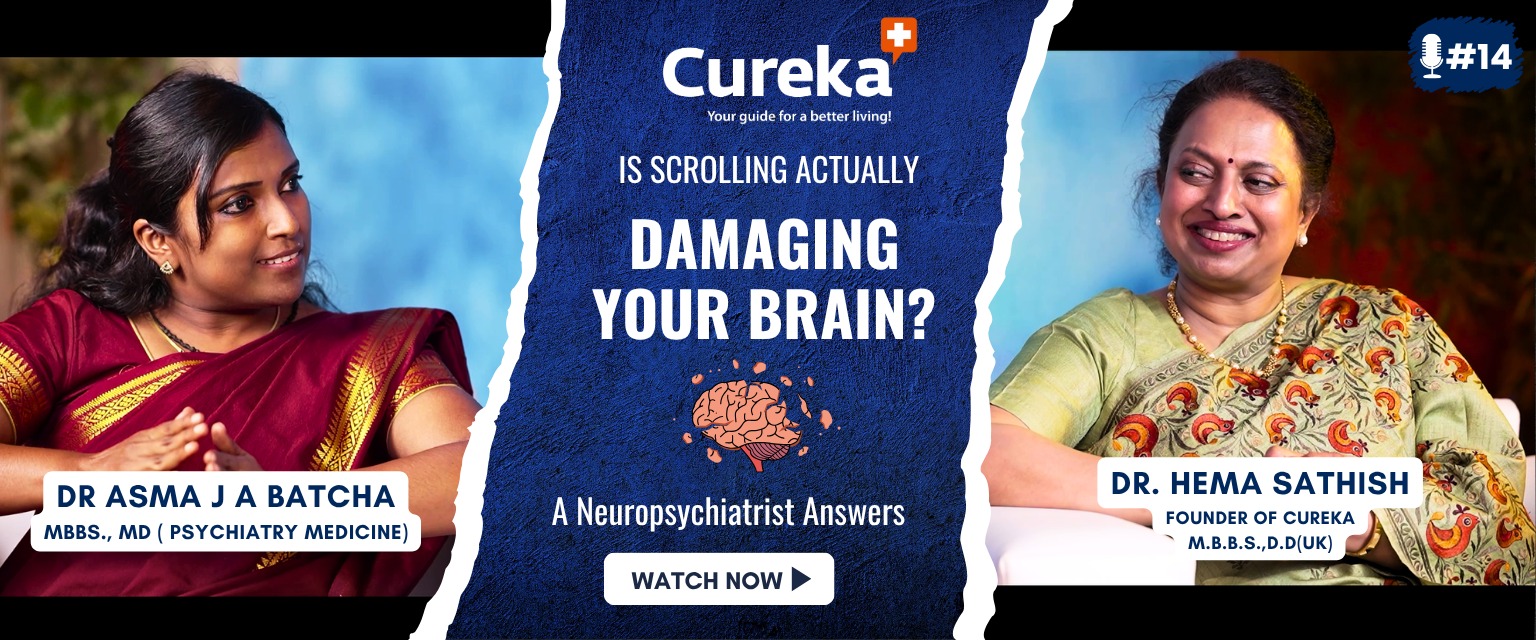
How Reels & Screen Time Are Damaging Your Brain | Dr. Asma x Cureka Podcast
Table of Contents:
- Most Common Types of Addiction Seen in Practice
- When Does Phone Use Become an Addiction?
- When Should You Seek Professional Help?
- Managing Screen Time During the Formative Years
- The Psychology Behind Instagram Anxiety
- The Psychological Impact of Viral Reels
- From Anxiety to Emotional Numbness: Understanding the Spectrum
- ADHD: Awareness vs. Misconception
- The Link Between Addiction and Depression
- Insomnia and Mental Health: Which Comes First?
- Insomnia and Anxiety: Which Comes First?
- Healthy Digital Habits for the Always-Online Professional
- How to Practice a Digital Detox
- The Rising Risk of Digital Gaming and Gambling
- The Truth Behind the Myths
Dr. Hema Sathish: Hello, everyone. Today we have Dr Asma J A Batchawith us. She’s not only a psychiatrist, she’s a neuropsychiatrist. So welcome, Dr. Asma. And I also wanted to specify that she’s doing her PhD in criminology. So, Dr. Asma, I would like to know what addiction really means. Usually it’s a very loosely used term, right? We talk about addiction very casually, but as a neuropsychiatrist.
Dr Asma J A Batcha: Addiction is used almost in all domains of our day-to-day lives. If you look into the definition of addiction, it is neurologically and psychologically a chronic disease of the brain where the person starts to wire, he wire himself to a particular behavior. It could be for a behavior, it could be for a substance, or it could be to food, or it could be over the internet. So this behavior makes this person to involve into that particular act, be it a substance or be it watching any film or pornography or internet or gambling. It could be anything wherein the person spends a lot of time on it because of which there’s occupational and functional impairment to the individual.
Dr. Hema Sathish: Well, would you say obsession and addiction are the same or there is a very fine line between that?
Dr Asma J A Batcha: There is actually a thin line of difference between both because addiction is a compulsive behavior. Wherein he starts finding a pleasure on one particular activity because of that this person wants to repeat this activity over and over. Where he starts to develop pleasure. So this pleasure and reward seeking happens within the brain, which tunes him to that particular behaviour again and again. So it’s more rather a compulsive behaviour than an obsessive behaviour.
Dr. Hema Sathish: Well, when you talk about addictions, there are different types, right? So as patients, when they come and visit you, by and large, what do you see more addiction of? Is it substance abuse more or it’s now, of course, internet is also an addiction, phone is addiction. But it truly exists, right? It’s not a very loosely used term because it is a very serious problem coming up. But how patients do come with addiction to the phone? They do?
Most Common Types of Addiction Seen in Practice
Dr Asma J A Batcha: Well, in the past, if you look into this addiction, many of them have had substance dependence, predominantly alcohol. Before that, it’s smoking dependence, nicotine dependence. Then it was alcohol dependence. Then comes cannabis. But of late, in the teens, the adolescents, the middle age, the old age, with everybody, smartphone addiction is on the rise.
Dr. Hema Sathish: Okay. But they come for treatment is it?
Dr Asma J A Batcha: Most often they are not being they don’t own up by themselves and come for the treatment they are brought by the family members or they are brought by their partners they are brought by the parents, because uh the time they spend with the family is drastically reduced and the time they spend on the mobile phones is more so they are often brought by the family members.
Dr. Hema Sathish: When do you draw the line that this is addiction and they need treatment? Because most of the kids are stuck to their phone and I think adults also many a times are stuck to their phone. So you can’t say they’re addicted as such, right?
When Does Phone Use Become an Addiction?
Dr Asma J A Batcha: Yes. So in this era of information and technology and this digital data collection, we have this feature where most of the software, most of the people of the IT company have to sit in front of their computer right through the day. So what they do in the work hours does not come into addiction. But what they do beyond the work hours, where they spend a lot of time because they don’t get to go out and spend time to relieve their stress out of the computer. So they are literally they are locked with the computer. So for their work, And apart from that, they cannot move about. So they use the internet itself as a form of a stress buster. So they go into other apps where it could be a range of apps from a shopping app to a video games app. To any kind of social media interaction, be it Instagram or Twitter or Facebook, where they have a lot of inputs from several different sources because of which they get addicted to it. And as they spend more and more time on it, the family members and the partners, their relatives or their friends, they notice the change in the behaviour. As I already said, social and occupational impairment. And this not only affects the productivity of the individual, it also affects the interpersonal relationship and thereby it causes a lot of harm to the individual psychologically, leading on to some psychiatric disorders.
Dr. Hema Sathish: So I would like to know, can you clearly describe when should a person take their partner or their child or their relative to the doctor and say no this is addiction this is not absolutely not because say usually you keep hearing your partner saying that you’re irritating me you’re stuck to your phone you love your phone more than anything else very common statements but that doesn’t mean that you know anybody would drag their spouse or their child or their relative to a doctor and say no they need treatment so which is that ringing sign they should look for?
When Should You Seek Professional Help?
Dr Asma J A Batcha: Most alarming sign is often not noticed by the patient, by the person.
Dr. Hema Sathish: Yeah, they cannot, they cannot, for them it’s normal, right?
Dr Asma J A Batcha: They would not know that they are into it. But according to researchers, we have a definitive criteria for it. We have a definitive criteria where the person tends to use the internet approximately seven to eight hours a day.
Dr. Hema Sathish: Oh, that’s a lot.
Dr Asma J A Batcha: Yes, yes, it’s a huge lot. Apart from their work schedule. If he’s spending more and more time on it, specifically, they put it as seven to eight hours per day and psychological changes within the individual as in terms of irritability, being of a low mood all the time, showing anger outbursts, inattentiveness, lack of concentration, then avoiding interacting with public, friends, with relatives, remaining withdrawn and being gelled to the phone all the time. So these are a few of the markers because of which the family members bring them.
Dr. Hema Sathish: That’s very clear, but then obviously you got to watch it.
Dr Asma J A Batcha: Yes ma’am. As far as kids are concerned, the absenteeism from school is being more rampant these days where this you wouldn’t find in the upper class because there the parents take the child to the school, they drop the child in the school in front of their eyes. The child goes to school and gets back. If you take the middle class and the lower middle class where the children go by buses or by private vans, many of the children are noticed to be absenting themselves without the knowledge of the parents.
Dr. Hema Sathish: But they just slip away…..
Dr Asma J A Batcha: They just slip away from there they just dodge from there from going to school they dodge elsewhere and then complaints received most often in middle class families where both the parents are working so parents do not have much time on the kids so this is also one of the factors why the kids slip into internet addiction because parents think the time they spend with the kids could be replaced with materials by buying things, by giving them clothing or taking them out for a movie or going out for a dinner. So this cannot replace the quality time we spend with the children. So this is lacking in certain families. So the parents do not come to know that their child is having such kind of an issue. They wouldn’t know that the child is having this kind of an issue unless it’s brought by the teachers or the school during the parents teachers meet. So that’s when the parents are literally alarmed when they’re hearing for the first time that the child has been absent for several days in school. So these children have spots. They have hotspots for their games, for their video games. So they know clearly much more than what we do. They know about these online game centers. So they go there and they spend hours playing there.
Dr. Hema Sathish: So materialistic things are not the only thing the child needs. Quality time cannot be replaced. That’s such a valid point, right?
Dr Asma J A Batcha: Yes, ma’am.
Dr. Hema Sathish: So you’re talking about these phone addictions. There’s one more thing, right? The parents cannot control the screen time. So how will the parent know that this is excessive screen time? You said 7-8 hours but for a child probably it’s not 7-8 hours and probably in them the these are the formative ages right so in that age itself they’re going to spend so much of this so what would be a timeline for a formative age child screen time would be I want to know.
Managing Screen Time During the Formative Years
Dr Asma J A Batcha: No, this is a gross identification that seven to eight hours of screen time is going to cause neuronal damages. This applies for adults as well as children. But children most often are not being noticed by the parents because parents themselves are not available at home most of the times because they’re working. So soon after the parents get back home, these children tend to take away parents’ phones and they start using it. And many a times these parents, when they find out that this is being done, how they identify that this is being done is they find unwanted apps being installed on their phones, which the parents are not aware of. And children lie a lot.
Dr. Hema Sathish: Okay and i think parents are the last person to find out.
Dr Asma J A Batcha: Yes yes so children are more fantasy thinkers than adults so children fantasize a lot they lie a lot they’re so deceitful so yeah so the best thing a parent could do is not just immediately grab the phone from the child, because this is going to cause a retaliated response. The child wouldn’t show up that it’s going to take the phone from home, but the child will start seeking these mobiles elsewhere from the schools where they discuss among themselves and they slightly bring the phone to classrooms, etc. So first and foremost, the parents should address this issue before pulling the phone away from the child. They should sit and talk with the child first. They should ask what the child’s interests are rather not confront the child directly about this phone behaviour. Instead spend more time as i already said quality time with the child and then parents can also install uh safety apps there are there are certain safety apps
Dr. Hema Sathish: Locks that they unlock very easily.
Dr Asma J A Batcha: No besides that there are so many new advances where these parents can go in for that And parents have to monitor the children as to what sites they are looking into by going into the browser history. So parents should have an eye on it. And gradually, they can step down the child by engaging the child in other play activities rather than sitting confined with the mobile, take the child out for a playtime activity.
Dr. Hema Sathish: Yeah, playtime is not there at all in many kids.
Dr Asma J A Batcha: Yes, we should encourage that more.
Dr. Hema Sathish: And not only that, I think even watching television also, the parents can sit and watch it together. They can watch it together.
Dr Asma J A Batcha: They can spend quality time together. They can go out together. They can talk stories. But these days you don’t find parents talking good, spending quality time among each other as well. So spending time with a kid besides all these things is definitely a tough task. But it’s not that it cannot be done.
Dr. Hema Sathish: For me, when my children were growing up, they could use my phone and we had everything common. So I knew whatever they were using, whatever they could view. And there’s one thing we always followed was bedtime stories. So we would read books before they fall asleep.
Dr Asma J A Batcha: That actually helps a lot. Bedtime stories do help a lot. So this children, one thing is here, before we advise the children, we should know that children don’t take up advices.
Dr. Hema Sathish: True, true, very true.
Dr Asma J A Batcha: Instead, they mirror what we do. So if a child is doing this, if a child is spending secretive time on the phone, it’s not because the child has learned it somewhere, but the child has learned it somewhere from within the family. So children mirror the behaviours of the parents rather than follow the advice of what’s being said. So the change should come from within us.
Dr. Hema Sathish: So that’s very true. You can’t ask a child not to do it or advise them. You have to be a role model. Once you’re a parent it’s given you can’t escape from that.
Dr Asma J A Batcha: One more thing is they are exposed to avatars in the video games so there is an avatar of every individual which shows a better version of the child or adolescent or anybody who’s indulged in the game so naturally they start believing that that virtual self is their real self
Dr. Hema Sathish: Okay.
Dr Asma J A Batcha: So this comparison with the virtual self But
Dr. Hema Sathish: Does everybody do it or?
Dr Asma J A Batcha: No, this is prevalent in almost all the online games because you don’t want to show up your identity and especially children who are grown as a shy boys or girls, they find it more pleasurable going on online because their identity is hidden. So from a hidden identity, they can create an avatar and they can keep winning games and they can go forward.
Dr. Hema Sathish: But don’t you think that child is psychologically affected and that child needs help?
Dr Asma J A Batcha: Definitely.
Dr. Hema Sathish: Because that’s not normal, right?
Dr Asma J A Batcha: So this is more, these children are more vulnerable to childhood depression. So this will not be identified by the family members at the start. But as the behaviours keep changing, as the academical performance goes down, slowly the parents start to identify, but they wouldn’t know the actual reason behind this. So they would think that it’s because of phone addiction or video game addiction. But this thing is rather much deeper where the child has started to compare itself with the virtual world. Self rather than the reality so that’s so sad yes ma so this is prevalent this is much common these days.
Dr. Hema Sathish: So the term instagram anxiety or you know the same exists right so what would you describe that as?
The Psychology Behind Instagram Anxiety
Dr Asma J A Batcha: This anxiety basically develops from a background of a low self-esteem because we are in constant need for validation right through our lives.
Dr. Hema Sathish: Okay, it’s normal, right? –
Dr Asma J A Batcha: We need people to validate. Yeah, if I’m dressing well, appropriately, if I’m dressing good. – It’s just human nature, right? – If someone tells me, “You’re looking nice, you’re looking good today.” So this boosts up our dope needs. This boosts up our pleasure zones, the reward areas being stimulated. So likewise, when they go into Instagram, they follow a lot of celebrities. They follow a lot of people around on Instagram. So without their knowledge, subconsciously, they start to mimic the behaviours. They have a secret longing to mimic those celebrities. So they start comparing themselves with the celebrities or with the personalities they see there. So when they post a picture, when they get likes, when the number of likes and the number of comments increase, naturally they get they feel happy. So they endorphins are stimulated. So thereby this small, small surge of dopamine gives them a short pleasure. But this pleasure is not long lasting because they have to get back to their reality once again. So that’s why they start avoiding the reality. They start seeing the Instagram more and more. So the more they start posting, the more they expect likes, but the likes are less, they get depressed. So this goes in like a vicious loop.
Dr. Hema Sathish: So who can help them? The parent? As a parent, what can we do for them?
Dr Asma J A Batcha: Point at to begin with when it’s uh very mild when the when the when the uh psychological disturbance is at a very mild level where the child starts to show irritability rather than a child or the adolescent or anybody when they start to show irritability first we have to address the issue like we we shouldn’t just blame them because we should stop stigmatizing them first of all we should stop stigmatizing we should stop hating them for what they are because when they are irritated, when they are angry, it just means that they are seeking some help within themselves of which even they are not aware. So first and foremost, we should sit, talk with them, ask them what their issue is or if they’re not ready to come out because many times even they wouldn’t know.
Dr. Hema Sathish: They wouldn’t even know it.
Dr Asma J A Batcha: They wouldn’t know that this is the reason behind it.
Dr. Hema Sathish: And in today’s world, it’s so difficult, right? Everybody wants to grab attention and everybody wants to push the other person down. So having a true friend is also very difficult for these kids.
Dr Asma J A Batcha: That is why the problem with kids when they discuss is they prefer not to discuss it with their parents. They prefer to discuss it with some online strangers where people start to exploit them. So they wouldn’t know.
Dr. Hema Sathish: They are talking sweetly just to exploit them.
Dr Asma J A Batcha: Yes, they wouldn’t know that. And they get cyber bullied. Cyber victimization is common because of this. So first of all, this can be identified by talking to them, asking them what the issue is when they still do not know. They can always seek out for a psychiatric support.
Dr. Hema Sathish: When we talk about viral reels, it’s so common, right? And having a viral reel is good for the person who’s posting it. But how does it affect a person otherwise? Because everybody seeks to look at the reel and everybody likes to have viral reels and everybody’s watching it. So in what way does a viral reel affect a person? I mean, it’s not just adolescents or a child or even adults are affected by it, right? So what is your take on that?
The Psychological Impact of Viral Reels
Dr Asma J A Batcha: If you look into this, if you ask me about this, if you take a film, for instance, Hero is valued second. Antihero is valued first.
Dr. Hema Sathish: Without an antihero, there’s no hero.
Dr Asma J A Batcha: Yes, yes. The way he fights, the way he plots the scene, the way he commits a crime, the way he plots the murder, and the way they picturize an antihero. So bad always spreads faster than good.
Dr. Hema Sathish: Okay.
Dr Asma J A Batcha: So when you see some thrill-seeking, some thrill-related incident on the media, something very sensitive, these super sensitive news, suppose there’s a news of a suicide, seeing that there’s an avalanche of suicide subsequently. So such kind of negative, if you would have seen at least a decade ago, there was this Blue Whale game.
Dr. Hema Sathish: Yeah, true.
Dr Asma J A Batcha: So this was attracting people very much, much more than the good things. So bad things always reach faster. That’s because they get immediate attention. So once again, this immediate attention a person gets is boosting his dopamine much more because good things always take a long time. So as they start posting, that’s why we see a lot of these ghost story, real makers on Insta. It’s not that they’re actually interested in ghosts, although they know that such things do not exist. They just do it because anything thrilling is fascinating for people just for the wants of likes and comments for want of more followers. They start doing these kind of things. So dangerous things spread much faster.
Dr. Hema Sathish: So one extreme end is this anxiety and there’s one another extreme end of the spectrum where they are very emotionally numb. I mean, how do you explain that?
From Anxiety to Emotional Numbness: Understanding the Spectrum
Dr Asma J A Batcha: Ma’am, this numbness is because the dopamine receptors are already kept at a supernormal high state. Because the dopamine, every now and then, this dopamine is increased by small, small pleasures they get on this Instagram and this continuous online exposure. So the sensitivity of the receptors is too high. So at a very normal sub-threshold level, these dopamine, at a very normal level, the dopamine are not stimulated. So the receptors are not stimulated because it needs a higher level of stimulation. So at a baseline level, they constantly have this feeling of loneliness, a feeling of emptiness and a feeling of numbness because they have this emotional non-reactivity to any kind of a situation. Suppose there’s a happy event happening in the family or a sad event happening in the family, although they’re physically present around that place, they’re not able to feel it. They lack this ability to feel it from within. They always feel a blanked out state.
Dr. Hema Sathish: Okay. That’s quite a challenge.
Dr Asma J A Batcha: Yes.
Dr. Hema Sathish: And when we see one more spectrum is where they have no focus at all. They can’t concentrate on anything. And they very proudly say, “I’m ADHD.” That’s not something which you can take pride in, number one. And second thing is that’s not good also, right? So how do you explain that?
ADHD: Awareness vs. Misconception
Dr Asma J A Batcha: This attention deficit mainly happens because we are used to these 15 short reels. Short reels are more fascinating. They’re more fascinating for everybody. Short reels are so interesting to people because it ends off quickly. You get a lot of inputs, a lot of information within that short period. So your brain is wired to think, to focus, to pay attention only for 15 to 30 seconds.
Dr. Hema Sathish: That’s bad.
Dr Asma J A Batcha: That is how the neuronal plasticity occurs. There’s a synaptic change that occurs within the brain. So this plasticity makes our focus sustain on only for about 15 to 30 seconds. So beyond this, if you try to put in your focus, there is fracturable focus, which is called this popcorn brain. There’s a term for it called this popcorn brain. So your focus is fragmented. You’re not able to concentrate beyond that. So beyond that, you cannot focus on that. Rather than that, it gets boring. So they stop looking into it. They abruptly stop looking into anything beyond 15 or 30 seconds. And then they move off to something else, more often than another one. If you see people, they scroll reels one after another, one after another. It’s because they need that constant stimulation.
Dr. Hema Sathish: So the brain is stimulated all the time.
Dr Asma J A Batcha: Yes, so the focus is for a short span. The attention is for a short span. Because of this, there are neuroplastic changes at a chronic level. If a person is getting himself exposed to a lot of screen time, if the screen time is increasing day by day…
Dr. Hema Sathish: So doing all this is damaging your brain slowly or your brain cells are just killing you?
Dr Asma J A Batcha: Without doubt. But the fortunate thing about this is it’s reversible.
Dr. Hema Sathish: Okay yeah that’s also a very good thing so guys listen to this so this is reversible so stop scrolling and start uh you know building your concentration and focus some more well and there’s one more uh section of people where you see that you know they are constantly on the phone and they see a lot of things and all but they constantly feel lonely also So how does that explain? Because as you said, the dopamine receptors are stimulated and then the good feel should come in. So then why is this loneliness there? So it’s quite controversial, right?
Dr Asma J A Batcha: Because getting back to reality always hurts. They are not in their world. They are out of touch with the reality altogether. Usually in psychiatry, we say out of touch with reality could be present only in psychosis. A neurotic patient can never fall out of reality. But sadly, ever since the advent of these mobile phones, smartphones, people knowingly or unknowingly spend more time on it. So thereby, their imaginations are all boosted up. They can become whatever they want to. A shy, timid person, an introvert person can chat with anybody he wants to. So this is a platform where he gets validated, where he’s not been validated in his real life. So they start to believe that virtual life is a real life. So when they get back to reality, they lack this emotional response. They do not want to indulge with people. They do not want to talk with people. They remain withdrawn from people. So these are a few of the markers by which we can make out that a person is slowly slipping into addiction.
Dr. Hema Sathish: Well, would you grade addiction and depression to be on the same board or addiction leading to depression?
The Link Between Addiction and Depression
Dr Asma J A Batcha: These are two different entities, ma’am. For instance, if you take sleep, many of my patients have said that they experience sleep disturbances because of which they start scrolling the phone. This is a chronically depressed patient. A depressed patient doesn’t fall asleep that quickly. So constant depression or an anxiety where they have initial insomnia. So he starts scrolling on the phone. Eventually, this crawling makes him to slip off into addiction. So just to watch the reels, he remains awake. So from the point where he started watching reels to because he was not getting sleep, he’ll stay awake to watch the reels.
Dr. Hema Sathish: So insomnia is the next thing i was planning to you just led me into it now so insomnia is another one thing so the chicken or the egg which one is first?
Insomnia and Mental Health: Which Comes First?
Dr Asma J A Batcha: Anxiety or addiction they go together yeah no not only that propensity to develop into addiction is not uh is not that much in a person with depression because a person with depression experiences something called this and he don’t know Hedonia is pleasure. So anhedonia is he avoids everything that produces a pleasure to him. So most often people with depression present with anhedonia, so their chances for them going into an addiction is quite unlikely.
Dr. Hema Sathish: Okay.
Dr Asma J A Batcha: Quite unlikely. But doesn’t mean that it cannot happen. It can happen. But a person with addiction is vulnerable to develop slip into depression easily. Depression and anxiety.
Dr. Hema Sathish: No, one was that and the next one which I wanted to know was insomnia leading to scrawling or scrawling leading to insomnia. This is where the chicken or the egg is.
Insomnia and Anxiety: Which Comes First?
Dr Asma J A Batcha: If you take anxiety, usually people would have initial insomnia. It takes a long time for them to fall asleep. Soon after they go to bed, they would not slip into sleep immediately. Whereas a depressed patient will fall off to bed, he’ll go to sleep easily, but he wakes up much earlier than the usual time of waking up. So if you look into depression, it presents with late insomnia, whereas in anxiety, there is initial insomnia. Because of the clouding of multiple thoughts that keep coming around the patient. Like, did I do this? Did I do that? He’ll rewind the whole incident of the day. Did I speak wrong with that guy? Did I react properly with this person? Did I apologize when I came out? Did I say excuse me when I went in? So all these thoughts, he knows these thoughts are meaningless, but still he keeps getting these thoughts. So these are more common with anxiety. So in anxiety, they have a difficulty in falling asleep. Whereas in depression, they wake up much earlier. And that is why the early morning suicides are much common in depressive patients than in anxiety patients. So insomnia is present in both anxiety and depression.
Dr. Hema Sathish: Well, what would you advise people who are always with their phones and working a lot online? So they are online because they need to be online because the job calls for it. But a person like that, what advice would you give? Like how they should take care of their mental health? Because those things also leads to a lot of screen time, a lot of moderation in their brain cells and it leads to insomnia also, right?
Dr Asma J A Batcha: Yes.
Dr. Hema Sathish: So what can they do?
Healthy Digital Habits for the Always-Online Professional
Dr Asma J A Batcha: Oh, we have a body, our brain is tuned in such a way that performance increases with a little bit of anxiety.
Dr. Hema Sathish: Okay.
Dr Asma J A Batcha: We need anxiety, a minimal amount of anxiety to have a good performance. But beyond the point where this anxiety picks up, where the threshold is reached and beyond that, if a person is, you know, exhausting himself to give a bigger performance. But you see in so many IT companies, they have this target achievement and all that. So they’ll have periodic reviews. So when they pressure themselves too much, this anxiety goes out of hand. So that puts them into a lot of stress. There is a cutoff limit for every person. There’s a threshold for every person, which that person themselves should identify when he feels mentally, physically exhausted or fatigued. That is the time. It’s an alarming sign where your body is giving a signal from within that it’s time you go for a check. A reality check. You’ve spent a lot of time on the phone, you’ve spent a lot of time on your laptop, so it’s time you get back. So this is when detox, a digital detox would help. As per researches, digital detox is staying away from the mobile phones, staying away from the internet for a period of 72 hours.
Dr. Hema Sathish: Okay.
Dr Asma J A Batcha: Fortunately, staying away from the phone for 72 hours produces a rewiring.
Dr. Hema Sathish: Okay.
Dr Asma J A Batcha: So the neurons tend to rewire back to how it was before. But if this is going to be a chronic, this is going to be a chronic habit where this is going to be for years together, where this person is addicted to the phone, where he’s overloaded himself with so much of stress. Over the laptop, over his work, which warrants him to sit in front of his laptop throughout the day, right through the day. If it’s going to be a chronic years together, then it would start producing permanent changes in the neurons. So he would start having neurodegeneration. The neurons start to degenerate and he would start showing early signs of dementia.
Dr. Hema Sathish: Oh okay yes that’s some memory impairment that’s so sad and that’s irreversible right?
Dr Asma J A Batcha: That’s quite irreversible because uh adequate amount of sleep and adequate sleep is important because you need the neurons to regrow back so sleep is uh has got beneficial effects on the memory so the quality sleep if it’s missing then it can make him to slip into uh memory disturbances sometimes it can go on to an irreversible stage also So digital detox is a must for such people.
Dr. Hema Sathish: So there’s something called digital detox. Just 72 hours off your phone. Not a tough job, right? You can do it. I mean, it’s not that easy as we say. It’s not easy either. So I think it’s up to the individual to decide. And if you have the willpower, then you should try this digital detox. Well, I would like to know, like, how often should you digitally detox yourself? It cannot be like once in two years, right?
Dr Asma J A Batcha: No, no, no.
Dr. Hema Sathish: So you have to tell me the timelines also so that people know, like, what’s the best way to digitally detox?
How to Practise a Digital Detox
Dr Asma J A Batcha: It depends. It depends from person to person how bad his functioning has become, how bad his psychological stability has become, how bad his interactions with people has worsened. It’s a multifaceted zone because they can slip into substances, they can slip into other gaming’s, they can slip into gambling, online gambling, several forms of addiction. Some of them can even go for frank binge eating. Eating is also a kind of an emotional way by which a person lets out his emotional stress. So it all depends on this. So if he’s going to such kind of disturbances, then the earlier we treat it, the better.
Dr. Hema Sathish: Okay, those are all like, extreme ends, right?
Dr Asma J A Batcha: Yes, ma’am.
Dr. Hema Sathish: So once in six months, detoxing should be enough for a normal person?
Dr Asma J A Batcha: I would say once in two months.
Dr. Hema Sathish: Oh, once in two months, wow!
Dr Asma J A Batcha: Yes.
Dr. Hema Sathish: So that’s a lot. Asking for a lot. But anyway, the best way to digitally detox yourself if you’re a normal individual is once in two months, 72 hours, no phone. Okay, well, when you spoke about gaming and gambling, that’s catching up like fire, right? There are so many games which are there in the market that’s addicting the children also and gambling is something even youngsters are doing and older people are also involved in. So what would you like to tell about that?
The Rising Risk of Digital Gaming and Gambling
Dr Asma J A Batcha: With gambling i see this more common than the intelligent population than the uneducated population.
Dr. Hema Sathish: Okay oh yes true.
Dr Asma J A Batcha: Because intelligent people always assume they are smart
Dr. Hema Sathish: Yeah
Dr Asma J A Batcha: So they want to achieve uh you know great heights without putting much of hard work so these the catch phrases they give for these uh gambling apps uh this rummy online etc So this makes them to just put in a little bit of they just have to it’s all it’s all the money is not from the hands, right? It’s all digital. So they think, OK, let me invest in the key. So to begin with, it shows a little bit of a profit. So that actually makes them get motivated ah that’s the usual it makes them get so the the wiring the the pathology is the same as the good old days casinos the pathology is more so the same only thing is there it was in real life and here it’s over the phones
Dr. Hema Sathish: And here it’s easily accessible and there you have to go to a place people wouldn’t know what you’re doing on the phone
Dr Asma J A Batcha: Here people wouldn’t know what you’re up to.
Dr. Hema Sathish: This is more dangerous, right?
Dr Asma J A Batcha: This is more dangerous than that. Because there at least people see them going, somebody would be there to check them. So this is more dangerous because everything is secretive. Everything is just between you and the arena out there.
Dr. Hema Sathish: So let’s bust some myths, Dr. Asma. Well, educational videos are good to watch, no? In reals.
The Truth Behind the Myths
Dr Asma J A Batcha: Educational videos are good to watch. It depends on the screen time, the amount of time you spend on it. So anything in excess is harmful.
Dr. Hema Sathish: So if someone doesn’t use the phone for a day, so they are not addicts, right?
Dr Asma J A Batcha: It’s not really so. Stopping them for a day does not mean they are not addicted. It depends on the loss of control over the use and a compulsive behaviour to use it.
Dr. Hema Sathish: So that’s the difference.
Dr Asma J A Batcha: That’s the difference.
Dr. Hema Sathish: Many a times you feel scrolling will help your brain relax. What’s your take on that?
Dr Asma J A Batcha: I don’t believe in that because scrolling leads to mental exhaustion and fatigue.
Dr. Hema Sathish: So multitasking is good generally, but on the screen multitasking, will it increase the productivity?
Dr Asma J A Batcha: It decreases the productivity by decreasing your attention span.
Dr. Hema Sathish: So children learn self-control with gadgets. True or it’s a myth?
Dr Asma J A Batcha: It’s a myth because children would not learn that. It all depends on the safe use of the phones which has to be monitored by the parents.
Dr. Hema Sathish: Okay. If somebody wins money, so they are skilled, right? They are not addicted.
Dr Asma J A Batcha: It’s not really so because this betting and gaming and gambling is an addiction.
Dr. Hema Sathish: Okay. And there’s no two ways about it.
Dr Asma J A Batcha: There’s no two ways about it.
Dr. Hema Sathish: Dopamine is a bad chemical right?
Dr Asma J A Batcha: Dopamine is not a bad chemical it’s a good chemical because dopamine is needed for motivation, pleasure and reward.
Dr. Hema Sathish: Social media directly causes depression in everyone is it?
Dr Asma J A Batcha: Not everybody is exposed to social media are prone to develop depression it depends upon the genetic vulnerability and the propensity of the individual to develop it.
Dr. Hema Sathish: So strict punishment should be one way to fix addiction, right?
Dr Asma J A Batcha: Strict punishment would only worsen addiction rather than improve addiction.
Dr. Hema Sathish: Addicted people simply lack willpower, right?
Dr Asma J A Batcha: Addiction is a chronic disease. It’s a chronic condition. So it’s not merely the absence of a willpower. It is a disorder. It’s a chronic disorder.
Dr. Hema Sathish: I want one piece of advice which you’ll want to tell everybody.
Dr Asma J A Batcha: Well, thank you for this opportunity and too much of anything is good for nothing. This is what I would like to say towards the end.
Dr. Hema Sathish: That’s a real pearl of intelligence. Thanks a lot, Dr. Asma.


