


Table of Contents:
Weekend Injuries
First step to do immediately after injury
How much pain one can manage?
Stop playing you feel you are injured
What are the precautions to be taken while playing?
Things to do after injury
Common injuries in sports
ACL injury
Toughest sports injury treated so far
Rehabilitation
RICE regimen
Clicks and the pops in Knee
Caution to be taken in gym
Obesity in sports injury
A gym or some sports?
Chronic injuries
Sport in day to day life
Tendinitis
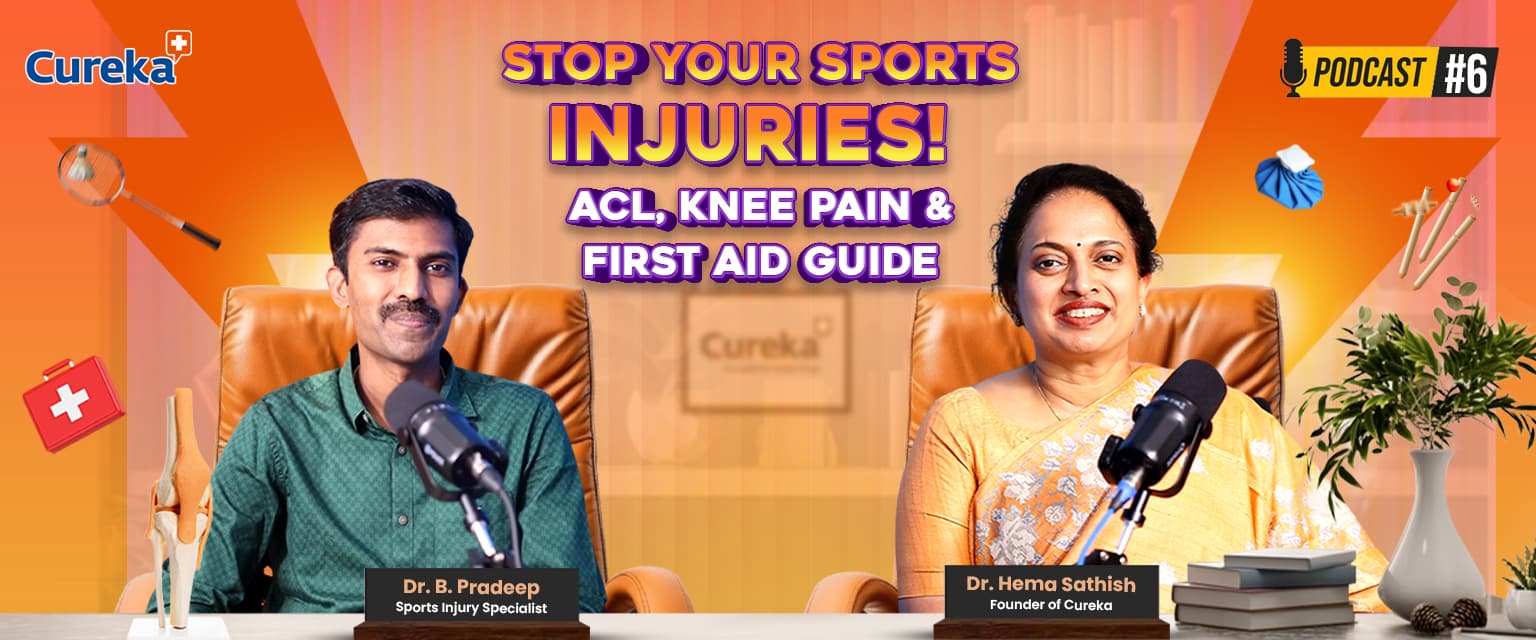
Dr. Hema Sathish: Hello everyone. Here we have Dr. Pradeep who is an expert in sports injuries. So Dr. Pradeep, we have seen that there are lot of sports injuries which are coming up now and it’s on the rise. I think there is a 20% increase in the last decade. So what’s your take on that?
Dr. Pradeep: So I’m Dr. Pradeep. So I’m a sports injury specialist and an orthoscopy surgeon. So basically what we have here is there is a tremendous increase in interest in sport basically. Majority of people in India previously who were taking sport for recreation purpose, they do it on a professional basis.
Dr. Hema Sathish: Oh okay. That’s quite interesting.
Dr. Pradeep: So we see many Indians winning medals. For example, you can see Neeraj Chopra who won an Olympic gold. So it was previously unheard of that he won javelin. So we see many people who are pushed towards sports for variety of purposes. So they wanted to do it out of passion now. So there are many disciplines like there are people who win in badminton on a regular basis, javelin is on the rise, and athletics is on the rise and gymnastics as well. So there is more volume of people involved in sports these days. So because of that injuries have also risen and we have lot of diagnostic tests now. So injuries can be detected very early and treated very well.
Dr. Hema Sathish: So that’s good. That’s one good reason that everybody is involved in sports and everybody is active. So that’s one way to look at it. But there is something called weekend injuries also. So why are they on the rise? That is also very common nowadays.
Weekend Injuries
Dr. Pradeep: Most common injuries which we see here nowadays is because we use a term called weekend warriors. So those are the people who are recreational athletes, not professionals. So nowadays we work almost like some 10 hours a day, 5 days a week. So people who are free on Saturdays and Sundays they try to go and just get out of their regular monotonous life and go hit the deck. So it’s not supposed to be that way. You are supposed to have a regular warm-up routine. Do basic warm-up daily and then if you play on the weekend it doesn’t make a difference.
But then your muscles are stiff, your body is tight, you go and just stop playing badminton or cricket or whatever. Then chance of injury is very very high. So warm-up is the basic routine which you need to follow on a daily basis so that you are fit enough.
Playing on weekend alone is not going to make you fit.
Dr. Hema Sathish: So some form of mobility at home and then weekend sports is absolutely fine. So that’s something, a takeaway for everybody. So just don’t think that weekend are for games. It is fine to play and have a good time but nevertheless make sure that you are having your routine exercises also everyday so that you don’t end up with any injuries. Well did you know that there are many knee injuries which are absolutely unwarranted.
And nobody tells you why this is happening and how this can be stopped. Well doctor there is one more thing I wanted to ask you. Now as you said if people go out suddenly and then they get injured. So what should be the first step they should take or what they should do immediately the minute they see an injury?
First step to do immediately after injury
Dr. Pradeep: So basically this one has to be taught right from school. First aid and injury prevention is very very important. And unfortunately if someone gets injured you should know what has to be done as a first aid. So this has to be done right from the coaches, persons who are playing with you, fellow players as well. So if anyone is injured just see if the injury is either a minor one or a major one.
Dr. Hema Sathish: Yeah how do you differentiate a minor or a major one?
Dr. Pradeep: Yeah differentiating is quite difficult actually. A major injury is one where you are unable to continue playing.
So you twist your knee, you are unable to play, that’s a major injury. And you avoid playing, stop it at the moment so that you don’t injure yourself further.
Dr. Hema Sathish: Can I ask you something. Now pain is something which is very relevant right. So some people they just feel pain, they can manage the pain. So how much to manage the pain?
How much pain one can manage?
Dr. Pradeep: That’s what previously all the coaches used to say you just push through pain. It’s not absolutely right. So you push through pain you are going to injure something else.
So what you are supposed to do is you need to know if your pain is within tolerable limit. If it’s just a nagging pain or just a small pricking pain which comes on occasionally. It usually settles down with just some muscle exercises or some physiotherapy routine.
But then if the pain is persistent, you are unable to play. A simple shot gives you a pain or just a simple smash or something gives you pain. It has to be checked by a doctor and make sure there is no serious injury.
Dr. Hema Sathish: So that’s quite a lot of information I think. But can I ask you like what is the first thing you should observe. Like when you get hit or when you are hurt or while playing you feel you are injured. But then you want to continue with the game. But then what should tell you that you have to stop now. It’s a hard stop.
Stop playing you feel you are injured
Dr. Pradeep: So once you get injured you know if you roll your ankle or twist your knee. There can be swelling. The swelling will keep increasing if you continue playing.
There is a huge swelling and everyone around you is panicking. So immediately just stop playing. Give a proper rest. Just put some ice. Do not rub it. If you rub it, it can worsen the pain.
So always try to keep an ice pack over it or a simple bandage over it will suffice. And then go consult a doctor and see what further can be done.
Dr. Hema Sathish: So the swelling is the biggest thing. So if you see a swelling and if you feel there is some redness also right. That is a sign of inflammation. So as the doctor said put some ice pack immediately. And I think you should rest the part of the body which is injured. Well we are still on the weekend sports. So I would like to know like you know there are times right. Many people they don’t find the time to exercise regularly. They are very busy. But then nevertheless they love to play games.
And when you are with friends and when you are with family or with children. You tend to play and you want to do something with them. So in such a case I mean can there be some precaution taken to play only on the weekend.
And make sure you are not injuring yourself.
What are the precautions to be taken while playing?
Dr. Pradeep: Sure. So this is the life skill which we follow.
So it’s a fast paced life. You are not able to avoid certain stuff. So people when they do find time on the weekends they do go play.
So it’s just a natural part of the process. So always try to be injury free. Injury happening in your teens or twenties is different than what happens in your forties.
So that’s true. So once you are past your thirties or forties you are past your prime. So you need to know what has to be done.
So the main step is a good warm up. And then if you have any nagging pains. The most common sport which we play now in India is cricket.
So usually majority of our fields which we see on Sundays is just full with cricketers. So cricket the most common injury is a twisted ankle. So an ankle sprain is very very common.
A good footwear is necessary to prevent an ankle sprain. And then if at all you feel your ankle is wobbly or something like that. There are braces.
You can wear an ankle brace to prevent injury. So that your ankle has a good support. So that you can have a good bowling action or a batting.
And then the next one is you play many of us play shuttle. So people love playing shuttle. So the more common injury is inner shuttle.
Again it’s an ankle injury or it can be elbow. So usually the proper technique to smash a shuttle is with your shoulder and not your elbow. So majority of people have elbow pain because they smash with their elbow.
So usually.
Dr. Hema Sathish: I think that’s the tennis.
Dr. Pradeep: Yeah that’s the tennis.
To avoid that usually you need to strengthen your elbows. And then you can wear a brace as well to avoid injuries.
Dr. Hema Sathish: So yeah there are so many braces available in the market. So you have to be wise enough to understand how what your capacity is I guess right. So first you assess that and then make sure you don’t get injured. So there are so many things to help you out. So you can have a ankle brace, a knee brace, elbow brace. Everything is available and make sure you play well but play cautiously. So doctor in case unfortunately somebody is injured. So what should they do?
Things to do after injury
Dr. Pradeep: So injuries are a part and parcel of every sports person’s life. Anyone in sports you know injury does happen. It is quite unfortunate but then it happens. But then it depends on how you recover from the injury. Almost like 90% of the injuries are almost fully treatable. You can get back to sport which you are playing previously.
Dr. Hema Sathish: That’s very heartening to know that 90% is fully treatable.
Dr. Pradeep: And then you can get back to the same level which you are playing previously. Because we see so many sports injuries. Example like there was a shuttle player named Carolina Marin from Spain. She was the world number one in badminton. She was playing against Sindhu I believe and she had an injury. It was an ACL tear which was diagnosed. She underwent surgery. She went back to the sport and the next year she again started playing.
She became the world number one again post surgery. So there are so many stories which you heard of. Even in cricket Kane Williamson was there. He had an ACL surgery and then went back to playing again. So then you should know what kind of treatment is needed for what kind of injury. So any injury which is major, you are unable to play through the injury. You need to consult someone who is good enough. And you need to have a proper investigation. You need some x-rays or MRI or something like that.
And then you decide what kind of surgery can be done. But then almost like as you are saying 75-80% of injuries do not need surgeries. So some adequate rest, proper physiotherapy, good training can get through most of the injuries.
But then certain injuries are totally unavoidable and these have to be treated surgically. So you need to know what type of injury you have. So it all depends on what kind of surgery which you may need later.
Dr. Hema Sathish: So the best thing is they should consult a doctor. Ideally a sports specialist. And find out what exactly has gone wrong with you and treat yourself really well.
And then you are back to normal. You can bounce back to normal as he said. He gave such wonderful examples of players who have done so greatly in life in spite of their injury.
Well in your practice as a sports specialist, injury specialist, I would like to know what are the common injuries you end up seeing?
Common injuries in sports
Dr. Pradeep: So the injuries are usually sports specific. It all depends on what type of sport you are playing.
Usually people who run a lot like cricketers, basketball or football. The most common injury is a knee injury. It can either be an ACL tear or a meniscal tear.
And people in shuttle usually the more common injury is in the shoulder. Because they play with their shoulders. So there is a term called an overhead athlete.
So usually shuttle players, volleyball players or for that matter baseball throwers. So they are all overhead athletes. So the injury spectrum is completely different.
We have knee injury specialist and shoulder injury specialist now. So there are two different injuries. You need to know what kind of rehabilitation you need.
So each sport has a proper training protocol. So you need to have a proper warm up, a proper muscle structure to play the sport.
Dr. Hema Sathish: But every time it is not possible to make sure that you are in a specific form to go and play. There are times when we also jump into playing with kids just to entertain them. Nowadays when you are so busy, when you find the time you want to do everything with your child. Because just to spend the maximum time or it is called quality time which you want to spend.
So in that case it becomes a little difficult. But nevertheless understanding that these things can happen. And how you can avoid them is the best way to help yourself.
So doctor you told ACL injury. So please explain that what ACL injury exactly means.
ACL injury
Dr. Pradeep: So basically your knee joint is a joint which connects the thigh bone and the leg bone. So there are ligaments inside the knee. The ACL is called the anterior cruciate ligament. There is one more ligament posteriorly at the back of the knee. That is called the posterior cruciate ligament. The PCL. So these two are the most common ligaments which are needed for a good function for any athlete. And there are other ligaments. These are called the meniscus. So they are the shock observers. So these basically make up the knee joint. So the ACL and the PCL they are needed for proper running, jogging, cutting activities. So people who are in football they have lot of cutting activities. Someone comes to tackle you need to jump over them or have a cutting action. So the ACL is most commonly torned during a cutting action. So that is a basic function for any footballer. So you need to have a proper muscle tone. Your quadriceps have to be very good to avoid these injuries. And you have to train very well to have an injury free life.
Dr. Hema Sathish: So well we are talking about injuries. Can I ask you like what is the weirdest or the toughest sports injury you have treated so far?
Toughest sports injury treated so far
Dr. Pradeep: So basically now we see like lot of people they are involved in sports. As well as they want to have like what do you say high intensity sports.
So many are marathon runners. We see lot of trekkers who do mountaineering every week. So there was a specific person almost 2-3 months back.
He does trekking a lot. He goes to all the peaks. He does some Himalayan trekkers.
Dr. Hema Sathish: It’s so common. Dr. Pradeep: It’s so common. So he had a knee pain which was difficult to manage. He had a small trauma when he was hiking down somewhere. And then he came to us with lot of knee swelling. He was unable to do trekking. So he wanted to get back to life. So then we analysed him and we found that there was a small cartilage defect. He had an osteochondral defect in the femoral condyle.
So it was causing him trouble. He was unable to go trekking or even unable to squat on the floor. So then we had an MRI done. And then we did an arthroscopy on him. We tried to fix the fragment back. And then we did something called cartilage procedures. We did chondropin fixation with fibrin glue. We tried to remodel his cartilage and get him back to normal. So then he started rehab for like some 3 months. He had a good physio help from us. And then he is back to normal now. It’s almost like some 4 months down the line.
He is back to trekking. He is good enough. He is going to all places.
And he is very happy now.
Dr. Hema Sathish: That’s wonderful. 4 months. Within 4 months is great timing, right? Because once you don’t use your muscles as much as you were using before, there is a lot of wastage also. And when the muscles are wasted, that’s again a problem, right? So you have to do a lot of exercise. So rehabilitation has to be taken up very seriously, right? Can you tell a little more on that?
Rehabilitation
Dr. Pradeep: Rehabilitation is a part and parcel of all surgical procedures as well as non-surgical procedures as well. So anyone who has an injury has to go through rehab. So the rehab starts on the day of surgery. Initially you give rest and then do some exercises like we call static quadriceps exercises. You do less movement and more work. You try to give rest to the joint as well as work your muscles. Because once you start taking rest, your muscles start going into waste. So you will have decrease in muscle pulse. And then getting back to normal is quite difficult. So you start rehab as soon as possible. Give some proper icing for the part. And then once the inflammation or swelling settles, you start exercises. So initially you try to move your muscles. You gain your good muscle tone. And then once you are confident enough, then you start doing aggressive exercises like weight training and stuff so that your muscle bulk improves.
Dr. Hema Sathish: Well, doctor, you spoke so much about first aid. I wanted to ask this very common term people use, you know, RICE. R-I-C-E. Can you explain a little more on that?
RICE regimen
Dr. Pradeep: So many of us would have heard of this regimen. It’s called the RICE regimen. It’s called R-I-C-E. R is for rest.
Once you are injured, you give rest to the part. Complete rest. That’s called R. I is ice pack. So once you are injured, you give a proper ice pack to the part. Don’t rub it. Either you can wrap the ice in a small polythene sheet or a kerchief or something like that. And then apply over the injured part. That is I. C is for compression. What do you do? You have a small bandage like a crepe bandage or something like that. You try to give compression to that part to avoid swelling. And E is elevation. You give a pillow or some small stool or something. Try to raise the part from the ground so that the inflammation settles down, the swelling settles down. So this is called the RICE regimen.
Dr. Hema Sathish: Okay. That’s quite interesting. So RICE regimen, anybody can follow wherever you are. And I think you should take it up seriously and start immediately if you have an injury. There’s one more thing, doctor. I have seen many patients who come. And we have heard also many a times that they have done hardly anything. And they would have torn their meniscus. In that case, what would you advise?
Dr. Pradeep: So the injury is like we classify injuries. We classify injuries as traumatic injuries and atraumatic injuries.
So traumatic injuries is when you do some violent sports or someone hits your knee and your meniscus is torn. So that’s quite a violent injury and the meniscus usually is completely torn. Another one is atraumatic or degenerative injury.
So then it occurs when you are just climbing down stairs, you hear a pop. Or you squat and then get up, you hear a pop. So these are small atraumatic injuries.
So these injuries are usually minor and sometimes heal on their own. The more violent injuries do not heal on their own. Small injuries usually when you give a wrist for like some three weeks or six weeks, it heals on its own.
Dr. Hema Sathish: Right. That’s quite interesting. There is one more thing. They say clicks and the pops which you are talking about. It happens very often as you age or some people have it otherwise also. Maybe a minor injury has been there and they are not really bothered about it.
So when do you think these clicks and pops should be taken very seriously?
Clicks and the pops in Knee
Dr. Pradeep: So many of us have the habit of breaking knuckles. That’s usually one way of putting it. So it usually happens when there is build up of air bubbles inside the joint. Once you break your knuckles, the air just pops. So that is breaking your knuckles. But then repeated action can cause erosions on the bone. So it’s not a very healthy habit actually. And then like hearing pops or clicks in your knee can be occasional. Someone sits and gets up, you can hear a pop.
But then unless there is pain, you need not worry about it. So if it’s just a click or a pop, it can be just an air bubble getting through. Or it can be just a small, a minor rubbing of the cartilages.
So if it’s pain-free, you can just leave it alone.
Dr. Hema Sathish: But when do you take the… I mean if it’s clicking. And then so is it the start of some problem? Or you take some precaution to avoid the major issue coming?
Dr. Pradeep: So usually if there is any pain associated with it, when you sit and get up, if there is a pain with a click, you always try to avoid it. So that you don’t aggravate it further. If it is pain-free, it can be just an incident. It can be just normal.
Dr. Hema Sathish: Once in a while. If it’s regular, then?
Dr. Pradeep: If it’s regular, then you are supposed to visit a doctor. And then see if there is any meniscal tear or something which is getting caught in your knee joint. So it can be troublesome as well.
Dr. Hema Sathish: That’s something quite troublesome, right? If a meniscus is caught between your knee joint. But then that will lead to a lot of swelling also.
Dr. Pradeep: And then it can progress. It can lead to tears in the other meniscus as well. It can lead to cartilage damage as well. So if it is occurring regularly, if it’s giving you trouble, it’s better to get yourself checked somewhere.
Dr. Hema Sathish: So don’t take things lightly. If you have a click regularly happening, and if you feel minor pain also, go to your doctor, take action. And make sure you don’t make your knee worse. Off late, I have seen a lot of youngsters who have a problem in their backs. And their major issue is, you know, they don’t have a problem actually. They go to the gyms and then they lift a lot of weight. So what word of caution would you ask them to take?
Caution to be taken in gym
Dr. Pradeep: So, we see gyms cropping up everywhere. The place I commute to, I have some like 4-5 gyms. So people want to get fit. So that’s actually a very good thing. But then you should know how to get fit. So that is quite true. So you need to have a proper coach or someone who guides you. So you cannot go and lift 150 kgs on your own. It’s absolutely impossible. So you need to have a proper work-up protocol. You need to strengthen your muscles first. Build your muscles. And only then you can start weight lifting. So if you start lifting heavy weights without a proper technique, it stresses your back. So you can end up with a disc bulge. It can be quite worrisome. You can be bedridden because of a disc bulge.
So lifting weights is not an easy task. You need to know a proper technique. Without a proper technique, you start lifting weights, and then it’s going to hurt your back.
Dr. Hema Sathish: So be cautious young boys and girls. Weight lifting is not just challenging. You should build your muscles, take care of yourself well, and make sure then you lift up the weight, right? So is obesity one of the reasons for frequent sports injury, doctor?
Obesity in sports injury
Dr. Pradeep: Yeah, absolutely. So previously when like a generation back or two decades back, people used to see a lot of kids who are playing outside daily. So that’s not the scenario now. Because the families are shrunken, kids are basically at home.
Dr. Hema Sathish: And everybody is stuck to their phone.
Dr. Pradeep: Yeah, everybody is stuck to their phone. And either stuck to their phone or eating pizzas or something. So obesity is like a silent epidemic in India now. We see a lot of kids who are overweight, who are unable to work out, who are unable to play. So that is one disturbing scenario now. So that is one of the main cause of any injury. So kids are pushed to play in the school, but then they are unable to play. So that has to be done right from your house.
So people at home need to know that junk food is not healthy at times. Can have it, but then you need to have a proper balance between food and workout. So kids have to play so that they don’t suffer in their later age.
Dr. Hema Sathish: Well, nowadays I see very young kids come and then they say they join the gym. And I am like, what are you doing in a gym? What would you advise? A gym or some sports? Because I feel playing games is a very happy way to live your life. So when we were children, we were playing, we had friends.
We used to talk to them, run around, do so many things. I think kids miss out on that, right? When you are in a gym, you have a coach who is telling you, do this, do that. And then you are not happy, I guess.
It’s fine. I mean, they would say probably they don’t realize. So what is your take on that?
A gym or some sports?
Dr. Pradeep: So sport is completely different. Sport is like it builds your character and then you have a team.
Dr. Hema Sathish: So true.
Dr. Pradeep: You have a team who is supporting you. So you get to mingle with so many people. And then sports gives you fitness on your own. It’s not like a gym. Gym, you just go, you work out one part. You either work your abs, your shoulder or your calf or something like that. So what happens basically in the gym is, you get into the gym at a very early age.
Your bones are not fully developed. So you can have bone pains. It’s very common.
If you start lifting weights at a very early age, you can start having bone pains. And then you need to have a proper diet. If you are lifting weights in the gym, you need to have a proper diet.
A high protein diet is a must, which many of us don’t do it. You just can’t go to the gym and do it.
Dr. Hema Sathish: Nowadays it’s the other way around also, right? High protein diet. People just buy protein powders in bulk. And then they want to add some more than the recommended dosage. And then eat a lot of it. And there are a lot of problems with kidney issues coming up very early. I mean, I’ve heard that even kids in 17-18 years and all, they tend to take all this protein because they want to build up muscle in the gym. And things like that. So that’s also not an option.
Dr. Pradeep: There are two extremes.
Dr. Hema Sathish: I know.
Dr. Pradeep: People who are obese going to the gym is completely different. People who go to get fit in the gym is different. And people who go there just to build muscle. So there is one group of people who just take protein diet, go to the gym and try to build muscle. So it’s a point of personal perspective, finally. But then you should know what is your limit.
So anything which is beyond the limit, it’s going to be harmful. Always try to be within your limits.
Dr. Hema Sathish: That’s so true. You should know where you should draw your lines. You should know what your capacity is. You should know where your upper limit is.
So, doctor, we’ve been talking about all the acute injuries. Now, could you tell me about some… Sometimes you have chronic injuries also, right? And sports injuries also, which have been there for ages together.
Dr. Pradeep: Yeah.
Dr. Hema Sathish: So could you tell something more about that also?
Chronic injuries
Dr. Pradeep: Yeah. So these are basically called as overuse injuries. So we call them as, what do you say, some repetitive injuries. So someone who is a baseball pitcher, so you keep pitching with your elbow, your elbow ligaments get torn.
Dr. Hema Sathish: So it’s over a period of time. Gradually.
Dr. Pradeep: Gradually. And then it can happen in shuttle players. So repeated injuries in the shoulder can cause some trouble.
Right. And then it can happen in footballers as well. So because of running miles together, so each match lasts for 90 minutes, you’ll be running almost like some 12-13 kilometers each day for a match. So there are people who play till their 40s. There is Ronaldo, for instance. Or there is one player previously called Ibramovic. So he played till his 40s. And he had two or three arthroscopy surgeries in the knee. So there were a lot of damage in the knee. There were a lot of degenerative tears. But then they continued to play. So it all happens over time. It does not happen immediately.
Dr. Hema Sathish: Okay.
Dr. Pradeep: Then you keep playing the sport for like some 20 years, 25 years. It does happen. Whether it depends on the athlete who wants to play professionally or recreationally. So someone who wants to take up sports for profession, they tend to go back to play.
They tend to have a proper physio team or a rehab team. So they have some cooling sessions basically. So after each match, they have a proper cooling chamber so that their muscles get cooled down fast.
And then injuries are quite infrequent in those kind of people. So they tend to, their career lasts long. They play till their 40s.
But then you should have a proper team who guides you. So that’s quite important as well. Dr. Hema Sathish: When you are saying 40s, 40s, 40s, it was giving me a heartache actually. Because I have seen so many people after 40s, they start playing games. Because they have suddenly woken up and then realized that they want to get healthy. So what would you advise for people like them?
Sport in day to day life
Dr. Pradeep: So there are people like involving yourself in sport is very good actually. So now pickleball is coming up. It’s a new fad actually. So there are a lot of pickleball courts coming up everywhere.
D. Hema Sathish: And I think it’s for more older people or middle aged people.
Dr. Pradeep: So you can get into it. Pickleball is like, you can have it, it’s like a stress buster.
You can just go play, it’s within a confined space. You need not run around 2 miles. So that’s quite good actually.
But then taking up sports is very very good. Even at, like you can take up sports even at 60. Doesn’t matter.
But then you should have like, should be injury free. That’s what matters.
Dr. Hema Sathish: So you should take good care of yourself. Take all the precautions necessary. And then surely play. There is one thing, tendinitis. Which is very common than any other sports injury, right? It’s not exactly injury injury. But it’s something you have to be, you should know and you should be cautious about. So please tell me more about it.
Tendinitis
Dr. Pradeep: So tendinitis is almost like many of them overlook it. So they say it’s just a nagging pain. So even a lot of my friends, they are marathon runners.
So it’s very common in runners actually. And the most common way to prevent this is having like a good footwear. Proper footwear will take care of your tendons.
Usually it’s more common in the ankles. The Achilles tendon which gives a problem. You have a good footwear which gives you a good cushion. Usually the tendon injury doesn’t happen. And then running on roads is quite harmful. You run on a track, it’s completely different. Running on a tar road, it’s actually quite, it’s like hard on your knees and hard on your ankle as well. So preventing injuries is like, what do you say, having a good footwear and running on an athletic track. So that is how you avoid your tendon injuries. And it’s tendon injuries like wear and tear. It doesn’t happen on day one. You keep running kilometres together and one fine day you have pain. So that happens because of repeated injuries over time.
Dr. Hema Sathish: Okay. So good footwear is must if you are planning to run regularly. But when you said run on tracks, at times it’s not possible, right? So what would you say for people who cannot run on track at all?
Dr. Pradeep: See, the main drawback for us is the traffic on the roads. So it’s almost impossible to run on the roads these days. If you want to run on roads, start early. That’s all. Like running by around 5 o’clock or 6 o’clock is fine. And make sure the road is level enough. That’s the only way you can prevent injuries.
Dr. Hema Sathish: So you were telling that running on tar roads can hurt your knee a lot more than running on proper tracks. But if somebody has to run regularly on tar roads or has to run on hard surfaces, would you advise them to use insoles which are available now?
Dr. Pradeep: Yeah, you can wear insoles. So insole is like it’s made of silicon. So it is quite soft enough. It’s like a cushion. You can add it on your shoes so that it takes much of the impact from the road. So insoles are a good way to prevent injuries.
Dr. Hema Sathish: That’s very interesting right so if you wear an insole and then you can prevent a lot more injuries and tendinitis of course for sure I guess. So finally doctor what would you advice on a regular basis for a healthy lifestyle to avoid sports injury?
Dr. Pradeep: So being like..if you want to be regular in sports make sure you have a proper routine. Its like a proper like how do you have a diet, you have a strict diet in your sports as well. Try to wake up early, have a good stretches and warm up so that your muscles are in tone. If you want to play, go warm up for at least 30 to 45 minutes and then play for 15 to 20 minutes. That’s the routine. And then once you are done playing, cool down, take some time to rest and then go back to your job. So injury prevention is very very important. Once you are injured, then it gets on your mind, it gets on your nerves as well. So try to be injury free and have a regular routine. So once your routine is broken, it’s quite difficult. So always have try to have a proper balance in sports as well as in your life.
Dr. Hema Sathish: So that’s a wonderful thing to hear, proper balance in light and in sports. So doctor, I have something very exciting which I would like to know and so I think im sure a lot of people who are hearing would like to know. So its very unfair to say that you got this problem so stop stop playing or doing things, you know. So now I want you to tell me what would you recommend for I’ll ask you the different types of injuries and you please tell me what sports would be recommended best suited for them. Back pain, back or back injury.
Dr. Pradeep: Cycling is very good for this one.
Dr. Hema Sathish: That’s quite interesting. Ankle pain.
Dr. Pradeep: Ankle pain you can go to swimming.
Dr. Hema Sathish: Oh Okay. Knee.
Dr. Pradeep: Knee again you can take up cycling so that you stop running, you don’t need to jog or run. You don’t do a cycling exercise.
Dr. Hema Sathish: Oh, that will help the knee.
Dr. Pradeep: Yeah, that will.
Dr. Hema Sathish: Alright, what about hip pain?
Dr. Pradeep: Hip pain basically avoid some sports which have like lifting weights or something you avoid it. Swimming is very good for your hips and back actually.
Dr. Hema Sathish: Okay okay wonderful. And what about shoulder?
Dr. Pradeep: Shoulder. So you avoid throwing basically for a shoulder and go for a jog. Jogging is a very good exercise.
Dr. Hema Sathish: Okay, elbow.
Dr. Pradeep: Elbow again you avoid throwing. You can go play like football or something like that. If your knee is good enough, and your ankle is good enough. Dr. Hema Sathish: Alright. Okay, what about wrist?
Dr. Pradeep: Wrist again you can go for sports which like jogging or something like that.
Dr. Hema Sathish: So if you guys want to ask any more questions which I might have missed, you’d be happy to answer that. Thank You.