


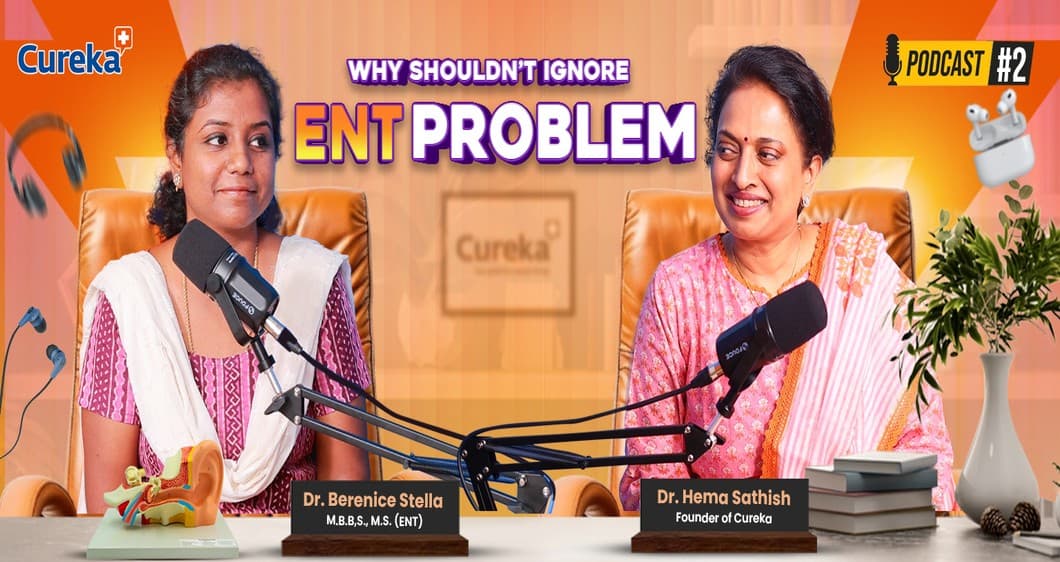
Why shouldn’t Ignore ENT Problems|Dr.Hema Sathish & Dr. Bernice Stella|Cureka
Table of Contents
The complications of removing wax.
The problems behind using ear buds
What is the limitation of putting the ear buds into the ear?
How to take care of the impacted wax?
Is hot oil made of spicy ingredients safe for ears?
The common reasons for hearing loss
Ear Phones and hearing loss
What is the right volume and decibels of using the hearphone?
What is the best headphone or earphone to use?
Explanation about middle ear infection
Is it necessary to treat the middle ear?
Symptoms of ear damage
Why is it important to talk about giddiness? Is it related to middle ear problem?
Children and hearing Deformities
How can the mother or care taker notice whether the child is having a hearing loss? What would be the symptoms?
Why should one use hearing aids?
What are the smallest bones of hearing?
How can a person keep their ears healthy?
Dr. Hema Sathish: Hello, welcome everybody. I am Dr. Hema Sathish and here we have our guest today, Dr. Bernice. Welcome Dr. Bernice.
Dr.Bernice:
Hi everyone. I am Dr. Bernice. I am an ENT surgeon from Madurai.
Dr. Hema Sathish: ENT is one subject I think we usually sideline it. I should say sorry to say it but it is true, right? To a certain extent. But nowadays the rising problems are quite a few. So there are so many issues, right? So what do you think is the commonest problem people come with?
Dr. Bernice: So ENT stands for ear, nose and throat. And as ma'am rightly said, of course it is sidelined and people tend to take decisions of their own when it comes to ENT. A lot of home remedies and techniques on how to cure yourselves and Google help. So this is why I would like to also say the importance of why and when you should see an ENT surgeon. That is one. And among ear, nose and throat, most people come primarily for ear complaints and especially hearing.
Dr. Hema Sathish: So are you doing the right thing? Keep that in mind.
Dr. Hema Sathish: So I always see that very commonly removal of wax, which is very, very common, right? It is a very regular routine thing for you in the ENT OPD must be. But nevertheless, many people try to remove it themselves. So what are the complications of doing that? And when it is right and when it is wrong? Could you just explain that?
The complications of removing wax
Dr. Bernice: Okay. So basically ear wax is nothing but what we call as sebum in medical terminology that is secreted by the sweat glands. So when it is inside the ear canal where there is no air circulation, that is when it becomes a little hardened and that's what we call as ear wax. It is normal for everybody to have ear wax and it is very normal even to have impacted ear wax. So nothing is abnormal. But what should be done is ear wax should not be attempted or cleaned at home because the ear canal is very narrow and at the end of the ear canal is the eardrum which is a very, very sensitive structure. Once damaged, even if the fantastic surgeons are giving you back an eardrum, it's still not as good as what God has given you. So I would advise that regarding ear wax impaction or issues for cleaning, please always consult your ENT surgeon to clean it properly. The other thing is I have seen many patients who come with a trauma in the ear canal when they have attempted cleaning it themselves. For example, using a hairpin, keys and most commonly ear buds. So as I said earlier, it is only a one-way open channel. The other side is not open. So it is very difficult for you to not see it, just feel it and pull it out. It is very difficult.
Dr. Hema Sathish: You spoke about ear buds being dangerous but it's so widely used. I have seen in children also they use it and they have some special ear buds for kids also. So when you are saying that you can't use ear buds at all, I mean what would you say when you should restrain from using it or how much can you use it? Can you explain a little on that?
The problems behind using ear buds
Dr. Bernice: So primarily ear buds were discovered by the British people and it was used to clean only the external ear. Because we have a lot of grooves in the external ear. But we are taking it inside where it should not be taken.
Dr. Hema Sathish:
So that's something which we have to be careful about. But now even if you say million times, something in your ear gets a little ticklish and whatever is there in your hand, it's key. Sometimes it's a pen also, sometimes it's a pencil. And I have seen myself cases when I was a student that a broken pencil was found inside the ear and then we had to remove it through surgery.So if you have to say like what could be the safest limit of putting it inside? So at least we can't stop them, at least they realize that they can't put it beyond that. So what would be your take beyond that?
What is the limitation of putting the ear buds into the ear?
Dr. Bernice: So the canal, the outer round 2 centimeters, it is a little soft. It has a lot of hair in it and I would say maybe if you have to go, it is only 1.5 to 2 centimeters not beyond that.
Dr. Hema Sathish:
So there is a limit. So it's 1.5 centimeters safest and maximum 2 not beyond that. So that's a very good tip doctor. When you see patients with impacted wax, but wax is not abnormal. Like some people believe that since you are dirty you have wax in your ear. But that's not true, right? Because it's just a normal phenomenon and everybody tends to secrete this. wax in your ear. Some people it but naturally it's supposed to expel out, right? Yes. But sometimes in some people it doesn't and so there is a lot of wax and then this hardens up also and to top it all it gets impacted also.So what do you want to tell people how to take care of impacted wax or not to end up in a situation where the wax is, you know, bothering your hearing? So what do you want to tell?
How to take care of the impacted wax?
Dr. Bernice:
For people with impacted wax, I would always suggest there are a lot of over-the-counter wax clearing drops which they can instill and they can come and see an ENT doctor so that absorbs the impacted wax is softened after using such drops and they can come to us and we will clean it with ease for the patients.
Dr. Hema Sathish: Like when you say drops, what kind of drops are you talking about? Should you use antibiotic drops also along with it or it's just that?
Dr. Bernice:
So these drops mainly contain ear safe chemicals like paradichlorobenzines which softens the wax and thereby sometimes it usually comes out by itself or we have to just take it out easily.
Dr. Hema Sathish: There are times people use oil also, right?
Dr. Bernice:
Yeah, that is also safe I would say but when you talk about impacted wax I think using these chemical drops is much easier.
Dr. Hema Sathish: But you know there is a concept especially in south of India we see or I do not know how it is in northern part of India but I've heard a lot of patients and they have hearing loss also because of that. What they do is traditionally they heat oil and they put some natural ingredients so called, I have heard ingredients like curry leaves and pepper, then red chilies, everything is added then boiled and then poured hot hot into the ear. I mean that sounds horrifying, so how bad is it to the ear?
Is hot oil made of spicy ingredients safe for ears?
Dr. Bernice:
So again hot and spicy they are irritants for the ear canal skin and they will perforate, they will put a hole in the eardrum which is eventually a permanent deformity in a patient. But I would say just using coconut oil, not the hot part, just coconut oil again that's the same.
Dr. Hema Sathish: So normal temperature, so how much do you recommend to use? Like should you use it every day or applied once in a while?
Dr. Bernice:
If they have impacted wax maybe two or three drops thrice daily for around three to four days it will soften the wax then they can wait for it to come out and fall eventually or they can come to a doctor and clean it.
Dr. Hema Sathish: So that's really good, right? So you can use some home remedies too but how safe you are and how much do you know to use it well? So we're talking about hearing loss because of impacted wax and because of other things done. Now if I have to ask you what are the other problems like what are the other reasons for hearing loss?
The common reasons for hearing loss
Dr. Bernice:
So hearing loss is a big topic. Yeah, we broadly classify, I'm not taking class, it's broadly classified into conductive and nerve related hearing loss. So conductive hearing loss is basically because of any problem in the canal, for example, wax and for example if there's any fluid in the middle ear which is behind the drum commonly because of any infections.
Dr. Hema Sathish: That is also missed several times, right?
Dr. Bernice:
Yes, yes. So this conductive group of hearing loss is very easily treatable if diagnosed properly and accurately in a right time and the other group is neural hearing loss which is difficult to treat should be identified early and if possible it should be prevented that is a little difficult to treat.
Dr. Hema Sathish: So this neural hearing loss when you spoke about that I just want to know, I mean what are the causes for it and what prevention we can do to avoid such conditions?
Dr. Bernice:
These neural hearing loss, that is the nerve damaging hearing loss that mainly occurs in today's setting I would say the most common cause is noise induced hearing loss. So that is one. The other is because of age, aging people can have weakening nerves, the ear nerves also get weakened. The third group is because of drugs.
Dr. Hema Sathish: Oh
Dr. Bernice:
Drugs like some antibiotics which are commonly used should be taken with caution, the right dosage and the right duration should be taken and some drugs that are given for example for cancer patients they all have those side effects so that cannot be avoided. But the common drugs if anybody, any doctor is prescribing you make sure to ask if it is damaging my ears.
Dr. Hema Sathish: Okay, so that's a very important tip doctor, that's quite interesting because you know these are things which if your awareness is there then people will tend to not use it or use it with caution. So you are aware that you know you don't have to get your ears spoiled because you're taking a medication. When you said neural hearing loss it was quite interesting to know that neural hearing loss is caused by ear pods and headphones and stuff like that. Can you explain a little more on that? Because that I think is the need of the hour, right? Because everybody is using their earphones every time you're stuck with something in your ear.
Ear Phones and hearing loss
Dr. Bernice: So I think noise induced hearing loss is a fancy topic for us. And I'd be glad to say how it happens and how we reduce it. So what happens is we have a lot of structures. It's like a flowchart from the external ear to the inner ear we say. And this inner ear has a lot of small hair cells. So they tend to vibrate when the sound passes through them and that gives it to the brain. So the nerves are limited. They don't grow back once they die. So that is where the check comes. So a lot of noise exposure. For example, people using AirPods, too much of headphones and people who are exposed to loud noises like loudspeakers and people who are working in such situations are heavy machine sounds. So these hair cells, they tend to die slowly. And at one point they are not enough, sufficient to pass on the sound from the external ear to the brain. So that's how noise induced hearing loss happens. So I would say restrict the use of AirPods or headphones. Even noise cancellation doesn't help that much. 60% of volume an hour a day, that is the safe limit.
Dr. Hema Sathish: Okay. Oh, that is very little limit. Yeah, that is very little. One hour. Oh my God. So that means we all are damaging our hair cells inside the ear.
Dr. Bernice: The only thing is these hair cells are irreversible like the brain. So that many people don't realize that.
Dr. Hema Sathish: That's a real problem then. So we have to be aware. But if you have to say in terms of decibels, like can you explain to what decibels? And so for people who are using the earphones or their headphones for longer periods of time, like sometimes even I use it a lot because when you are in a meeting, you tend to have it and then the meeting goes on and on and then you don't want any disturbance. Then you keep it, keep the volume also high because somebody is talking and you don't want to miss something. So if you could say what kind of a decibels then, you know, at least to take a caution that I was reading somewhere that if you take it at a lesser, I mean, if you take, if you keep the volume lesser, then you can use it for a longer period of time or keep it on one year. So can you tell all the permutations and combinations?
What is the right volume and decibels of using the hearphone?
Dr. Bernice: Yeah, that's like a simple flow chart. So when I have to say about decibels, 60 to 85 decibels are the normal range. So that is okay, accepted. But when it comes to the time duration, 60% of volume, 60 minutes a day is the maximum. When you come down to 50% of volume, then you can increase the duration by one and a half hours. If it is 40 decibels, then it's two hours. It is only like that. And I think this one year, I'm sure I'm not heard about it. So the damage is the same even if you use one side or two sides.
Dr. Hema Sathish: Oh, okay. All right.
Dr. Bernice: So use one side, that side is affected, the other side is normal. That is all. It is not like we are giving a break for one year when we use the other year. So only thing is the amount of sound and the duration that we use.
Dr. Hema Sathish: So when you say this damage happens, so obviously I'm sure youngsters don't even realize that they blast it and then they don't want to hear anything else. When it's on noise cancellation, how much we call them also they are not hearing it. So when it comes to a scenario like that, what do you think, like how many years does it take for this to set in and then to be established? Because obviously in the initial stages, probably you don't even realize that you are having a problem, right? You just have a little bit of mild hair loss and it's not something which is bothering you must have thought that the volume is a little low. So increase the volume a little bit more and stuff like that. But then what would you like to advise on that also? Like how long and how much time? And what would be your initial symptoms?
Dr. Bernice: So when I say the time duration that is taken for hearing loss, for example, noise induced in a patient, I see patients in the OP. So people who are 70 and above, that generation, 70 and above is when they start having hearing loss. But people who are 40 and above are coming with hearing loss nowadays. So the older generation who are not exposed to such modes of external hearing devices, they tend to have later hearing loss because they have not caused much damage.
Dr. Hema Sathish: And for them, probably it's genetic and because of aging and all the other factors.
Dr. Bernice: But people nowadays, because as you said, our job and our preferences and everything, I can even see as early as 45 year old people, they come with noise induced hearing loss. And the first warning sign would be what we call as tinnitus, the ringing sensation. So when these hair cells start reducing in number, they just give this false signals and that we perceive as ringing sensation in the ear. We call it as tinnitus. Ear or tinnitus. So sometimes when you have this ringing sensation in the ear, do not take it for granted and please consult your ENT as early as possible.
Dr. Hema Sathish: Oh, that's something really alarming now. But then there is a heralding site. So we have to be careful, right? So if you hear something ringing in your ear, then you have to run to your ENT.So we were talking about this headphones, earphones and everything. So as we have already seen and we have rationalized that it's not possible to totally avoid it. So what would your suggestion be like, what best kind of headphone or earphone would you suggest for comfortable for the ears and for job also?
What is the best headphone or earphone to use?
Dr. Bernice: The safe kind of headphones I would say, there are two: Over the ear headphones. They look like earmuffs. So they are very good. The other thing is the recent thing is bone conduction headphones. They are very recent wherein the sound is taken from here in front of your ear and your canal is absolutely safe. They are very new to India, but they are excellent when you have to protect your ears. Otherwise over the ear headphones are the ones that we suggest.
Dr. Hema Sathish: Oh, that's great. So if you want to use your headphones or earphones, then you should take this piece of advice. Thank you. You were saying that hearing loss can happen because of middle ear infection. Now when we come to the middle ear infection, it's quite common, right? In children also, even in adults I've seen. So can you elaborate a little more on that?
Explanation about middle ear infection
Dr. Bernice: So middle ear is the crucial part of the ear where the entire drama is happening. That's where our bones, the small bones are there which vibrate along with the air present around them and that's how they give the sound. So when the air is replaced by fluid, that's when the hearing gets dampened. So this is the physiology behind it. Why does middle ear have fluid where air should be there? And this is closely related to the nose and sinuses. So middle ear functions efficiently only when the nose and the sinuses are amazing. If there's any problem in the nose and they have frequent sinusitis and most commonly allergies, nasal allergies, that's when middle ear gets a lot of fluid and that's when the hearing reduces.
Dr. Hema Sathish: So it's only allergy or some kind of infection also can cause, right? So any infection in the throat can also lead to it.
Dr. Bernice: Yeah, throat infections but predominantly it is nasal infection and sinus infections.
Dr. Hema Sathish: So now when you talk about these infections of course you need antibiotics and you need to treat. But how will you find out you have a middle ear infection? Because many a times people say I have regular sinusitis. It's such a common thing because allergy is also very common nowadays. Anybody and everybody has got allergies becuse of the dust, the environmental factors are so bad nowadays. So because of that they have. But then how are we going to say that okay, when do you say that okay this is a middle ear infection and you have to run to the doctor?
Dr. Bernice: First thing is ear is again sensitive. Anything small happens in the ear, first thing is you'll have pain. Especially pain during night time. When we all lie down and sleep that's when the air is very less in the middle ear. So pain is a first awakening symptom. The other is they'll come and say that I feel a gurgling sound inside my ear as if I'm inside the water. So that is when directly the water in the middle ear is shown as a symptom. The other is reduced hearing. They have dampened hearing. The last one is tinnitus. They also have ringing when there is fluid in the middle ear.
Dr. Hema Sathish: So anything goes wrong the ear makes a ring, the alarm.
Dr. Bernice: Yes, actually ear is very sensitive. It starts giving you warning signals very early. You just have to pick it up and go to the right person.
Dr. Hema Sathish:
So this is something I think everybody misses. Then they tend to say like I think I have fluid in my ear. I've seen people do it. That I have fluid in my ear. I just get my ear cleaned and then they get it cleaned in local I don't know what not places and get damaged also. And if middle ear is not treated then of course the eardrum can crack up.
Is it necessary to treat the middle ear?
Dr. Bernice: Yes, of course. When the fluid in the middle ear if it is not drained with the help of either antibiotics or sometimes when it is very resistant doesn't come. We do a small surgery. We just put a small hole in the drum and we put small tubes called grommet. So that is how the fluid in the middle ear gets drained. That is also a procedure which is usually done for little children. For them it is difficult to come out. If we don't address that early this hearing becomes permanent. Hearing loss becomes permanent.
Dr. Hema Sathish:
So that's really sad right? Especially in children. Yes. Because I have seen and heard of cases where the parents have missed because the child has been crying frantically and sometimes they even do is they sedate the child thinking the child is not sleeping .And then they have had a burst eardrum. So that I have seen. So when the child is crying it's ideal to attend to the child because the child is having a problem, right?
Dr. Bernice:
I know. I've also heard when a child cries, I think the parents or the mother immediately thinks of two things: Ear pain and Tummy ache. So I think the traditional practices were right.
Dr. Hema Sathish:
So we have to be cautious on that also. And so the first thing is run to your ENT or get your antibiotics right and get them sorted. Don't let the infection rise beyond a certain point. Now when do you say like you know this, like for a person to understand that you can't go beyond this or this is going to damage? So what would be that point of, what would be that symptom rather?
Symptoms of ear damage
Dr. Bernice:
So this excessive fluid in the drum and when it is becoming very severe, the predominant sign is ear pain and severe hearing loss. So that time we have to bring the children or the adult and start them with antibiotics that will settle the pain and maybe some drugs or sprays through the nose which will bring the fluid out from the nose. As I said earlier, the nose and the middle ear are connected.
Dr. Hema Sathish:
That's given, right? And one more thing which people complain of is middle ear problem when they have many a times. It's very common nowadays, people also know. So they complain of giddiness.
Dr. Bernice:
Yes.
Dr. Hema Sathish:
Why?
Why is it important to talk about giddiness? Is it related to middle ear problem?
Dr. Bernice:
So giddiness again is caused by a lot of things. The balance for an entire body also lies in the ear. I know it's a tricky subject. The inner ear as we call regulates the balance of our entire body. Again, for the inner ear to act properly, the air column from the middle ear has to reach there and give proper functioning of the inner ear. So when the middle ear is again filled with fluid or the external ear has a lot of wax, again we have giddiness. That can originate from the ear.
Dr. Hema Sathish:
Now we spoke about so much about the middle ear and the wax and everything. But it's very unfortunate that some children are born with hearing deformities and some children develop it. But nevertheless it's very early in their life, right? So how can we help them out or what is being done or what would you like to advise them?
Children and hearing Deformities
Dr. Bernice:
So there is a practice called neonatal hearing screening that is mandatory in our country also nowadays. It was primarily from London, but now it is being mandatory here. So every child that is born in any of the government, private or any center here in India, they have to be tested for hearing before their discharge of the mother and the child, which is within a week of birth. So they have machines and they do tests called autoacoustic emissions and they give a report if they have passed or if they have failed. So that is a report we give. So that is called neonatal hearing screening. And if it is passed, then okay, fine, they are considered having normal hearing. And if it is referred, then again they have a protocol. They have to come back to us to an ENT surgeon after that, check their hearing again, check the middle ear. Again, like I said, middle ear fluid and nerve related hearing loss. Everything is checked accordingly. And according to that, we start helping them initially by giving hearing aids as early as possible and then doing the right treatment.
Dr. Hema Sathish:
Because I've seen and of course it's proven also that if they have a problem with their hearing, then they do not speak also.
Dr. Bernice:
Yes, that is very important. I think that is the news everybody has to receive because hearing is very vital for the child to have a normal speech. And normal speech puts the child in the society as normal. So that is where an entire individual's future lies. So that is why I think neonatal hearing screening was made mandatory here.
Dr. Hema Sathish:
But if somebody has not done it and they don't realize the child is having a hearing deficiency or a hearing loss. So what would be the first signs or symptoms a mother or the caretaker of the child would notice?
How can the mother or care taker notice whether the child is having a hearing loss? What would be the symptoms?
Dr. Bernice:
So they will not respond to loud sounds. They try to look at our reactions, emotions. They look at our lips and try to read and they don't say monosyllables like ma, pa. They don't start saying anything. But rather they try doing actions when they want to convey something. So that is how we get a lot of children who are born by very maybe rural areas or at home births who have not been screened. Such children are brought by their parents by saying that he does not say monosyllables and he tries to look at our lips rather than speaking.
Dr. Hema Sathish:
That is way later, right? But earlier there is nothing to see. It's just that they don't turn to sound or they don't wake up.
Dr. Bernice: Yes, they don't turn to sound.
Dr. Hema Sathish:
But many a times kids do that, right? When they are newborn, they sleep for long hours and then they don't wake up for very small sounds oranything. Of course, until and unless it's a disastrous sound which has bothered them. And many a times we also try to maintain an environment where the sound is not too much. So we are like, the child is sleeping. So that time they won't be able to tell.
Dr. Bernice: So I think until 6 months, it is very difficult to pick up because they don't say and we also will think it is fine. I think that is where it is made mandatory that we should somehow pick it up before they get discharged from the hospital.
Dr. Hema Sathish:
That's a very valid point. When we see hearing loss in adults, what would your best advice be?
Dr. Bernice: Again we will do that specific test, find out if it is a conductive hearing loss, can be easily treated with medicines or anything. Otherwise if it is neural hearing loss, then our only path for neural hearing loss in adults would be hearing aids.
Dr. Hema Sathish:
When we speak about hearing aids, I have seen many people they don't like it, right? They feel it's such a shameful thing to have a hearing aid. Nowadays of course there are many new versions I have seen but nevertheless people don't want to have a hearing aid. So what kind of advice would you give to them?
Why should one use hearing aids?
Dr. Bernice: I would say if you have been diagnosed as having hearing loss and that disrupts your daily life or your work balance, then please go for hearing aids as early as possible if you have found out you have a nerve related hearing loss. So these hearing aids, they are easily affordable and they can be kept well inside the canal. So that is where the problem comes especially for women. They think that wire which is seen outside is going to isolate them from the society. For them I would like to say there are a lot of newer versions of hearing aids which can be completely kept inside the canal which is totally not seen and they are really advanced and they are excellent. So when the earlier you start using the hearing aid and you can actually avoid the further damage to hearing.
Dr. Hema Sathish:
So that is also good, right? That's really good news.
Dr. Bernice: So people who postpone, okay I will come after 6 months, I will come after a year for hearing aid, I don't have that much of damage right now for you all. Earlier the hearing aid you can have that hearing stabilized.
Dr. Hema Sathish:
Oh wow, that's fantastic. So that's good. And one more thing what I wanted to know was like when you mean hearing aids, so people wonder how to approach or should we go to a doctor or is there some other procedure like doing an audiometry will help. Obviously you need an audiometry but many people don't know about it. So how do you go about it? Can you just explain in details at least a bit of it so that if somebody wishes to avail a hearing aid, how should they go about it and in their mind they are very clear what they should do.
Dr. Bernice: So anybody who has hearing loss, first thing is you can consult your ENT and find out if you have wax, that's a simple thing. If not, if your drum is alright, those two are the things and then you will be referred to an audiologist and they will do a test called as audiometry which is subjectively evaluating the percentage of hearing loss and the type of hearing loss. So from then on we will be taken care of and the appropriate hearing aids will be given for us.
Dr. Hema Sathish:
Oh, that's fantastic. So that's not very time consuming either, right?
Dr. Bernice:
It takes only 20 minutes for an audiometry to be done for a patient and then for your trial another 10 minutes, that's all. So within half an hour you will be sorted out for the hearing loss. Oh, so as simple as that.
Dr. Hema Sathish:
So take action faster, be cautious and don't ruin what you already have.As usual, we would like to tell everybody that God has given us very good things, a lot of machines inside our systems and we have to take good care of it.There's one mor